Will New Delhi force Pakistan to face the truth of India’s "Indus Heritage", following a formal SCO invite?
Only days prior, at the SCO Council of Heads of Government meeting in Dushanbe, Defence Minister Rajnath Singh delivered an uncompromising, direct address with Pakistan"s Deputy Prime Minister Ishaq Dar sitting in the room.
NewsBharati 28-Oct-2026 16:27:21 PM
Total Views |


In a development that underscores the evolving landscape of South Asian diplomacy, India has formally extended an administrative invitation to Pakistan’s Minister for National Heritage and Culture, Aurangzeb Khan Khichi. The outreach requests his presence at the inaugural Shanghai Cooperation Organisation (SCO) Civilisational Dialogue Forum, set to take place at the historic Purana Qila in New Delhi from November 20 to 22, 2026. While independent commentators may rush to frame this as an olive branch, the reality on the ground reflects a much deeper, calculated exercise of strategic statecraft.
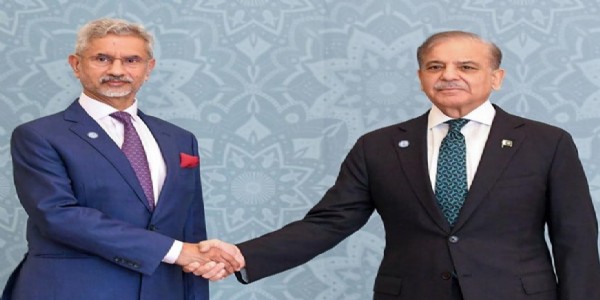
This move marks the first official, high-level invitation extended to Islamabad since the intense military hostilities of Operation Sindoor in May 2025, and it demonstrates that contemporary India dictates the terms of regional engagement entirely from a position of unchecked strength. Crucially, this forum opens at a time when Islamabad has repeatedly attempted to misappropriate the legacy of the ancient Indus Valley Civilisation, trying to project this fundamentally Bharatiya heritage as exclusively its own.
The critical question now remains; "Will the Indian government leverage this sovereign platform to aggressively dismantle Islamabad's revisionist propaganda, draw an unyielding line on our sacred heritage, and unequivocally re-establish Bharat’s absolute, primordial custody over the Indus legacy directly to the visiting delegation?"
Highly placed diplomatic sources have made it explicitly clear that this administrative communication carries zero bilateral weight. It is a mandatory statutory obligation tied to India's role as the institutional host nation for this iteration of the 10-member Eurasian bloc. The Civilisational Dialogue Forum itself is a unique cultural platform originally conceptualised and proposed by Prime Minister Narendra Modi during the previous SCO Leaders' Summit. By bringing all ten member states, including major powers like Russia, China, and Iran, to the heart of India's capital, New Delhi is establishing its presence as a civilisational anchor rather than opening a back-channel for diplomatic normalization.
The primary geopolitical takeaway from this event is the ultimate validation of India's long-standing policy; the absolute decoupling of multilateral commitments from bilateral relationships. South Asian diplomacy was bottlenecked by a regional framework for decades, where India's broader ambitions were constantly weighed down by the necessity of managing Pakistan. Today, New Delhi has smashed that template. By hosting an international summit on its own territory, India is projecting its global responsibilities seamlessly while keeping its "terror and talks cannot go together" foundational policy firmly entrenched. There are no scheduled side-line discussions, no bilateral handshakes, and no concessions on cross-border security.
Furthermore, this entire diplomatic exercise operates under the undeniable, long shadow of Operation Sindoor. Triggered by the tragic Pahalgam terror attack in the spring of 2025, India’s high-voltage kinetic response established an entirely new threshold for military deterrence in the subcontinent. The crushing precision of that operations campaign fundamentally re-wrote the rules of engagement. By forcing Pakistan to participate in a cultural forum under the direct canopy of India's military dominance, New Delhi is signaling a profound psychological edge. It demonstrates that India possesses the strategic luxury to act as a responsible global institutional leader without diluting its fierce territorial red lines or compromising its security posture.
Even within these multilateral cultural halls, India refuses to provide an escape route for sponsors of radicalism. Only days prior, at the SCO Council of Heads of Government meeting in Dushanbe, Defence Minister Rajnath Singh delivered an uncompromising, direct address with Pakistan's Deputy Prime Minister Ishaq Dar sitting in the room. Singh explicitly stated that the "entire ecosystem of terrorism" must be completely dismantled. The message resonates clearly from Dushanbe to New Delhi, that cultural heritage displays at the Purana Qila will never serve as a diplomatic camouflage for state-sponsored militancy.
Ultimately, this invitation exposes the stark asymmetric reality between the two neighbors. While Islamabad grapples with structural instability and a rotating, limited role within global frameworks, New Delhi is actively designing the cultural and strategic architecture of the region. India is no longer reactive. It is entirely proactive. By hosting this summit on its own terms, India proves to the international community that it can manage complex global networks with absolute sophistication, all while holding a steady, unyielding line of steel against external threats.
This upcoming forum also provides New Delhi with a critical opportunity to confront Islamabad on matters of cultural theft. Recently, Pakistan has engaged in a coordinated effort to misappropriate the legacy of the ancient Indus Valley Civilisation, attempting to package and project this fundamentally Vedic and Bharatiya heritage as exclusively its own on the global stage. As Pakistan's Culture Minister prepares to arrive in the national capital, a vital question lies before the Indian government;
Will Bharat use this very platform, the "Civilisational Dialogue Forum", to boldly reclaim its civilisational sovereignty, setting the historical record straight and asserting India's undeniable, primary custody over the Indus heritage directly in front of the Pakistani delegation?
Himali Nalawade
Himali Nalawade is associated with News Bharati as an Author since a considerable period. She is mostly linked with researched articles from the areas of Defence, Defence Infrastructure and Culture-Religion. Along with her Masters in Mass Communication and Journalism after her graduation in History, she has also studied Diploma in Underwater Archaeology and Diploma in Indology.