Former top Maoists’ ‘united front’ plan reeks of betrayal of public trust
Surrendering weapons is undeniably an essential prerequisite for entering peaceful public life.
NewsBharati 03-Oct-2026 15:56:03 PM
Total Views |


A surrender can end an armed struggle, but it does not necessarily end the ideology that sustained it. That distinction is now at the heart of the political manoeuvring by former top Maoist leaders in Telangana, who have announced plans to bring Left and Marxist-Leninist factions under a ‘united front’. Their formal surrender and renunciation of armed violence were initially welcomed as a move towards mainstream democratic life. Their latest political initiative, however, raises questions about whether the ideological mindset behind the insurgency has truly changed.
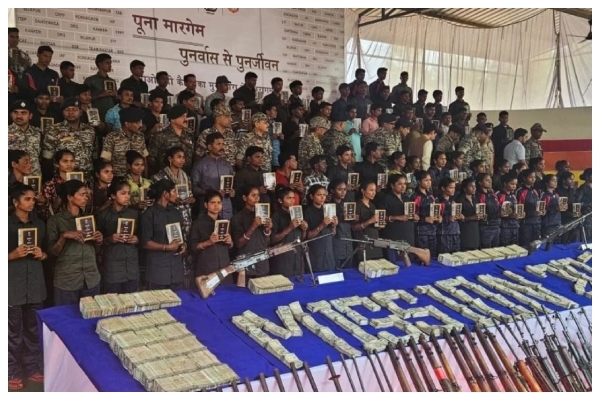
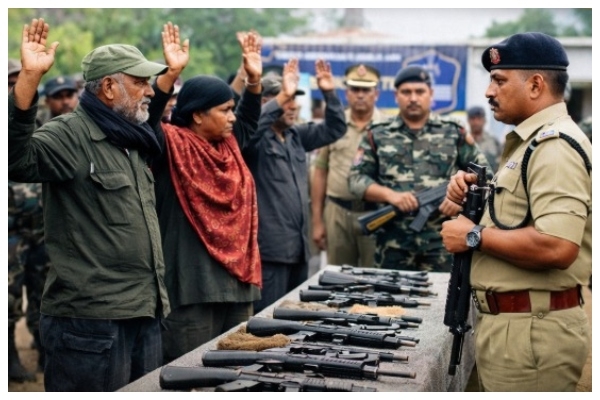
After decades of unleashing terror and violence on tribals, Dalits, and other innocent civilians, Left-Wing Extremism, Naxalism or Maoism has been pushed to the margins by the resolute action of the Modi Government. The banned CPI (Maoist), once a formidable anti-national subversive network, now stands severely weakened, with its Central Committee members either killed in encounters, arrested or surrendered. Over the past two years, Maoist leaders and cadres have surrendered in large numbers across different states. The government, security establishment that fought the Maoist menace for decades, and ordinary citizens have welcomed these surrenders as a new dawn.
The Indian masses trusted the surrendered Maoists, despite their involvement in some of the most brutal and violent anti-democratic, anti-Constitutional and anti-government acts, to tread a new path and contribute to the effort of making India stronger. However, the plan announced by surrendered top Maoist leaders in Telangana, Tippiri Tirupati alias Devji, Malla Raji Reddy alias Sangram, and Pulluri Prasad Rao alias Chandranna, to launch a ‘united front’ appears to betray that trust.
Surrendering weapons is undeniably an essential prerequisite for entering peaceful public life. But exchanging armed insurgency for rigid, fringe ideological politics under an organisation claiming to take up ‘people’s issues’ does little to address the deeper requirements of constructive democratic participation. The phrase ‘people’s issues’ itself appears to provide a convenient vehicle for the surrendered leaders to continue their old rhetoric against what they describe as ‘exploitation and oppression by imperialist, capitalist and feudal classes, as well as fascism’. In that sense, the plan resembles ‘old wine in a new bottle’. The difference is that violence may no longer be preached directly, while the potential to foment social unrest remains.
Ideological relics in a modern republic
The fundamental flaw in the approach of the former Maoist leaders in Telangana lies in the continued reliance on hardline Marxist-Leninist frameworks to address contemporary socio-economic challenges. On the face of it, though they have used the term ‘Marxist-Leninist’ and ‘Left’, one suspects if the ‘Maoist’ ideological influence has mutated silently from armed insurgency in the jungles to something more sinister and operating under the garb of ‘political activism’ in the cities.
For decades, Left-Wing Extremists operating in tribal and rural hinterlands justified their opposition to the state through narratives of ‘revolutionary’ class struggle. History has repeatedly demonstrated that these frameworks of violence and subversion often lead to social stagnation, economic disruption, and deep community fragmentation rather than meaningful empowerment.
Now, by attempting to unite fringe Marxist-Leninist groups into an organisation and appealing to the ‘people belonging to the revolutionary camp’ in Telangana to ‘join the organisation’, these surrendered Maoist leaders appear intent on resurrecting an outdated ideological narrative. Retaining an ideology rooted in mid-20th-century revolutionary theory fails to resonate with a populace increasingly seeking modern education, quality healthcare, employment opportunities, and sustainable governance.
The illusion of political legitimacy
When insurgents/armed extremists surrender, the democratic expectation is that they will integrate into the Constitutional framework, respecting state institutions and engaging in constructive dialogue. However, building a ‘revolutionary’ political strategy around regrouping far-Left splinter factions raises valid concerns about their true trajectory.
Rather than channeling their extensive field experience into development-oriented thinking and offering meaningful democratic and constructive solutions for national progress, these former Maoist leaders risk perpetuating a culture of systemic grievance. Organizing under radical banners even while eschewing armed struggle often serves to legitimize extremist rhetoric within public discourse. Such an approach creates an illusion of political legitimacy but manufactures an environment where opposition to state institutions is prioritized over collaborative problem-solving, creating friction rather than tangible development for the Indian masses.
Moral accountability and public trust
A crucial element often overlooked in these political transitions is moral accountability toward the communities affected by decades of insurgency. The conflict between Maoist groups and security forces historically left deep scars across rural regions, impacting innocent civilians, tribal populations, and local infrastructure.
Transitioning into ‘revolutionary’ political leadership through ideological coalitions without a candid, public reckoning regarding the human cost of past violence undermines genuine public trust. True rehabilitation requires more than laying down arms. It demands a clear refutation of the divisive dogma that justified violence in the first place. Rebranding the same ideological agenda under a political front leaves critical questions unanswered regarding their commitment to Parliamentary democracy under the Constitutional umbrella. Of course, one would say sceptically whether ‘moral’ accountability ever mattered for Left-Wing Extremism. Well, only time can be the best judge in this regard.
The need for practical reform over radical dogma
Telangana’s socio-economic landscape requires pragmatic policy solutions, robust democratic institutions, and constructive civic engagement. The issues facing marginal farmers, rural youth, and indigenous populations cannot be solved through theoretical anti-state rhetoric or radical coalition-building. They require strengthening Panchayati Raj institutions to ensure local self-governance, expanding skill development and employment programmes tailored for rural youth, improving healthcare, education, and market connectivity in former conflict zones.
If former Maoist leaders genuinely seek to serve the public, their focus should shift toward leveraging Constitutional mechanisms, participating in mainstream democratic processes, and advocating for policy reforms through established legislative institutions. Radical dogma and rhetorics of ‘exploitation’, ‘capitalism’, ‘feudalism’, ‘fascism’ are not going to help.
Kartik Lokhande
Kartik Lokhande is a senior journalist with experience of 26+ years. He is a former Deputy Editor of The Hitavada, Nagpur. Naxalism, defence, and security issues are the topics of particular interest.