The Assam Agitation of 1983: ABVP’s role in the movement that put demographic change on India’s national agenda
By 1983, the assam agitation had reached its most turbulent phase, marked by a deeply contested electoral process, state action and widespread violence.
Total Views |


The Assam Movement (1979–1985) was one of the longest mass mobilisations in post-Independence India and a defining moment in the political history of the Northeast. At its core was growing anxiety over demographic change, particularly the large-scale illegal immigration from neighbouring Bangladesh and its perceived impact on Assam’s indigenous population. The issue came into sharp focus during the 1979 Mangaldoi Lok Sabha by-election, when the discovery of a large number of suspected undocumented foreign nationals on the electoral rolls triggered widespread alarm and eventually a mass civil disobedience movement.
Led primarily by the All Assam Students’ Union (AASU) and the All Assam Gana Sangram Parishad (AAGSP), the agitation soon acquired a significance beyond its regional roots. The role of nationalist student organisations in broadening this discourse, however, has received comparatively less attention. The Akhil Bharatiya Vidyarthi Parishad (ABVP) was among those that sought to give the Assam issue a wider national dimension. It framed unchecked illegal immigration as a question of national security, sovereignty and demographic stability, arguing that what was unfolding in Assam had implications for the country as a whole.
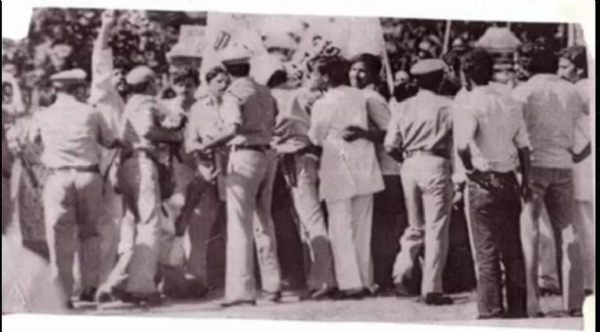
By 1983, the agitation had reached its most turbulent phase, marked by a deeply contested electoral process, state action and widespread violence. The ABVP’s involvement during this period reflected an effort to connect Assam’s concerns with a larger national consciousness, while resisting what it regarded as the political exploitation of illegal immigration for electoral purposes. Its intervention also sought to ensure that the Northeast’s concerns were not treated as a distant regional issue, but as part of India’s larger national debate.
The Crucible of 1983: Forced Elections and Democratic Breakdown
To understand the ABVP’s position on the Assam Movement, it is important to examine the volatile political climate of early 1983. The immediate roots of the crisis went back to the revision of electoral rolls for the 1979 Mangaldoi Lok Sabha by-election. Objections were raised against nearly 70,000 names, and subsequent proceedings identified large numbers of people as suspected non-citizens. For the movement’s supporters, the episode reinforced long-standing concerns that continued illegal immigration was altering Assam’s demographic and political landscape.
Between 1980 and 1982, the Centre held more than 50 rounds of talks with movement leaders, but the negotiations failed to produce an agreement on the cut-off date for identifying and dealing with illegal immigrants. Against this unresolved backdrop, the Election Commission of India and the government led by Prime Minister Indira Gandhi proceeded with Assembly elections in February 1983, conducted in three phases. The decision to use the unrevised electoral rolls, despite the controversy surrounding them, was seen by the agitators as a serious challenge to the democratic process.
The AASU and AAGSP called for a complete boycott. Several opposition parties, including the Bharatiya Janata Party (BJP), Janata Party and Lok Dal, supported the boycott. Leaders such as Atal Bihari Vajpayee publicly criticised the electoral exercise and urged voters to stay away. The administration faced widespread resistance, with state government employees refusing election duties and polling personnel and security forces having to be brought in from outside Assam. Around 400 paramilitary companies and 11 Army brigades were deployed as the government sought to conduct the elections amid intense opposition.
The ABVP viewed the elections as a serious constitutional and democratic issue. Its position was that allowing disputed names to remain on the electoral rolls, while questions over citizenship remained unresolved, could undermine the voting rights of genuine Indian citizens. The organisation therefore supported the boycott and used its student network to mobilise opinion around what it regarded as a wider constitutional crisis in Assam.
The elections were followed by some of the worst violence in Assam’s post-Independence history. The scale and nature of the violence remain deeply contested, as do interpretations of its causes and responsibility. Critics of the movement portrayed the agitation as communal, exclusionary or driven by ethnic chauvinism, while its supporters argued that the forced electoral exercise aggravated existing ethnic, social and economic tensions. From the ABVP’s perspective, the violence was a tragic consequence of an unresolved citizenship dispute being pushed through an electoral process despite strong opposition on the ground.
The ABVP perspective: National security over vote-bank politics
The ABVP’s involvement in the Assam agitation was rooted in its core ideological tenet: the nation comes first. During the late 1970s and 1980s, left-wing and regional organizations often dominated university campuses. The ABVP, founded on the core principle of nationalism and the institutional motto "Chhatra Shakti Rashtra Shakti" ("Student Power is Nation's Power"), positioned itself as a counterweight, focusing on national integration.
When mainstream political parties and sections of the national press labeled the Assam movement as "chauvinistic," "anti-Bengali," or "secessionist," the ABVP worked to dismantle this narrative. The organization articulated a clear distinction between internal migration and international infiltration. While the Indian constitution guarantees citizens the right to move and settle anywhere within the country, the porous border with Bangladesh was facilitating a silent, illegal demographic invasion.
The ABVP argued that the indigenous people of Assam were fighting a proxy war for the defense of India’s borders. If the demographic shift in Assam was left unchecked, it would inevitably lead to severe geopolitical consequences, threatening the strategic "Chicken's Neck" (Siliguri Corridor) that connects the Northeast to the rest of India.
To bridge the gap between regional aspirations and pan-Indian public opinion, the ABVP popularized the national rallying cry: "Assam Bachao, Desh Bachao" ("Save Assam, Save the Country"). By explicitly linking the demographic preservation of the Brahmaputra Valley to national security, the ABVP shifted the conversation within mainland university circles. The organization maintained that the Assamese people were fighting on the physical frontline of the Indian Republic against demographic shifts, and that abandonment of the state by the national mainstream was a betrayal of constitutional integrity.
This conceptual alignment was supported by organizational relationships built through the Students’ Experience in Inter-State Living (SEIL) initiative. Launched decades prior to facilitate educational exchange visits between Northeastern youth and families across peninsular India, SEIL had cultivated personal and operational connections across the Brahmaputra Valley. When regional student bodies were cut off by communications blackouts and media censorship during the 1983 election cycle, the ABVP utilized its network to carry the message of the agitation into campuses across the country.
The Architecture of mobilisation: The countrywide campaigns of 1983
One of the most significant challenges of the Assam Movement was the geographical and psychological isolation of the Northeast. The central government frequently imposed media censorship under the Assam Special Powers (Press) Act, restricting the flow of information to mainland India. Consequently, a deep sense of alienation began to take root among the Assamese youth, leading some factions toward armed insurgency and secessionism.
Rather than limiting its participation to statements of solidarity, the ABVP identified this alienation as a critical threat to national unity. To counter it, the organization launched nationwide sensitization campaigns throughout 1983 to counter government policy and dismantle the administrative isolation of Assam.
The mobilization began across metropolitan universities. The ABVP organized national seminars in key academic hubs, including Delhi, Hyderabad, and Bhubaneswar. By flying AASU representatives into these assemblies, the ABVP provided regional leaders with an unmediated platform to present demographic data, historical land tenancy records, and constitutional arguments directly to mainland intellectuals and student bodies. These seminars punctured the official narrative that the anti-poll movement was anti-Indian, framing it instead as a defense of the Republic’s external boundaries.
The next phase took place during the festival of Raksha Bandhan in August 1983. Designating the occasion as "Save Assam Day," the ABVP produced and distributed hundreds of thousands of specialized "Assam Rakhis" across college campuses nationwide. Male and female students throughout western, central, and southern India tied these bands on wrists as a mutual pledge of civic duty and protection toward the people of Assam. This cultural symbolism converted abstract territorial concepts into immediate personal commitments among mainland youth, generating countrywide interest in the political conflict unfolding in the Northeast. It sent a powerful psychological message to the people of Assam: they were not fighting alone, and the rest of the nation recognized their struggle as a shared Indian cause.
The campaign culminated in early October 1983 with the Assam Jyoti Yatra. On October 1, an ABVP delegation carried a Swahid Jyoti (Martyr Light) originating from Mahatma Gandhi’s memorial at Rajghat in New Delhi and delivered it to the executive leadership of AASU in Guwahati. The delivery honored the hundreds of agitators who had died since 1979 in police firings and civil unrest, emphasizing that the Assamese struggle drew directly upon the Gandhian tradition of non-violent resistance.
The following day, Gandhi Jayanti on October 2, 1983, the ABVP held a mass satyagraha at Judges Field in Guwahati. Approximately one thousand ABVP student leaders and cadre, drawn from almost every state in India, traveled to Guwahati to participate in civil disobedience alongside indigenous demonstrators. The newly installed Hiteswar Saikia government met the peaceful assembly with severe state force. Paramilitary forces surrounded the venue, deploying tear gas, carrying out lathi charges, and arresting hundreds of demonstrators, including visiting delegates from western and northern states.
The visual reality of non-Assamese students enduring police beatings alongside local students dismantled the government’s claim that the movement lacked pan-Indian legitimacy. By mobilizing youth in Gujarat, Bihar, Delhi, and Maharashtra to march in solidarity with Assam, the ABVP successfully prevented the agitation from devolving into a purely secessionist movement. It provided a platform for Assamese student leaders to travel across the country, address public gatherings, and explain the ground reality of the infiltration crisis, effectively bypassing the state-imposed information blockade.
Violence, polarisation, and the legislative aftermath
The human cost of the Assam movement was staggering. The year 1983 was marked by severe civil violence. The central government's choice to conduct elections amid communal distrust provoked sectarian clashes between pro-poll migrant communities and anti-poll indigenous populations. Attacks and counter-attacks resulted in the Nellie massacre, which claimed between 2,000 and 3,000 lives within a span of hours, as well as the Khoirabari massacre and incidents of retaliatory communal bloodshed across lower and central Assam. Over the six-year agitation, an estimated 855 individuals lost their lives to state police action and related violence, ultimately being recognised as martyrs of the Assam Movement.
The electoral statistics of 1983 serve as a stark testament to the scale of the boycott. In several constituencies in the Brahmaputra Valley, voter turnout was historically low, with some booths registering zero votes. The resultant state assembly was widely viewed by the public and student organizations as illegitimate, lacking the mandate of the indigenous populace. It was only after the signing of the historic Assam Accord in 1985 — which accepted 1971 as the cut-off year for identifying foreigners and mandated border fencing — that democratic normalcy was restored.
Critics of the agitation cited the violence as evidence that the movement had acquired a communal character, alleging that right-wing and student organisations had pushed it towards anti-immigrant violence. The T.P. Tewary Commission of Enquiry, established to investigate the 1983 election-related violence, ultimately concluded that giving the tragedies a purely communal tag was unwarranted.
The commission noted that violence affected multiple ethnic, linguistic, and religious groups, and that the violence stemmed from the unaddressed, decades-old fear among indigenous populations of being demographically outnumbered by unchecked migration. The panel concluded that this demographic anxiety had been identified by British and post-independence administrators long before AASU, the AAGSP, or the ABVP began organizing protests.
Rather than implementing border controls or updating electoral rolls, the Union government passed the Illegal Migrants (Determination by Tribunals) [IMDT] Act in late 1983. Applied exclusively to the State of Assam, the IMDT Act created a unique legal process: unlike the nationwide Foreigners Act of 1946, which placed the burden of proof on the accused individual to establish citizenship, the IMDT Act transferred the burden onto the resident complainant and local police authorities. Furthermore, it required complainants to live within a restricted geographical radius and pay administrative fees to initiate an inquiry.
The ABVP condemned the IMDT Act as statutory gerrymandering, arguing that it gave legislative protection to undocumented immigrants in exchange for electoral support while placing an unfair burden of proof on indigenous residents. Decades later, the Supreme Court of India in Sarbananda Sonowal v. Union of India (2005) struck down the IMDT Act as unconstitutional. Echoing the legal and national arguments raised by the ABVP in 1983, the Supreme Court ruled that the statute created an insurmountable barrier to detecting illegal immigrants, leaving the state vulnerable to what the court termed "external aggression" through demographic change.
The historical legacy of the 1983 intervention
The ABVP’s multi-layered engagement during the 1983 Assam agitation left an imprint on modern Indian political mobilisation. By actively challenging the narrative of regional isolation, the Parishad bridged the gap between sub-national grievances in Assam and pan-Indian constitutional nationalism. Through initiatives like the "Save Assam Day" Assam Rakhis, the Swahid Jyoti Yatra, and the October 2 satyagraha at Judges Field, the organisation built cross-regional solidarity with Assamese youth.
When the agitation concluded on August 15, 1985, with the signing of the Assam Accord between student representatives and Prime Minister Rajiv Gandhi, ABVP national president Dr. O.P. Kohli was among the first national leaders to publicly welcome the settlement.
The Parishad’s work in 1983 shifted national perspectives on regional demographic issues, turning border management and electoral roll integrity into core concerns of Indian domestic policy. By channeling student activism into constitutional advocacy during a period of state overreach, the ABVP expanded its public footprint and advanced its long-held philosophy that organised student mobilisation serves as a pillar of national preservation.