Unmasking Shabana Azmi, pro-Rohingya ActionAid, and CJP’s agenda against Electoral Rolls Cleanup
The very NGO, Action Aid India, under Shabana Azmi"s leadership faced an intensive CBI probe initiated by the Ministry of Home Affairs over foreign funding violations, leading to major scrutiny over how its funds are managed and utilized.


On October 2, veteran actor Shabana Azmi joined the Cockroach Janta Party (CJP) protest at Mumbai’s Shivaji Park and backed its demand for the resignation of Chief Election Commissioner Gyanesh Kumar over the Special Intensive Revision (SIR) of electoral rolls. She spoke about voting rights, deleted names and citizens’ right to question the authorities.
Fair enough. But when someone steps onto a political stage speaking about democracy and electoral rolls, the public is entitled to look beyond the microphone. No doubt, her participation gives the protest a familiar public face. But it also brings into focus some questions. Who is Shabana Azmi really? What organisations does she represent? Who funds those organisations? And what causes have those organisations worked on?
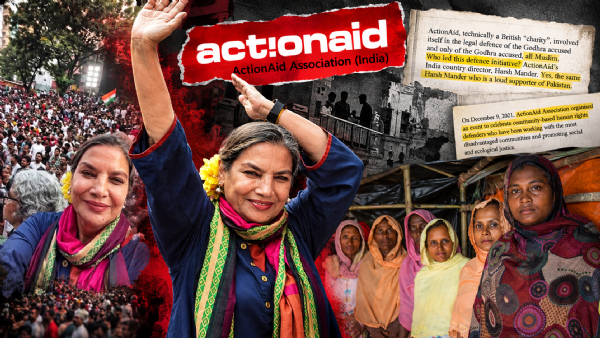
Azmi is not simply any other celebrity who appeared at a rally. She is the current Chairperson of the Governing Board of ActionAid Association, the Indian organisation affiliated with the international ActionAid network. ActionAid Association describes itself as a nationally registered organisation working in India and says it operates across multiple states and Union Territories. Its own website identifies Azmi as the Chairperson.
Now, here is the twist. ActionAid is funded by the Ford Foundation, Canadian Government and The European Union along with START NETWORK connected to THE CLUB OF ROME. It receives more than ₹85~₹100 crore in foreign funding every year.
The very NGO, Action Aid India, under Shabana Azmi's leadership faced an intensive CBI probe initiated by the Ministry of Home Affairs over foreign funding violations, leading to major scrutiny over how its funds are managed and utilized.
Shabana Azmi is a out and out leftist Lal Bindi gang member helping Illegal Rohingyas infiltrators settle in India.
— The Story Teller (@IamTheStory__) March 23, 2026
She is the chairperson of the board for ACTIONAID INDIA.
ActionAid India is funded by:
Ford Foundation
Omidyar Network
Among so many other US Left liberal non… https://t.co/eTH4ZWMzZo pic.twitter.com/By4Oc670nI
What makes Azmi's current crusade over "electoral roll revisions" particularly explosive is ActionAid’s documented history regarding demographic interventions, specifically its work with Rohingyas.
Its own published material documents ‘assistance to Rohingya refugee communities’. Its 2019-20 reporting describes work involving Rohingya families, including food, winter kits, sanitation support, education and healthcare-related assistance. The organisation has also documented refugee assistance in Mewat, Deoband and other sensitive areas.
Shabana Azmi, chairperson of the British Christian NGO 'ActionAid' in India that receives more than ₹85~₹100 crore in foreign funding every year. Deep State has started fresher notoriety on July 20 - the beginning of monsoon season to actualize regime change plot and push India… pic.twitter.com/EsqtCMfwYW
— Salah Uddin Shoaib Choudhury (@salah_shoaib) July 21, 2026
Connecting the Dots: What is the Real Agenda?
This brings us back to October 2 and the protest against the SIR of the electoral rolls. The core argument presented by the organizers is that voter list updates threaten disenfranchisement. However, when an activist-celebrity heading a foreign-funded NGO deeply entrenched in refugee rehabilitation including illegal migrant populations like the Rohingyas champions a resistance against rigorous voter roll verification, legitimate questions emerge.
The CJP protest is challenging the electoral-roll revision process. Its argument is that names could be removed from voter lists and that citizens' voting rights could be affected.
Shabana Azmi's October 2 appearance at CJP protest cannot simply be reduced to a celebrity showing up at a rally. It sits alongside a much larger record of activism and NGO work. The public can decide what significance to attach to that record. Azmi’s participation is part of a broader pattern of political mobilization. Her historical alignment with similar contentious platforms, including past agitations concerning student and youth policies, such as controversies surrounding the NEET examinations and parallel political front rollouts, also had attracted public attention.
After connecting the dots one thing becomes clear: there is a network worth examining. This brings up a glaring conflict. Why are individuals tied to networks advocating for foreign refugees heavily invested in pushing back against administrative electoral roll revisions? When people linked to pro-illegal migrant lobbies protest verification processes, it raises hard questions about whether they are protecting legitimate Indian citizens or safeguarding a backdoor for illegal voters to remain on electoral registries.
When celebrity power is deployed to challenge core state mechanisms like election oversight, it weaponizes public sentiment under the guise of neutral artistic conscience. But when the institutional infrastructure backing that celebrity involves multi-crore foreign funding, complex transnational networks, and documented advocacy for foreign refugee communities, the public has every right to ask deeper questions. Is this truly an indigenous defense of constitutional rights, or is it a calculated alignment of civil society NGOs pushing a hidden agenda against the state’s effort to make electoral rolls cleaner through SIR?
The habitual PIL cartel strikes again!
— Megh Updates 🚨™ (@MeghUpdates) October 3, 2026
Unable to arm-twist the Election Commission through legal routes, armchair activists have formed a SELF-STYLED TRIBUNAL to probe VOTER ROLL REVISIONS.
Look at the advisory roster: Kapil Sibal, Prashant Bhushan, Vrinda Grover.
– These… pic.twitter.com/qW5ARfUXLk
This campaign does not stop with Azmi. Looking at the wider legal and institutional chessboard, a parallel legal challenge has unfolded through Public Interest Litigations (PILs) filed against the electoral rolls revision. Familiar faces from the core activist-lawyer circuit such as Harsh Mander, Kapil Sibal, Prashant Bhushan, and Vrinda Grover have repeatedly driven litigations challenging state mechanisms. These figures carry deep, well-documented connections to foreign-funded networks, civil rights advocacy groups, and international donor ecosystems often associated with entities like George Soros’s Open Society structures, which consistently target India's administrative and sovereign checks and balances.
When you connect the dots – from multi-crore foreign funding and illegal migrant rehabilitation networks to synchronized street agitations and targeted legal challenges – a stark reality emerges.
This is not a spontaneous grassroots defense of democratic rights. This is a calculated mechanism of anarchy.