For over four decades, the Indian National Congress used "Garibi Hatao" as a defining political slogan, yet generations of Indians remained trapped in economic stagnation as grand promises repeatedly failed to deliver structural change.
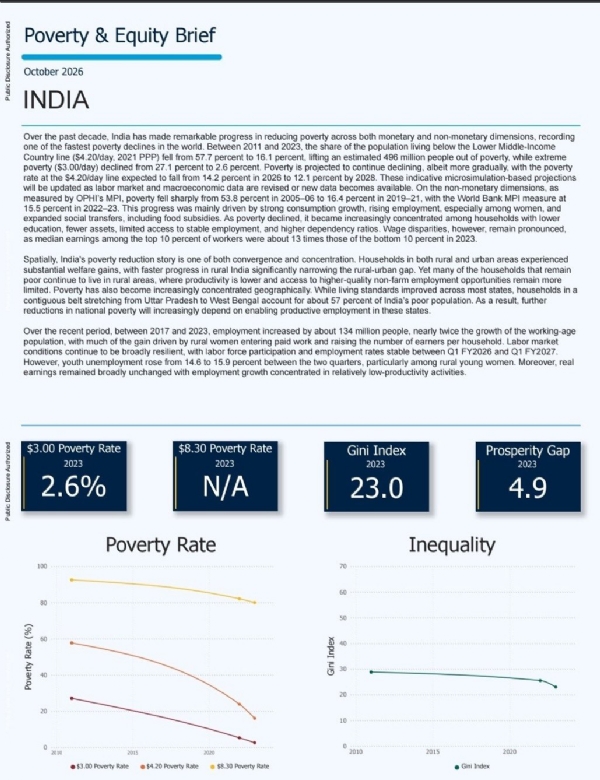
The true turning point arrived with a decisive shift in governance after 2014, replacing decades of political rhetoric with execution-driven policy, digital infrastructure, and targeted welfare delivery.World Bank findings show that India’s extreme poverty rate plunged from 27.1 percent down to 2.6 percent, lifting nearly 500 million citizens into financial stability through targeted welfare, digital infrastructure, and expanded economic inclusion.
The
nation’s extreme poverty rate fell from 27.1 percent in 2011 to just 2.6 percent in 2023.
This rapid shift spans a crucial 12-year window. Global economists call this transformation one of the fastest poverty reductions in modern history.
Describing the progress as "one of the fastest poverty declines in the world", the World Bank attributed the improvement primarily to strong consumption growth, rising employment, particularly among women, and expanded social transfers, including food subsidies.
Multiple factors drove this incredible turnaround. Strong consumption growth played a vital role. More citizens secured steady jobs. Female participation in the workforce surged. Expanded social welfare schemes provided a crucial safety net. Targeted food subsidies helped millions of families survive tough times.
Financial benchmarks showed broad improvements. The lower-middle-income poverty line is set at $4.20 per day. This metric uses 2021 purchasing power parity. The percentage of people below this line dropped sharply. It fell from 57.7 percent down to 16.1 percent.
India added approximately 134 million people to its employed workforce between 2017 and 2023, nearly twice the increase in its working-age population. A substantial share of this employment growth came from rural women entering paid work.
Future projections look promising yet steady. Poverty rates are expected to decline further. However, the pace will likely slow down. World Bank models forecast continuous improvements. The $4.20 poverty rate could fall even lower by 2028.
However, the report also pointed to emerging concerns in the labour market. Youth unemployment increased from 14.6 per cent to 15.9 per cent between the first quarters of FY26 and FY27, with rural young women particularly affected.
Real earnings also remained broadly unchanged, while employment growth was concentrated in relatively low-productivity activities.
Important challenges still remain ahead. Geographic disparities continue to pose hurdles. A large portion of the remaining poor population lives in specific regions. About 57 percent are concentrated in a contiguous northern belt. This zone stretches from Uttar Pradesh to West Bengal. Targeted job creation in these areas is vital.
Employment trends present a mixed picture. Total employment grew by roughly 134 million people. This expansion happened between 2017 and 2023. It outpaced the growth of the working-age population. Rural women drove much of this new employment surge.
However, some vulnerabilities persist in the labor market. Youth unemployment saw a noticeable uptick. Real earnings remained largely flat for many workers. Much of the recent job growth happened in low-productivity sectors. Boosting job quality remains a key national priority.
Experts note how data collection methods evolved. Household consumption surveys captured these welfare gains. Some improvements reflect better tracking technologies. Yet, the core welfare transformation remains undeniable.
India's journey offers lessons for the developing world. Massive scale social programs deliver results. Economic expansion can lift hundreds of millions upward. Sustaining this momentum requires addressing regional gaps. The next phase focuses on inclusive, high-productivity growth.