Uttarakhand prepares new religious education curriculum for madrasas & minority institutions; Effective from current academic session
The new curriculum has been developed under the Uttarakhand State Authority for Minority Education (USAME), which was established following the dissolution of the state"s Madrasa Education Board. It covers educational institutions belonging to Muslim, Sikh, Jain, Buddhist, Christian and Parsi communities.
Total Views |


Uttarakhand has prepared a new religious education curriculum for madrasas and other minority educational institutions, becoming the first state in the country to introduce a structured religious education framework covering six notified minority communities. The curriculum is scheduled to be implemented during the ongoing academic session, with the syllabus for Classes 1 to 8 already finalised and that for Classes 9 to 12 also completed.
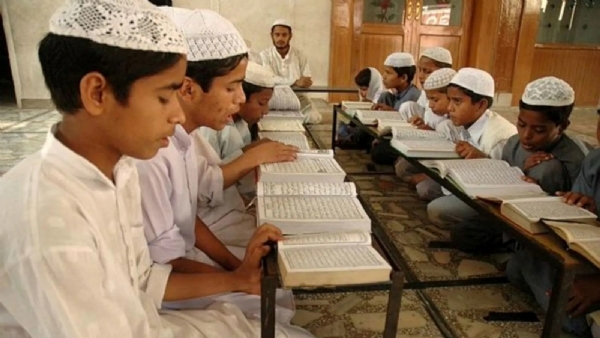
The new curriculum has been developed under the Uttarakhand State Authority for Minority Education (USAME), which was established following the dissolution of the state's Madrasa Education Board. It covers educational institutions belonging to Muslim, Sikh, Jain, Buddhist, Christian and Parsi communities.
According to the latest announcement, the curriculum for Classes 1 to 8 was completed recently and is expected to be introduced this week. The syllabus for Classes 9 to 12 has also been prepared, and the state government is planning to formally release it through Chief Minister Pushkar Singh Dhami.
🚨 BIG: Uttarakhand FINALISES a COMMON SYLLABUS for ALL Madrasas!
— The Analyzer (News Updates🗞️) (@Indian_Analyzer) October 30, 2026
=> CM Dhami launches a DIRECT STRIKE against radicalisation!🔥
Era of unregulated religious schooling in Madrassas is OVER🤯
• Madrasa Board ABOLISHED.
• Modern subjects alongside religious education.
•… pic.twitter.com/ezw8zAKk1F
Religious education to follow prescribed syllabus
With the introduction of the new framework, recognised minority educational institutions will be required to provide religious instruction according to the syllabus prescribed by the authority. The initiative is intended to bring greater uniformity to religious education while allowing individual communities to retain their distinct religious and cultural traditions.
The curriculum has been developed through committees comprising religious leaders and educationists from the respective communities. USAME chairman Dr Surjeet Singh Gandhi said that the curriculum had been prepared through consultations with these committees and would not require separate approval from the Education Department.
Digital learning material initially, textbooks next academic session
For the ongoing academic session, study material for Classes 1 to 8 will be made available through online and offline platforms. Examinations will be conducted on the basis of the prescribed syllabus. A similar arrangement will be followed for Classes 9 to 12.
Printed textbooks are expected to be published from the next academic session after the necessary budgetary arrangements are made. The current academic session is already more than halfway through, making digital and other study materials the immediate means of implementing the curriculum.
Curriculum combines religious studies with modern subjects
Apart from religious instruction, the new curriculum incorporates subjects intended to develop students' social awareness, ethical understanding and responsible behaviour. These include moral values, India's freedom struggle, digital awareness, prevention of drug abuse and brotherhood.
The inclusion of these themes is intended to familiarise students with contemporary social issues and national history alongside their respective religious traditions. The framework seeks to combine religious learning with modern educational and social values.
Up to Rs 5 lakh penalty for institutions violating rules
The state government has also strengthened the regulatory framework governing minority educational institutions through an amendment to the Uttarakhand Minority Education Act.
Under the reported provisions, institutions providing religious education in violation of the prescribed rules may face penalties of up to Rs 5 lakh. Further action, including closure of the institution and appointment of a receiver, may also be initiated in cases covered by the law.
The new regulatory arrangement follows the enactment of the Uttarakhand Minority Education Act, 2025, and the subsequent establishment of USAME. The authority is responsible for recognition and regulation of minority educational institutions under the revised framework.
Only 35 institutions have obtained recognition from USAME
The transition to the new regulatory system has also resulted in changes in the recognition status of minority educational institutions.
Previously, 452 madrasas were operating under the Uttarakhand Madrasa Education Board. Following the establishment of USAME, 35 institutions have reportedly obtained recognition from the new authority. More than half of the previously registered madrasas are reported to have closed.
Meanwhile, approximately 80 institutions have obtained recognition through the Education Department, while more than 100 institutions have submitted applications to the department.
The figures indicate the scale of the transition from the previous Madrasa Board system to the new recognition framework.
Dhami says quality and uniform education remain priorities
Chief Minister Pushkar Singh Dhami said that providing quality and uniform education was among the government's priorities. He stated that the religious education curriculum had been prepared and would be introduced shortly.
The Chief Minister emphasised that children studying in madrasas and other minority educational institutions should receive modern and employment-oriented education so that they could contribute to nation-building.
USAME chairman Dr Surjeet Singh Gandhi said that committees comprising religious leaders and educationists had prepared the curriculum, taking into account the traditions and requirements of different minority communities.
With the new framework, Uttarakhand is seeking to bring religious education in minority institutions under a structured regulatory system while combining community-specific religious instruction with modern academic and social learning.