Diljit Dosanjh responds to CJP’s Abhijeet Dipke at Delhi concert, says ‘Don’t teach Punjabis how to fight’
The exchange followed months of disagreement between Diljit Dosanjh and Cockroach Janata Party founder Abhijeet Dipke over the singer’s initial reluctance to comment on the agitation.
Total Views |


Punjabi singer and actor Diljit Dosanjh responded to months of criticism over his remarks on the student protests during his concert at Delhi’s Jawaharlal Nehru Stadium on October 30.
Addressing the audience, Diljit defended his position as an artist and pushed back against attempts to dictate how he should respond to public issues.
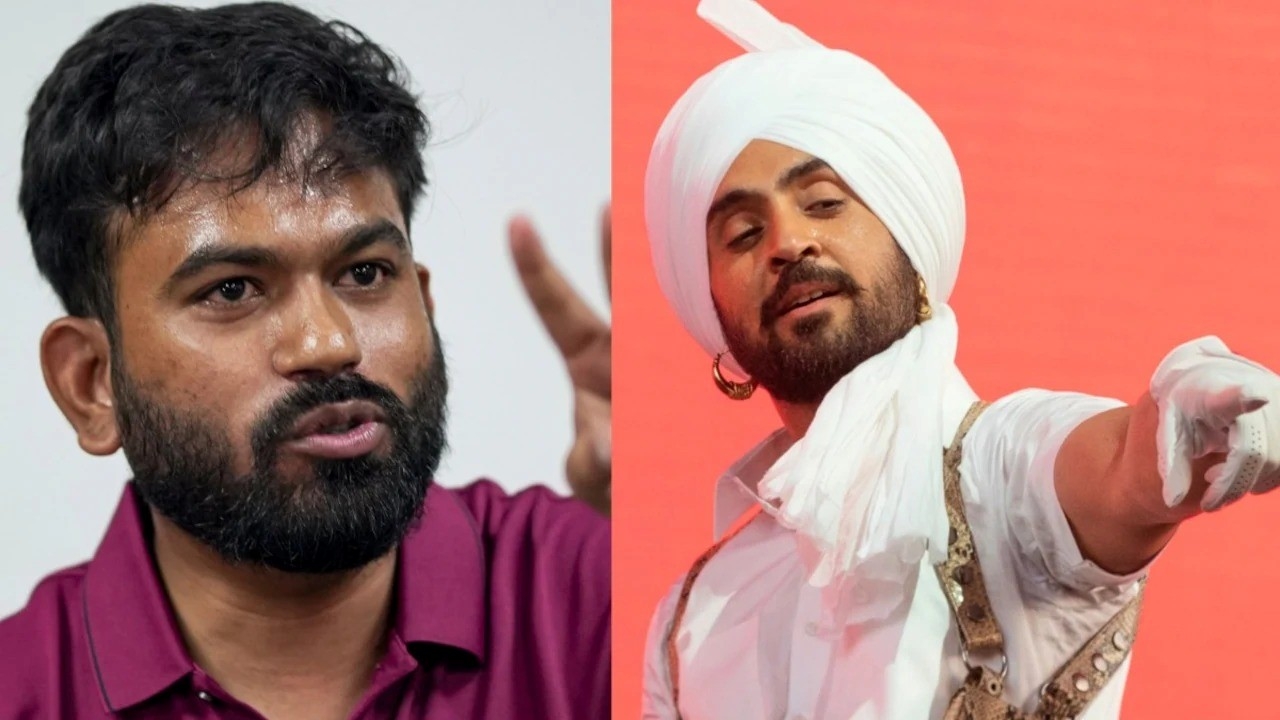
Diljit Dosanjh and Abhijeet Dipke amid the public controversy, (Image: India Today)
“I love all of you because I am an artist, bro. I am being quiet, so let me stay quiet. I support all of you. But don’t teach Punjabis how to fight,” he said.
He also referred to the criticism surrounding his film on human rights activist Jaswant Singh Khalra, stating that considerable efforts had gone into making and securing the release of the project.
“The film you are making fun of on stage, Jaswant Singh Khalra’s film, we fought for that film for a long time,” Diljit said.
Without directly naming the Cockroach Janata Party (CJP) or its founder Abhijeet Dipke, the singer appeared to address the controversy that had developed following his earlier comments on the student agitation.
Diljit also reiterated his affection for his audience, including those who disagreed with him or disliked his position.
Diljit Dosanjh Hits Back at CJP Over His “I Am an Artist” Remark, Says Punjabis Know How to Fight Their Battles pic.twitter.com/mJDWQZN7Ph
— Grey Insights (@GI_Bharat) October 30, 2026
How the disagreement between Diljit and Dipke began
The public disagreement dates back to July 2026, when a fan asked Diljit about the student protests organised by the Cockroach Janata Party over alleged examination irregularities and paper leaks.
During an Instagram Live session around July 1, the singer expressed reluctance to get involved in the controversy.
“Keep me away from all this. Bro, I’m an artist. I’m no politician… I don’t know what you think I am,” he said.
Diljit also quoted a line from the Guru Granth Sahib, “Nanak dukhiya sab sansar”, referring to the suffering in the world and the importance of finding peace through faith. He wished both the protesters and the opposing side well, while maintaining that he wanted to concentrate on his music and entertainment career.
His response drew criticism from Dipke and several supporters of the student movement.
Many questioned why Diljit, who had openly supported the farmers' protests of 2020-21, was reluctant to comment on the students agitation. They also referred to his association with the film on Jaswant Singh Khalra, which had faced prolonged certification-related difficulties.
Abhijeet Dipke posts conciliatory message
Following Diljit's remarks at the Delhi concert, Dipke posted an Instagram note addressed to the singer, adopting a conciliatory tone.
He said he had been hurt by Diljit's earlier comments, not because he had anything against him personally, but because he had always regarded the singer as someone who spoke up for important causes.
Dipke described himself as a longtime admirer of Diljit and recalled attending his Chicago concert in May 2026, shortly before returning to India.
He praised the singer for taking Punjabi and Indian music to an international audience while remaining connected to his roots.
Dipke also acknowledged that one disagreement or misunderstanding would not change the respect he had for the singer.
Describing himself as Diljit's younger brother, he asked him to 'mitti pao', a Punjabi expression commonly used to suggest putting an issue behind and moving on.
He concluded his message by quoting a line from Diljit's popular song 'GOAT': “Gabru ta vairi nu vi mitha bolda…”
The message indicated a willingness to end the public disagreement and restore cordial relations.
Delhi concert faced permission-related uncertainty
Diljit's Delhi concert also attracted attention before the event, as Delhi Police initially withheld or denied permission, citing security, law-and-order and festive-season concerns.
The development triggered criticism on social media, with Dipke reportedly mocking the situation with remarks questioning whether authorities were now afraid of concerts.
The show eventually received clearance after organisers submitted the required security arrangements.
During the concert, Diljit also referred to attempts to stop the event and said he would remain in India until around December 20, with the remaining tour dates scheduled to proceed.
CJP's AAP connections
Launched in May 2026 by Abhijeet Dipke, the Cockroach Janata Party initially presented itself as a youth-led movement against unemployment, examination paper leaks and institutional failures.
However, its political background has attracted scrutiny. Dipke previously worked with the Aam Aadmi Party's social media team, while a report by ThePrint on August 13 revealed that six of the 12 members inducted into CJP's national working committee had either been associated with the AAP or publicly supported it.
The report also highlighted the involvement of former AAP volunteers in the organisation's activities.
Many argue that the organisation appears to be providing another platform for Opposition-aligned political mobilisation at a time when the INDI bloc is struggling to regain electoral ground.
From student protests to anti-ECI campaign
CJP initially gained prominence through protests at Delhi's Jantar Mantar over alleged NEET-UG examination irregularities and paper leaks.
However, its activities subsequently expanded into political campaigns against the Election Commission of India.
On September 24, Dipke issued a 48-hour ultimatum demanding the resignation of Chief Election Commissioner Gyanesh Kumar. The organisation also demanded an inquiry, criminal proceedings against the CEC and a halt to the Special Intensive Revision (SIR) exercise.
On October 28, CJP announced its support for the INDI bloc's November 1 rally at Delhi's Ramlila Maidan against the SIR exercise and the Chief Election Commissioner.
Dipke also endorsed the campaign with the slogan "GYANU MUST GO!"
The development raises questions about why an organisation that initially claimed to represent students and unemployed youth is increasingly aligning itself with the Opposition's political campaigns.
Targeting a constitutional authority and demanding the resignation of its head through street mobilisation cannot become a substitute for established legal and constitutional remedies.
Bangladesh and Nepal models: India is not its neighbours
The political narrative surrounding CJP has also attracted attention because of comparisons with youth-led movements in Bangladesh and Nepal, which played a major role in the collapse of governments in those countries.
Speaking at a press conference on October 15, Prashant Bhushan said: “Yes, we want regime change. What is wrong in this? I am saying today that yes, it is a battle for regime change, and we will get it done anyhow.” He also argued that demanding a change of government was a democratic right.
His remarks came amid protests involving the CJP, Left organisations and INDI bloc leaders against the SIR exercise and CEC Gyanesh Kumar.
The controversy was further fuelled by a video message from AISA president Neha Bora to Bangladesh's Socialist Students' Front. Referring to Bangladesh's Gen-Z movement, she said: “The Gen Z protests that we are seeing everywhere in this country first started in Bangladesh. And congratulations to you for showing us the way.” She also said that Indian youth were drawing inspiration from the struggles for democratic and voting rights in Bangladesh.
It is important to note here that, India is not Bangladesh or Nepal. It is a constitutional democracy with an established electoral system, independent judiciary and institutions responsible for safeguarding democratic processes.
Political change must come through elections and constitutional mechanisms, not through attempts to manufacture instability or undermine elected governments through sustained street confrontation.
India will not accept attempts to bypass democratic processes
The larger issue surrounding CJP is not whether young people should protest. They have every right to question the government, demand accountability and seek justice.
However, genuine public grievances should not become instruments for political destabilisation or campaigns to delegitimise constitutional institutions.
The Election Commission, judiciary and other constitutional bodies must remain open to scrutiny, but their authority cannot be dismissed simply because a political organisation disagrees with their decisions.
India's governments are elected by the people and can be changed by the people through democratic elections.
This is India, not Bangladesh or Nepal. Attempts to import political upheaval, manufacture instability or replace electoral legitimacy with street pressure will not provide a shortcut to power.