Sugarcane farmers siege vital Maharashtra-Karnataka trade corridors over pricing deadlock
With an aim to enforce maximum economic leverage, the blockade will actively target both incoming raw sugarcane and trucks attempting to move already-processed sugar out of factories.
Total Views |


Kolhapur, Oct 31: A volatile border standoff over sugarcane procurement has brought the vital agricultural corridors between Maharashtra and Karnataka to an absolute standstill. Large-scale mobilisations by prominent regional farmer bodies have escalated from targeted factory sit-ins to systemic blockages.
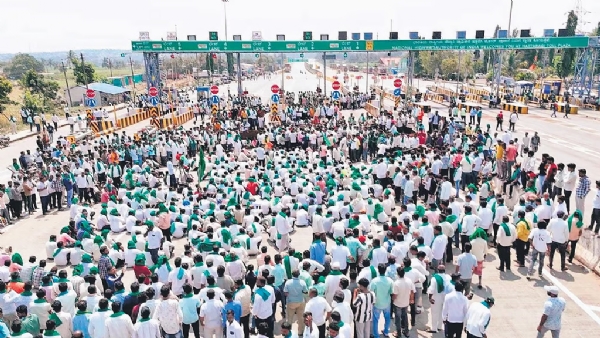
The unrest reached a structural tipping point on Saturday (Oct 31) as the Karnataka Rajya Raitha Sangha (KRRS) and Hasiru Sene enforced a strict statewide bandh. Protesters successfully choked strategic junctions on the Pune-Bengaluru National Highway (NH-48) and rural border lines cutting through Belagavi, Chikkodi, and Nipani. The development validates recent raw footage of gridlocked national logistics routes and mounting law enforcement deployments.
What is the issue and what are the demands?
The current crisis underscores a widening gap between rigid regulatory price controls and the practical, inflation-driven costs of modern farming.
Road block by farmers for msp on sugarcane at honnapur (Goa - Alnavar road)
— Yuvi (@WaveYuvi) October 31, 2026
vehicles are lined upto 5 kms both side 😭 pic.twitter.com/06VfOkVMSD
In North Karnataka, agitating growers are demanding a sweeping state support package ensuring ₹5,500 per tonne. Concurrently, in Western Maharashtra, the Raju Shetti-led Swabhimani Shetkari Sanghatana has rejected standard baseline factory offers, aggressively demanding a first-instalment payment of ₹4,500 per tonne. Protesters maintain that exponentially rising input costs, including fuel, chemical fertilisers, and manual labour, have rendered current yields completely unviable under the existing pricing frameworks.
Cooperative and private sugar mill managements counter that paying these steep premiums is economically impossible due to a central policy imbalance. While input parameters have climbed, the Minimum Selling Price (MSP) of processed sugar has remained legally frozen by regulations at ₹31 per kg since February 2019. Mills argue that they cannot generate the cash flow required to meet farmer demands unless they are permitted to sell the final product at a realistic, market-reflective rate of ₹40–₹50 per kg.
The Three-Tier Policy positions
The Union Government has fixed the nationwide Fair and Remunerative Price (FRP) for the current season at ₹3,650 per tonne. In direct response to the escalating border tensions, the Centre dispatched a high-level expert committee that concluded a structural assessment tour of Bengaluru on October 29–30. The panel is actively reviewing agricultural pricing formulas, ethanol procurement policies, and sugar MSP models. A comprehensive report is expected to be presented to the Union Cabinet ahead of the late-November policy deadlines.
The Congress-led Karnataka administration, under Chief Minister D.K. Shivakumar, has attempted multiple rounds of marathon negotiations to break the deadlock. Facing stubborn resistance from both farmers and factory owners, Shivakumar has formally appealed to Prime Minister Narendra Modi, pushing the policy burden back onto New Delhi. The state argues that because crucial decisions governing sugar MSP and ethanol restrictions fall strictly under central jurisdiction, federal intervention is mandatory to avoid industry-wide bankruptcy.
At the same same time, Devendra Fadnavis-led Maharashtra government is employing a strategy of localized mediation to protect its massive cooperative sugar belt. Guardian Minister Prakash Abitkar has held consecutive emergency conciliation meetings in Kolhapur. The state is pressuring individual mills to calculate their maximum viable premium payouts above the central FRP floor, attempting to forge a localized compromise that can safely resume crushing operations without triggering violent market instability.
What has worsened the situation?
The crisis took a sharp turn for the worse following a complete breakdown of the Kolhapur conciliation talks. Citing a total lack of financial guarantees from mill owners, Raju Shetti announced that the Swabhimani Shetkari Sanghatana will completely halt harvesting operations across the region.
The group has now announced an indefinite "Chakka Jam" (highway blockade) scheduled for November 3 at the Kini Toll Plaza on the Pune-Bengaluru National Highway. With an aim to enforce maximum economic leverage, the blockade will actively target both incoming raw sugarcane and trucks attempting to move already-processed sugar out of factories. In response, local administrations in Dharwad and Belagavi have clamped strict Section 163 BNSS prohibitory orders near major toll plazas and highways to keep essential transit lanes clear, setting up a high-stakes showdown between security forces and agrarian unions.