"If you tell a lie big enough and keep repeating it, people will eventually come to believe it."
As Adolf Hitler once cynically observed about propaganda, if you repeat a big enough falsehood long enough, people will eventually believe it. That classic maxim fits like a glove on the well-oiled machinery of outrage operating in India today. Look at the absolute tamasha unfolding on the streets. The self-styled Cockroach Janta Party (CJP) is out on the streets against Chief Election Commissioner Gyanesh Kumar, shouting about the Special Intensive Revision of electoral rolls and promising more marches to Delhi. Many leaders, self proclaimed journalists and communist have joined the tea party funded by the “Soros gang” at the Jantar mantar.
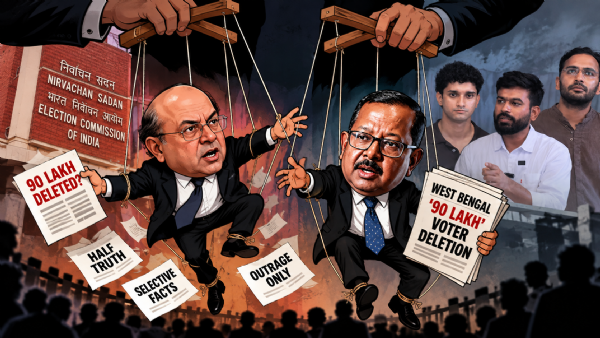
And stepping right into the limelight to exploit the public's deep-rooted faith in our judiciary is retired judge Rohinton Fali Nariman. He is playing his scripted part in a coordinated campaign, weaponizing the emotional trust that ordinary citizens place in the robes of a former Supreme Court judge to push a partisan narrative.
Former Supreme Court judge Rohinton Fali Nariman is out here playing fearmonger. Standing tall on a podium, he wept buckets over an "astounding" figure of 90 lakh voters supposedly disenfranchised in West Bengal, gasping that it somehow handed a win to the government at the Centre. It is the same tired, recycled script meant to delegitimize any process that doesn't fit their political bias
He said the right to vote was “at great peril” and described the appointment of Election Commissioners entirely by the government of the day as a “red flag”.He called for the Supreme Court to decide at the earliest on the validity of the Chief Election Commissioner and Other Election Commissioners Act, 2023, which governs the appointment of Election Commissioners.
The man speaks as though democracy is hanging by a thread, but his entire argument is built on lazy half-truths, selective amnesia, and a heavy dose of partisan hand-wringing.
Start with the word "disenfranchised." Being dropped from a draft list during a Special Intensive Revision is not the same as losing your vote for good. The whole process has a stage for claims and objections, and a stage for appeals before tribunals that the Supreme Court itself set up. The gap between a draft deletion and a final exclusion is the point of the exercise, not a technicality.
Then look at who gets removed. Electoral rolls carry dead people, duplicate entries, people who moved away, and people who were never eligible. Reported breakdowns of the 90 lakh put around 24 lakh as deceased, over 32 lakh as shifted or absent, and more than a lakh as multiple entries. Nobody was picked out by caste, religion or politics. That is what a revision does.
Next, the appeal numbers. The Election Commission told the Supreme Court that adjudication ordered 27.16 lakh deletions, and 22.21 lakh of those people appealed. Nariman's 93% comes from about 1.2 lakh appeals decided so far. That is a small slice of the total, and he treated it as if it described all of them. A fair reading is that the appeal system is doing its job and fixing mistakes. It doesn't prove 90 lakh people were wronged.
Now the part that sinks the big claim. If these deletions were built to hurt the TMC and help the BJP, you'd expect the TMC to suffer where the deletions were heaviest. Check the 20 assembly seats with the most deletions after adjudication. TMC won 13. BJP won six. Congress won one. A plan to rig Bengal that leaves the target party holding most of the hardest-hit seats is a bad plan.
There's also turnout. Bengal's turnout this year was above 93%, which would be the highest the state has recorded. A state hollowed out by mass disenfranchisement doesn't usually vote like that.
And a general point on why elections go the way they do. Candidate strength, caste and community arithmetic, anger at the sitting government, who has workers on the ground, and regional mood all play a part. Pinning a change of government on one voter-roll exercise is a political argument, not an analysis. It's hard not to notice that Nariman's real unhappiness seems to be that the BJP won.
He also leaned on an Indian Express report about two election commissioners objecting to decisions by the Chief Election Commissioner, followed by what he called a patch-up. That's his right. But the same paper reported the seat-wise results, and those didn't come up in his speech. You can't pick the reporting that fits and skip the reporting that doesn't.
Then there's the question of why he's suddenly so worried about how election commissioners get appointed. Go back a few decades. In the 80s, 90s and 2000s, Congress prime ministers picked commissioners pretty much as they liked. Navin Chawla went from being a favourite of the government to sitting on the election panel, and later became a minister too. Did Nariman say anything about the independence of institutions then? Nariman’s sudden panic over the ECI is rich with hypocrisy.
And if retired judges weaponizing their past prestige wasn't enough, we now have sitting members of the highest court stepping directly into the political arena. Take Justice Ujjal Bhuyan's speech on October 4th at the NALSAR Moot Court Competition in Hyderabad. Without explicitly naming the Special Intensive Revision, Justice Bhuyan slammed voter deletions as "intrinsically arbitrary," declaring that any process disenfranchising millions makes them "second-class citizens" and acts as a "negation of the constitutional order."
Ironically, Milord hails from Assam, the very ground zero of mass illegal infiltration where fraudulent voters on rolls are an existential crisis. Yet, he lectures on "arbitrary" deletions, as if routine administrative cleanups should grant blanket exemptions to illegals.
When a retired judge with transparent ideological biases peddles an alarmist narrative, it is par for the course. But when a sitting Supreme Court judge uses a public platform to paint standard administrative roll revisions in such loaded, apocalyptic terms, it crosses a dangerous line. It pre-emptively delegitimizes lawful institutional processes and blurs the vital boundary between judicial adjudication and partisan commentary.
Why is a sitting Supreme Court judge pronouncing a verdict from a university stage on a matter about to be heard by the Chief Justice's bench? Justice Bhuyan delivered an outside-the-bench intervention into territory a designated Bench was about to enter. Without giving the Election Commission a chance to answer or evidence to be tested, he supplied a powerful constitutional vocabulary for one political side to weaponize. Posing as neutral guardians, these figures act as a synchronized propaganda machine, pre-judging sub-judice pleas to feed an ecosystem designed to delegitimize our democratic institutions.
When robes of prestige are repurposed to run a political campaign, the pretense of judicial independence dies a quiet death. For decades, the intellectual-ecosystem ecosystem and its patrons have operated on a singular, unwritten rule: when institutional appointments and administrative clean-ups serve their political worldview, silence is maintained. But the moment a nationalist, non-dynastic governance model alters the framework or challenges bloated, ghost-ridden electoral rolls through statutory revisions, the entire narrative machinery shifts into overdrive.
This coordinated theater whether played out through alarmist pronouncements from retired dignitaries or pre-emptive, outside-the-bench proclamations from academic stages is not about protecting the Constitution or defending the common citizen. It is a desperate bid to delegitimize autonomous constitutional bodies like the Election Commission of India because their preferred political outcomes failed at the ballot box. By weaponizing public faith in judicial symbols to launder partisan talking points, these actors expose an intellectual bankruptcy that refuses to accept the democratic verdict of an awakened Bharat. The public sees right through the smoke and mirrors; the era of unchallenged narrative manipulation is over.