Jaishankar: US Has ‘Deliberately Become a Lonelier Power’
landscape was undergoing a major transformation, marked by a sharp US-China strategic competition and the growing assertion of emerging and middle powers.
Total Views |


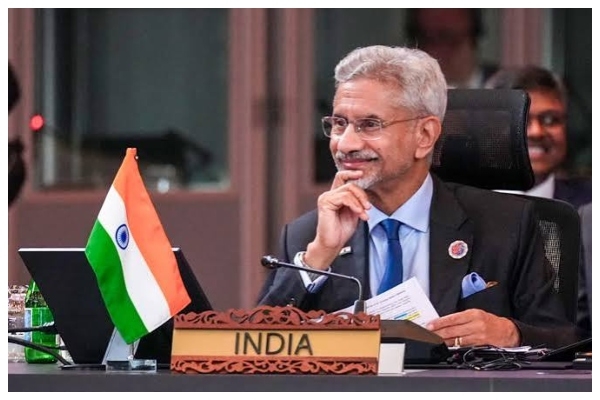
New Delhi, October 5: External Affairs Minister S. Jaishankar has described the United States as having “deliberately become a lonelier power”, saying Washington’s radical repositioning and the rise of China are reshaping the global order.
He identified the rise of China as the second major feature of the changing global order. According to Jaishankar, the competition between Washington and Beijing is no longer confined to the two powers and is increasingly resulting in countries using their economic, technological and strategic advantages as leverage.
He cited the Quad, India-Middle East-Europe Economic Corridor, International North-South Transport Corridor and the Northern Sea Route as examples of such cooperation. He also pointed to BRICS, the International Solar Alliance and the Coalition for Disaster Resilient Infrastructure as examples of countries developing common platforms where their interests converge.
The External Affairs Minister also referred to the emergence of a more multipolar world, in which countries would increasingly maintain relationships with powers whose interests may not always be easy to reconcile.
He described this as a strategy of “advancing by hedging”, arguing that countries would increasingly diversify their partnerships rather than depend excessively on any single major power.
Jaishankar also underlined India's own prospects in the emerging order, saying India has the potential for decades of high growth and possesses a demographic profile capable of supporting that growth. He suggested that India may not necessarily have to follow the traditional industrialisation path taken by earlier economic powers.
His remarks came amid continuing differences between India and the US over trade, tariffs, Russian energy purchases and Washington’s approach towards Pakistan. The External Affairs Minister had recently said that India's strategic interests and “red lines” needed to be respected in bilateral negotiations.
The latest remarks therefore underline New Delhi’s broader approach to the changing global order: India intends to deepen cooperation with the US where interests converge, while retaining strategic autonomy and expanding relationships with other major and emerging powers.
Speaking at the 62nd Munich Security Conference’s Leaders Meeting in New Delhi on Sunday, Jaishankar said the international landscape was undergoing a major transformation, marked by a sharp US-China strategic competition and the growing assertion of emerging and middle powers.
“No one in the room would disagree with the fact that the landscape today is primarily marked by a radical repositioning of the United States,” Jaishankar said, describing the change as “a posture of choice” through which the US had, in a way, “deliberately become a lonelier power”.
“That competition today, not limited to these two countries, has led to a weaponization of any leverage that any country has,” he said. At the same time, he noted that strategic competition was taking place alongside growing global economic and political interdependence.
Soviet Union/Russia🇷🇺 "stood by us" when our security, territorial integrity was under threat & at a time "much of the world preferred backing a military regime🇵🇰 next to us" says EAM Jaishankar, Explaining, "India's experience with Russia has been consistently positive" pic.twitter.com/QeQIdx4FJQ
— Sidhant Sibal (@sidhant) October 4, 2026
Jaishankar said emerging and middle powers were responding to the changing environment by strengthening cooperation among themselves while simultaneously maintaining relationships with both the US and China.
He cited the Quad, India-Middle East-Europe Economic Corridor, International North-South Transport Corridor and the Northern Sea Route as examples of such cooperation. He also pointed to BRICS, the International Solar Alliance and the Coalition for Disaster Resilient Infrastructure as examples of countries developing common platforms where their interests converge.
The External Affairs Minister also referred to the emergence of a more multipolar world, in which countries would increasingly maintain relationships with powers whose interests may not always be easy to reconcile.
He described this as a strategy of “advancing by hedging”, arguing that countries would increasingly diversify their partnerships rather than depend excessively on any single major power.
Jaishankar also underlined India's own prospects in the emerging order, saying India has the potential for decades of high growth and possesses a demographic profile capable of supporting that growth. He suggested that India may not necessarily have to follow the traditional industrialisation path taken by earlier economic powers.
His remarks came amid continuing differences between India and the US over trade, tariffs, Russian energy purchases and Washington’s approach towards Pakistan. The External Affairs Minister had recently said that India's strategic interests and “red lines” needed to be respected in bilateral negotiations.
The latest remarks therefore underline New Delhi’s broader approach to the changing global order: India intends to deepen cooperation with the US where interests converge, while retaining strategic autonomy and expanding relationships with other major and emerging powers.