When Thackerays Blame Everyone Except Themselves
Raj and Uddhav may demand that EVMs be replaced with paper ballots.
NewsBharati 05-Oct-2026 13:25:54 PM
Total Views |


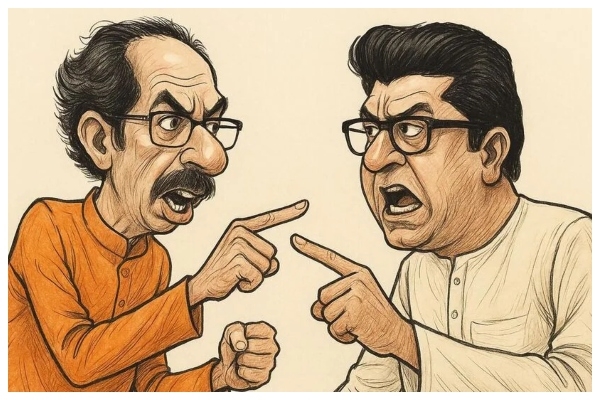
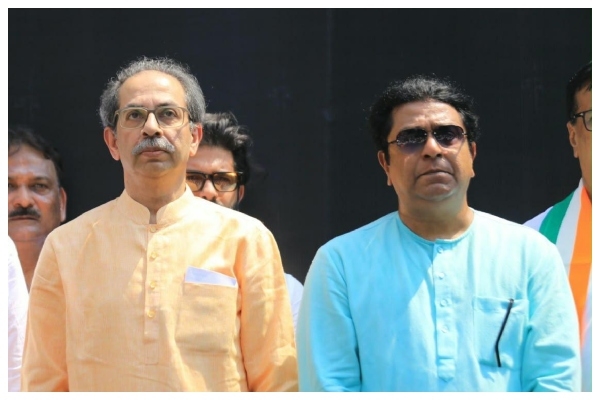
The most revealing feature of the Thackeray brothers’ Mumbai morcha was not their reunion. It was the explanation they offered for their political predicament. SIR, EVMs, the Election Commission, the CEC, alleged vote theft and institutional failure everything came under attack. One institution after another was placed in the dock. There was, however, one conspicuous absence from their indictment: their own politics. That omission is the real story.
 In the 2024 Maharashtra Assembly election, Shiv Sena (UBT) won only 20 of 288 seats, while the rival Shiv Sena won 57. The BJP won 132. The Mahayuti's overwhelming Assembly victory cannot automatically be attributed to one factor, but neither can the UBT's performance automatically be attributed to electoral manipulation. The voters' verdict deserves to be taken seriously.
This is where the Thackeray brothers' present campaign begins to look less like an examination of electoral reform and more like an attempt to find an external explanation for political erosion.
Raj Thackeray presents a different but equally uncomfortable case. His political positions have shifted dramatically over the years: from support for Narendra Modi in 2014 to an aggressive anti-Modi campaign in 2019 and subsequently back towards the NDA in 2024. Is it political inconsistency or flexibility? Voters had replied to this question since the inception of Maharashtra NavNirman Sena (MNS). Every reversal carries a credibility cost for Raj. A politician cannot repeatedly change political direction and then expect the electorate to remain permanently attached to an earlier political identity. The problem, therefore, is not merely SIR. The problem is credibility.
And credibility cannot be restored by attacking the Election Commission.
Raj and Uddhav may demand that EVMs be replaced with paper ballots. Fine. But a change in voting technology cannot manufacture a political constituency. Nor can SIR explain every electoral defeat. If there is evidence of wrongful deletion of voters, produce it. If there is evidence of manipulation, establish it. If the allegation is that millions of genuine voters have been removed, identify the voters and the constituencies and demonstrate the chain of wrongdoing.
The louder the allegation, the greater the obligation to produce evidence. Instead, the Mumbai platform produced a familiar political formula: make a sweeping allegation, attach it to democracy, constitutional values and institutional capture, and then ask the public to accept the allegation as self-evident. That is not how a constitutional democracy should work.
Uddhav's reported description of the CEC as a “weapon of the BJP” takes the rhetoric even further. If a constitutional functionary is accused of acting as an instrument of a political party, that is an exceptionally serious charge. It demands exceptionally serious evidence. Political speeches are not substitutes for evidence. The same applies to the increasingly extravagant “vote theft” narrative. If votes were stolen, where are the stolen votes? If voters were deleted illegally, where are their names? If machines were manipulated, where is the technical evidence? If the electoral process was systematically captured, what precisely was the mechanism?
If the voters have moved, blame the rolls. If the result is unfavourable, blame the EVM. If the institution disagrees, blame the CEC. If the court does not immediately agree, blame the judiciary. Eventually, everyone is responsible except the politician who has to face the electorate. That is the fundamental weakness of this policy.
The Thackeray brothers are perfectly entitled to challenge But they cannot demand that the country accept the proposition that their political decline is proof of institutional conspiracy. The electorate is not an extension of any political family's legacy. It can change its mind.
And when it does, the first responsibility of a politician is not to search for a machine to blame. It is to understand why the voter walked away. The Thackeray brothers have reunited. That may be politically significant. But reunion is not revival, rhetoric is not evidence, and a crowd is not a mandate.
The real battle they face is not against SIR, EVMs or the Election Commission. It is against the possibility that Maharashtra's voters have simply outgrown the politics they are trying to revive.
What we are witnessing today is the politics of two leaders struggling to come to terms with their own diminishing relevance. Frustration has replaced strategy, accusation has replaced introspection and conspiracy theories have replaced the hard work of rebuilding public trust. The more their political space shrinks, the more desperately they search for an external explanation. But politics offers no consolation prize for inherited influence. A surname may command attention, but it cannot command voters forever. The Thackerays are discovering the most unforgiving rule of democracy: when people move on, blaming everyone except oneself only makes the decline more visible.
Uddhav Thackeray cannot discuss the decline of the political space once occupied by the Shiv Sena without answering for the choices that took him away from the BJP and into an alliance with Congress and the NCP after the 2019 Assembly election. That was not a technical adjustment. It was a fundamental ideological and political realignment. That changed the political equation around the party. The electoral results thereafter cannot simply be wished away.
This is where the Thackeray brothers' present campaign begins to look less like an examination of electoral reform and more like an attempt to find an external explanation for political erosion.
Raj Thackeray presents a different but equally uncomfortable case. His political positions have shifted dramatically over the years: from support for Narendra Modi in 2014 to an aggressive anti-Modi campaign in 2019 and subsequently back towards the NDA in 2024. Is it political inconsistency or flexibility? Voters had replied to this question since the inception of Maharashtra NavNirman Sena (MNS). Every reversal carries a credibility cost for Raj. A politician cannot repeatedly change political direction and then expect the electorate to remain permanently attached to an earlier political identity. The problem, therefore, is not merely SIR. The problem is credibility.
And credibility cannot be restored by attacking the Election Commission.
Raj and Uddhav may demand that EVMs be replaced with paper ballots. Fine. But a change in voting technology cannot manufacture a political constituency. Nor can SIR explain every electoral defeat. If there is evidence of wrongful deletion of voters, produce it. If there is evidence of manipulation, establish it. If the allegation is that millions of genuine voters have been removed, identify the voters and the constituencies and demonstrate the chain of wrongdoing.
The louder the allegation, the greater the obligation to produce evidence. Instead, the Mumbai platform produced a familiar political formula: make a sweeping allegation, attach it to democracy, constitutional values and institutional capture, and then ask the public to accept the allegation as self-evident. That is not how a constitutional democracy should work.
Uddhav's reported description of the CEC as a “weapon of the BJP” takes the rhetoric even further. If a constitutional functionary is accused of acting as an instrument of a political party, that is an exceptionally serious charge. It demands exceptionally serious evidence. Political speeches are not substitutes for evidence. The same applies to the increasingly extravagant “vote theft” narrative. If votes were stolen, where are the stolen votes? If voters were deleted illegally, where are their names? If machines were manipulated, where is the technical evidence? If the electoral process was systematically captured, what precisely was the mechanism?
Democracy cannot be reduced to a vocabulary of suspicion. There is another uncomfortable question the Thackeray brothers appear reluctant to confront: what if a substantial part of their political problem is political rather than technological? What if voters did not follow them because of their changing alliances? What if Uddhav's post-2019 political realignment altered the constituency that once identified the Sena with Hindutva? What if Raj's repeated shifts made it difficult for voters to understand what his politics ultimately stands for? What if the Thackerays are discovering that political inheritance is not permanent property?
These questions are more difficult than blaming an EVM. And that may explain the attraction of the institutional-blame narrative. It provides a remarkably convenient political escape hatch. A party can avoid asking whether its ideology has weakened, whether its alliances have alienated supporters, whether its organisation has declined or whether voters have simply chosen another political alternative.
The Thackeray brothers are perfectly entitled to challenge But they cannot demand that the country accept the proposition that their political decline is proof of institutional conspiracy. The electorate is not an extension of any political family's legacy. It can change its mind.
And when it does, the first responsibility of a politician is not to search for a machine to blame. It is to understand why the voter walked away. The Thackeray brothers have reunited. That may be politically significant. But reunion is not revival, rhetoric is not evidence, and a crowd is not a mandate.
The real battle they face is not against SIR, EVMs or the Election Commission. It is against the possibility that Maharashtra's voters have simply outgrown the politics they are trying to revive.
What we are witnessing today is the politics of two leaders struggling to come to terms with their own diminishing relevance. Frustration has replaced strategy, accusation has replaced introspection and conspiracy theories have replaced the hard work of rebuilding public trust. The more their political space shrinks, the more desperately they search for an external explanation. But politics offers no consolation prize for inherited influence. A surname may command attention, but it cannot command voters forever. The Thackerays are discovering the most unforgiving rule of democracy: when people move on, blaming everyone except oneself only makes the decline more visible.

Editor's Desk
Editor's Desk