India's Wildlife Comeback: How a Nation Pulled Its Giants Back From the Edge
The turning point arrived with a decisive shift in national policy. In 1972, India passed the Wildlife Protection Act, effectively outlawing hunting and laying down strict legal protections. A year later, in 1973, Project Tiger launched a bold attempt to safeguard not just individual animals, but whole, interconnected ecosystems.
Total Views |


Every few years, the world gets a reminder that the news is not always bad. India has just handed it one. Across forests, grasslands and floodplains, species once written off as lost causes are now growing in number. Tigers, lions, leopards, rhinos, elephants, and even the cheetah, which vanished from Indian soil decades ago, have all become part of a story that conservationists elsewhere are studying closely.
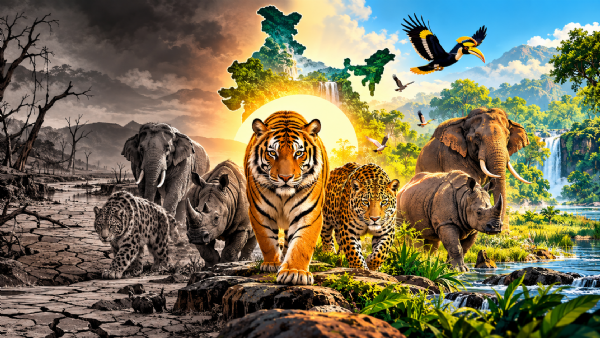
For over a century, the primary threat to the subcontinent's iconic big cats was not ecological change, but systematic destruction. When the British Empire consolidated its rule over India, it institutionalized big-game hunting on an industrial scale. British colonizers framed the tiger not as a vital apex predator, but as a dangerous impediment to civilization and a coveted trophy of imperial dominance. Officers, aristocrats, and civil servants treated the Indian wilderness as a shooting gallery. Historical records reveal that between 1875 and 1925 alone, over 80,000 tigers were systematically slaughtered under British colonial bounty programs and sporting expeditions. Entire habitats were cleared, and local ecosystems were depleted to supply imperial hunting parties.
By the time India achieved independence in 1947, a landscape that had once harbored an estimated 100,000 tigers at the turn of the century was severely depleted. The carnage continued unabated through post-independence trophy hunting and habitat encroachment. By the early 1970s, the national tiger count plummeted to fewer than 2,000 animals. The Asiatic lion was in an even more precarious position, pushed back into a single sanctuary in Gujarat’s Gir forest with only a few dozen survivors. The one-horned rhinoceros was similarly reduced to a fragile remnant in the floodplains of Assam, while the Asiatic cheetah was officially declared extinct on Indian soil in 1952. The numbers were small enough that extinction felt less like a risk and more like a countdown.
India’s wildlife story is one the world should be talking about.
— Sameer (@BesuraTaansane) October 5, 2026
Since 2014:
🐅 Tigers: 2,226 → 3,682 (+65%)
🦁 Asiatic lions: 523 → 891 (+70%)
🐆 Leopards: 7,910 → 13,874 (+75%)
🦏 Greater one-horned rhinos: 4,000+ in Assam, with India holding the vast majority of the…
The turning point arrived with a decisive shift in national policy. In 1972, India passed the Wildlife Protection Act, effectively outlawing hunting and laying down strict legal protections. A year later, in 1973, Project Tiger launched a bold attempt to safeguard not just individual animals, but whole, interconnected ecosystems.
What happened next was slow, unglamorous work. The idea was to protect not just the animal but the forest and the prey it depends on. A national authority and a wildlife crime bureau were created, villages inside core forests were offered voluntary relocation with compensation, and scientists began counting animals properly. Camera traps, many placed in forests where no person could stay for long, started recording individual tigers by their stripes, replacing guesswork with evidence. But the real change took place after 2014.The results now show in the data.
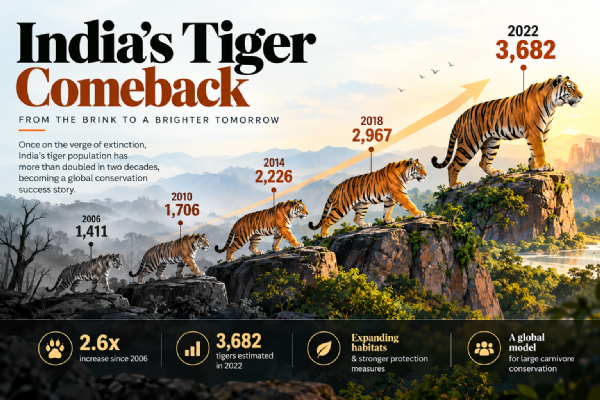
Since 2014, India's tiger population has climbed from 2,226 to 3,682, a rise of about 65 percent. That means India holds roughly three of every four wild tigers on Earth, in a country of 1.4 billion people. Behind the numbers sits a quieter expansion of space: tiger reserves have grown from 50 to 58, and protected areas from 981 to 1,134. Each new boundary on the map meant more room for animals to breed, hunt and move.
The tiger is only one chapter, and the Asiatic lion's story is arguably more fragile. India is still the only country in the world where this lion lives wild. Villagers around Gir have shared their land with the big cats for generations, and the growth from 523 to 891 lions, about 70 percent, shows what that coexistence can achieve. Lions now wander beyond the forest into coastal belts and farmland, regaining ground they lost long ago. Scientists still stress the need for a second home, because a species confined to one place is always one disease or disaster away from trouble.

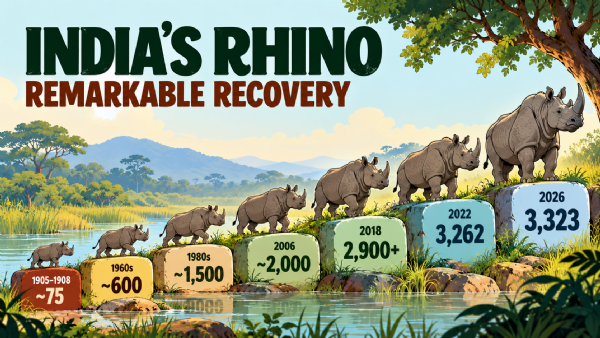
In Assam, the greater one-horned rhino now numbers more than 4,000, and India holds the vast majority of the world's population. Kaziranga has become a symbol of what sustained anti-poaching effort can do. An animal once reduced to a few hundred has been pulled back through patrols, protected grasslands and constant vigilance against those who hunt it for its horn.
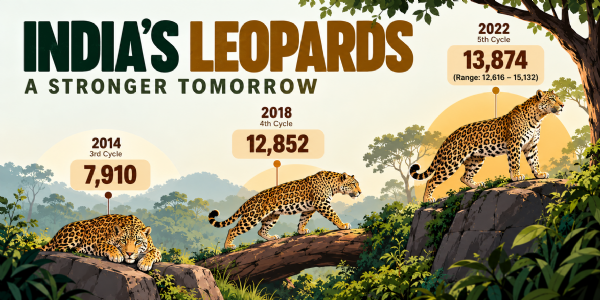
The leopard's rise is perhaps the most surprising of all. Adaptable and secretive, leopards slip through farmland and the edges of towns, and their numbers have climbed from 7,910 to 13,874 in under a decade. That growth is a sign that the benefits of conservation are spilling beyond the famous reserves into the wider countryside.
Then came a bold experiment. The cheetah was declared extinct in India in 1952. In September 2022, cheetahs from Namibia arrived at Kuno National Park in Madhya Pradesh, followed by more from South Africa in 2023. Moving big cats across continents is hard, and the project has faced setbacks as well as births. But cubs have been born on Indian soil, and the programme is still unfolding. It shows a country willing to repair an old loss and not only protect what remains.
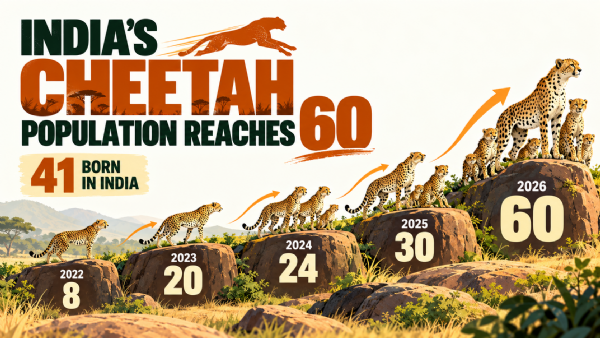
Another historic and joyous milestone for Project Cheetah! 🐆❤️
— Bhupender Yadav (@byadavbjp) October 5, 2026
KJP21, a 32-month-old Indian-born female cheetah, has given birth to five healthy cubs in Kuno National Park today.
KJP21 is the third Indian-born female cheetah to give birth, after Mukhi and KGP12—an important… pic.twitter.com/j9mc9E5SMO
What makes this story convincing is that it is not built on slogans. It rests on counted animals, protected habitat, trained rangers, technology and political commitment that has lasted across governments. Communities have been part of it too, through ecotourism income, compensation schemes and a long cultural tradition of respecting forest life.
None of this means the work is finished. Roads, mining, farming and growing cities keep squeezing wild spaces, and more animals need more room. But for now, the world has something rare to look at: a crowded, fast-growing country that chose to make space for its giants. If India can bring tigers, lions, rhinos and elephants back from the brink, the lesson is simple and hopeful. Extinction is not inevitable. It is, very often, a choice, and India has chosen otherwise.