Tripura Ballot Box Speaks: Opposition’s Narrative Faces a Reality Check
There is another lesson.
Total Views |


The latest election results from Tripura have produced a political message that deserves attention beyond the tribal belt of the Northeast. The 2026 Tripura Tribal Areas Autonomous District Council (TTAADC) Village Committee elections were conducted through traditional ballot papers and ballot boxes, not EVMs. Yet the result once again left the principal non-BJP Opposition parties CPI(M), Congress and other marginal forces — with little political recovery to show.
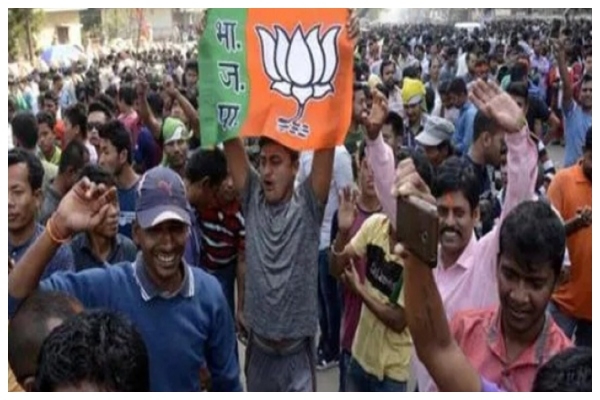
The final figures are striking. Tipra Motha won 3,428 seats and the BJP 859. CPI(M) won 87, while Congress managed only 14. Independent candidates secured 173 seats and IPFT won 33. Tipra Motha obtained majorities in 457 Village Committees, while the BJP secured majorities in 94. Congress did not secure a majority in any Village Committee.
The Opposition cannot simply dismiss this as an electoral exercise dominated by uncontested seats. Of the 4,597 seats, 2,950 actually went to polling after 1,644 candidates were elected unopposed. In the contested seats, Tipra Motha again maintained a substantial lead.
This is where the ballot-paper factor becomes politically relevant. For months, sections of the Opposition have attempted to make the Election Commission, electoral machinery and voting process central political issues. Congress leaders have publicly targeted Chief Election Commissioner Gyanesh Kumar, alleging manipulation, intimidation and erosion of democratic rights. The Tripura Congress itself staged a protest demanding action against the CEC and accused the BJP government of undermining the electoral process. These remain political allegations made by the Opposition, not established findings.
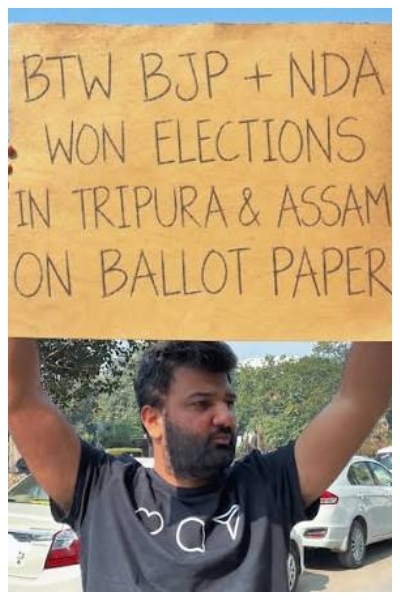
But Tripura introduces an awkward question into that narrative: when voters were given ballot papers instead of EVMs, why did the political fortunes of the Opposition not improve? The answer cannot automatically be attributed to voting technology. Ballot papers do not manufacture political support any more than EVMs do. They merely provide a different mechanism for recording the voter's choice. The Tripura result therefore shifts attention back to the more fundamental question of politics - what are voters actually choosing?
The CPI(M) has a particularly difficult problem. Tripura was once one of the Left's strongest political bastions. The party governed the state for decades. Yet in these village committee elections it secured only 87 seats, despite fielding a substantial number of candidates. Its vote share was reported at around 12.9 per cent, but that translated into a relatively small number of seats.
Congress faces an even sharper organisational challenge. It won only 14 seats and failed to secure a majority in even one Village Committee. This is not the electoral footprint of a party that has successfully rebuilt itself at the grassroots. The result also demonstrates the importance of regional political organisation. Tipra Motha's extraordinary performance cannot be explained simply through the BJP-versus-Opposition framework. It is a tribal-based regional party with its own political identity and organisational network. Its victory in 3,428 seats shows that voters in the ADC areas responded strongly to that regional mobilisation. Its alliance with the BJP further complicated the traditional Opposition's attempt to portray every election simply as a two-sided BJP-versus-rest contest.
There is another lesson. Elections are ultimately about voters, not political narratives. An opposition party can hold press conferences, organise demonstrations and question institutions. It can allege that the electoral system is defective. But those allegations do not automatically become public opinion.
The Tripura ballot paper has therefore become an important political reality check. The larger issue is the Opposition's inability to confront its own organisational and political weaknesses. CPI(M) is struggling to recover a lost political base. Congress remains weak at the grassroots. Other Opposition formations have yet to establish a durable alternative structure. Meanwhile, Tipra Motha has demonstrated the power of regional mobilisation, while the BJP retains a significant organisational presence.
Tripura thus sends a simple message from the ballot box: political credibility cannot be manufactured by attacking electoral institutions. It has to be earned from voters. The ballot paper has spoken and the Opposition still has to explain why the voters did not speak in its favour.