FCRA: A Judicial Hammer Blow to Its Opponents
The trust had sought FCRA registration while maintaining that its activities were not religious
NewsBharati 08-Oct-2026 13:06:09 PM
Total Views |


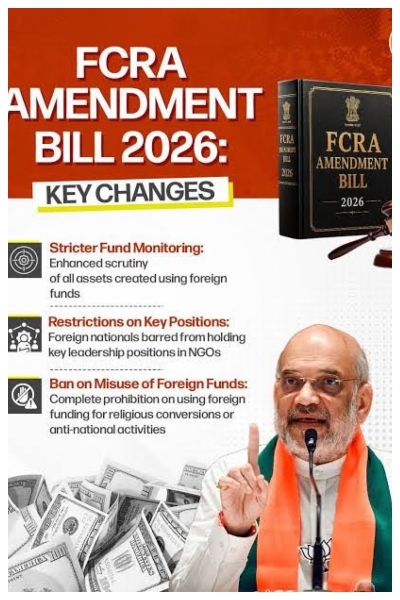
The Madras High Court’s judgment upholding the rejection of FCRA registration to the Kanzeon Public Charitable Trust has significant implications for the continuing debate over foreign funding, religious activity and the proposed strengthening of the Foreign Contribution (Regulation) Act. At its core, the judgment affirms a simple principle - an organisation seeking foreign money cannot conceal or misrepresent the nature of its activities. The Court has also underlined that receiving foreign contribution is not a vested or absolute right; at best, it is a privilege subject to statutory regulation.
The case concerned a trust running a Montessori school and a Zen meditation centre at Kodaikanal. The trust had sought FCRA registration while maintaining that its activities were not religious. The Madras High Court, however, found that the trust itself claimed adherence to Zen Buddhist philosophy and that its application therefore had to correctly disclose its religious character. The Court held that the authorities were justified in rejecting the application and dismissed the appeal.
The significance of the judgment goes beyond the individual trust. The Court made it clear that the FCRA does not prohibit religious organisations from seeking registration. What it demands is candour. The prescribed application itself requires an organisation to identify whether it is religious, cultural, educational, economic or social and, where applicable, its religious category. There can be no selective disclosure when foreign money is involved. The Court's formulation that an applicant must make a “clean breast of everything” and that this is “no game of hide and seek” goes to the heart of the regulatory principle.
More importantly, the judgment directly addresses religious conversion. The Court observed that the statutory restriction applies across religions. It specifically stated that even a fundamentalist Hindu organisation engaged in Ghar Wapsi could not be granted FCRA registration. In other words, the principle is not designed to target one religion. If foreign funds are used to facilitate conversion in a manner covered by the Act, the same regulatory standard applies irrespective of the religious identity of the organisation. The Court linked unrestricted foreign funding for conversion with a potential threat to national sovereignty, making clear that foreign contribution cannot be treated merely as a private financial transaction divorced from its wider social and national consequences.
The Court’s observations on Abrahamic religions have inevitably attracted attention. It observed that, unlike Hinduism, which it described as inclusive, Abrahamic religions are inherently exclusive, adding that devout Jews, Christians and Muslims believe theirs to be the one true and complete revelation. These are broad theological observations made in the course of examining the statutory issue, and reasonable people may debate their formulation or applicability.
One may particularly differ with the Court’s treatment of the Buddhist or Zen dimension of the case. But that disagreement should not obscure the larger issue. The judgment is fundamentally about transparency, foreign funding and the State’s legitimate authority to ensure that money originating outside India does not become an instrument for activities capable of disturbing social harmony or affecting sovereignty.
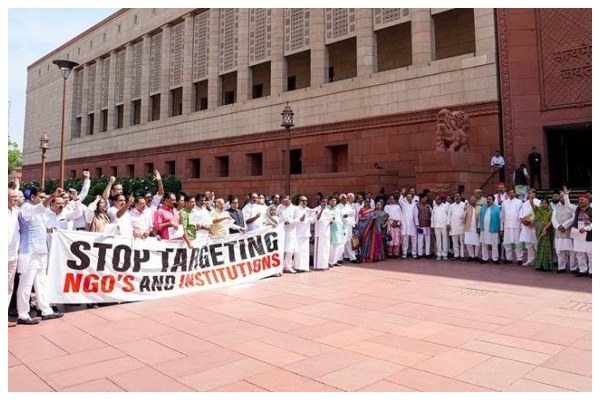
This is precisely why those campaigning against tighter FCRA regulation need to engage with the substance of the judgment rather than dismissing every regulatory measure as an assault on civil society. Christian missionary organisations, in particular, have faced continuing public scrutiny over conversion-related activities and foreign funding. That does not justify treating every Christian organisation as suspect, nor does the present judgment establish such collective guilt. But sustained concerns surrounding foreign-funded religious activity cannot simply be wished away. Organisations opposing amendments must answer the legitimate question: why should greater transparency, disclosure and accountability be objectionable?
The Court has also drawn an important distinction between religious activity and the dissemination of Indian Knowledge Systems. Organisations principally engaged in teaching Vedanta, the Bhagavad Gita, the Upanishads, Yoga and allied subjects may ordinarily fall within educational or cultural categories rather than automatically being treated as religious organisations. The judgment therefore does not create a blanket prohibition on foreign-funded cultural or educational activity.
The larger lesson is unmistakable. Foreign contribution carries obligations along with opportunities. A sovereign country has every right to know who is receiving foreign money, from where it comes, how it is being used and whether the recipient has accurately disclosed its objectives and activities. The FCRA is precisely the mechanism through which that accountability is exercised.
The Madras High Court has now provided judicial reinforcement to that principle. Whatever one's view of individual observations in the judgment, its central message cannot reasonably be ignored - foreign funding is not an entitlement, religious activity must be honestly disclosed, and money crossing India's borders cannot be allowed to operate beyond the scrutiny of Indian law. That is not hostility towards religion or civil society. It is the basic logic of sovereignty, transparency and regulatory accountability.
Those opposing the FCRA amendments must now answer a basic question - what exactly are they seeking to protectthe right to genuine charity and social service, or the freedom to receive foreign money without adequate scrutiny? The Madras High Court has made the principle clear - sovereignty cannot be compromised in the name of unrestricted foreign funding, and religious activity cannot be hidden behind institutional labels. If organisations have nothing to conceal, greater disclosure should cause no anxiety. The louder the opposition to transparency, accountability and regulatory safeguards, the more urgent it becomes for Parliament to examine why such safeguards are being resisted.

Editor's Desk
Editor's Desk