Jute: How India’s Golden Fibre Supports Farmers, Industry and Sustainable Development
The government has introduced several measures to support jute farmers, improve productivity and expand the market for jute products.
NewsBharati 09-Oct-2026 16:03:58 PM
Total Views |


Jute, often called the “Golden Fibre” because of its natural golden colour and economic value, remains an important part of India's agricultural and industrial economy. India is the world's largest producer of raw jute and a leading producer of jute goods. The fibre supports millions of livelihoods, provides raw material to industries and offers a biodegradable alternative to several synthetic materials.
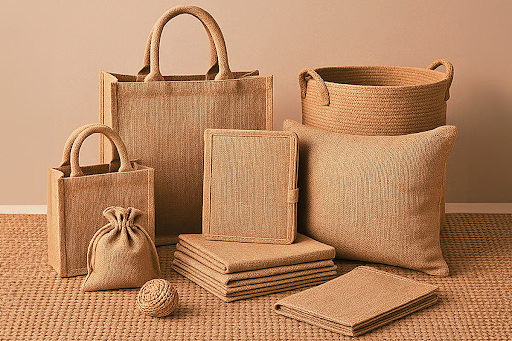
India produced 76 lakh bales of raw jute and 12.80 lakh metric tonnes of jute goods in the financial year 2025–26. The country exported 22,700 metric tonnes of raw jute worth Rs. 225.11 crore and 1,71,300 metric tonnes of jute goods valued at Rs. 3,155.27 crore during the same period.
What Makes Jute Important?
Jute is a natural fibre obtained from plants that grow mainly in hot and humid conditions. It is widely used to manufacture gunny bags, ropes, sacks, carpets, furnishing materials and other industrial products.
The fibre is biodegradable, recyclable, strong and relatively inexpensive. It can also absorb moisture and provide thermal and sound insulation, making it useful in several applications beyond traditional packaging.
Jute is increasingly being used in geotextiles, which are materials used in construction and environmental protection. Jute geotextiles help control soil erosion, stabilise slopes, protect riverbanks and support road construction. Since the material naturally decomposes, it can also contribute to soil improvement over time.
A Major Source of Rural Livelihoods
The jute industry plays an important role in employment and rural income. According to the PIB, the sector provides direct employment to approximately 3.70 lakh workers in organised mills and diversified jute units. It also supports nearly 40 lakh farming families engaged in jute cultivation.
West Bengal is the main centre of India's jute industry, followed by states such as Bihar, Assam, Odisha and Jharkhand in cultivation. As of December 2025, India had 120 composite jute mills, of which 89 were located in West Bengal.
🧵 Strengthening India’s Golden Fibre | A New Chapter for the Jute Sector! ✨
— OFFICE OF THE TEXTILE COMMISSIONER (@txcindia) October 6, 2026
Smt. Vrunda Manohar Desai, IRS, Textile Commissioner, Government of India, Mumbai, has taken over the additional charge of Jute Commissioner, Ministry of Textiles, Government of India.
Her leadership… pic.twitter.com/PsiE7WWG2r
'
Jute is generally sown between March and April and harvested within approximately 100–110 days. Its cultivation depends on suitable rainfall, humidity and temperature, making eastern and northeastern India important production regions.
Government Support for Farmers and Industry
The government has introduced several measures to support jute farmers, improve productivity and expand the market for jute products.
For the financial year 2026–27, the minimum support price (MSP) of raw jute has been fixed at Rs. 5,925 per quintal. This is an increase from Rs. 2,400 per quintal in 2014–15. The Jute Corporation of India is the designated agency responsible for implementing the MSP policy by purchasing raw jute directly from farmers when market prices fall below the support price.
The National Jute Development Programme, implemented through the National Jute Board, supports improvements in cultivation, fibre quality, processing and product diversification. Its initiatives include training, improved farming methods, machinery support and assistance to small manufacturers and artisans.
The JUTE-ICARE scheme, launched in 2015–16, promotes scientific cultivation, better retting techniques and mechanisation to improve fibre quality and productivity.
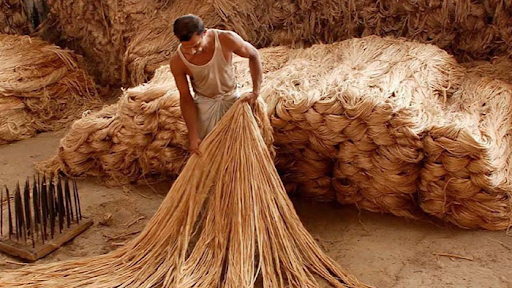
The government has also mandated jute packaging for 100% of foodgrains and 20% of sugar, creating a market for jute bags and supporting demand for the fibre.
Expanding Beyond Traditional Uses
India is exploring new applications for jute in construction, agriculture, fashion and environmentally friendly consumer products. Jute-viscose blended clothing developed for India's contingent at the 2026 Commonwealth Games also highlighted the potential of innovative jute-based textiles.
The sector's future depends on improving fibre quality, modernising production, developing new products and expanding domestic and international markets.

Kajal Bhalerao
Kajal Bhalerao is currently pursuing Mass Communication and Journalism in B.Voc.