Why the INDI Alliance Keeps Rural Taps Dry to Block Modi’s Antyodaya
INDI alliance parties treat public welfare as a zero-sum turf war. Their message to the marginalized is chillingly transparent: Your survival, your thirst, and your dignity matter far less than their political narrative.


“When governance is trapped in the narrow prison of ego, political malice takes precedence over human mercy, and the basic amenities of the poor become hostage to a game of credit.”
Those words sound heavy until you see what they cost. In Chatra, they cost a bucket of water. Walk through Giddhaur block in Chatra, Jharkhand, and the tragedy is right there in broad daylight. Nobody is hiding it. A multi-crore project stands in the open: the Centre's flagship Jal Jeevan Mission, Har Ghar Jal. Today it is a monument to official apathy. Water towers worth crores rise over cracked earth. Pipes lie half-buried and forgotten. Thousands of families repeat the same punishing routine every day. They walk miles under a scorching sun for a single bucket of muddy water.
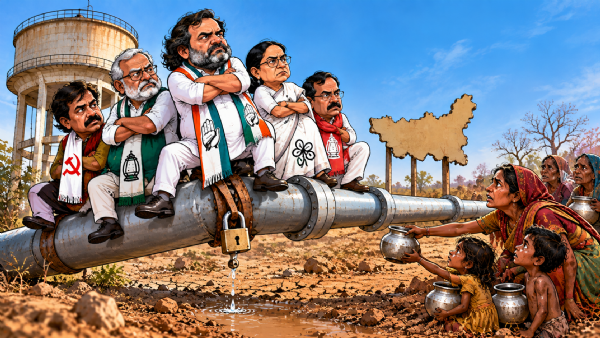
It has been years since the rollout. The people of Chatra now ask one plain question. Where is the water?
If you look closely at ground reports and viral video dispatches from these interior villages, the reality is heart-wrenching: women and children are seen scrambling around small, hand-dug earth pits, desperately scooping up muddy, stagnant seepage just to sustain their daily lives.
📍Chatra, Jharkhand
— Rishi Bagree (@rishibagree) October 8, 2026
Since it’s an INDI alliance-ruled state, they didn’t implement the Modi govt’s Jal Jeevan Yojana properly because they didn’t want the BJP to get the credit.
They want you to stay like this so that you keep voting for their poverty porn. https://t.co/BdQrhTMDKG pic.twitter.com/LigOXi7wQx
The answer is not a technical snag, and it is not a shortage of central funds. It sits in the politics of the state capital. In states run by the INDIA alliance, a habit has set in. When a scheme comes with Delhi's stamp on it, regional leaders break out in a political allergy. Their reasoning is small and cold. If the poor get clean water from a central scheme, who takes the credit?
It is easy to brush off localized delays as routine red tape, but macro-level data tells an undeniable story of institutional foot-dragging. Ground reality tracking indicates that Jharkhand continues to lag significantly behind the national average in rural tap water connectivity. While the national average for the Jal Jeevan Mission has soared past milestones nationwide, regional execution in non-NDA pockets frequently hits an administrative roadblock.
The national picture is easy to state. Rural tap water coverage under Jal Jeevan Mission has crossed 82 per cent, up from under 17 per cent in 2019. Jharkhand is nowhere near that. The CAG's audit, tabled in the state Assembly in August, found that only 55 per cent of rural homes had a working tap by March 2025, against 80 per cent nationally. The same report says the state approved 98,067 schemes and finished 27,249 of them by December 2024. Twenty-seven thousand done. Seventy thousand still waiting. In March this year, the Centre told Parliament that Jharkhand is among the states where more than 40 per cent of rural households still have no tap water.
The gap inside the state is just as telling. One analysis of the JJM dashboard found Simdega at 92.72 per cent, while Pakur sat at 12.75 per cent and Godda at 19.16 per cent. Same state. Same scheme. Same funds. One district got its water and others got files. That is not what a technical bottleneck looks like. That is what a choice looks like.
Think about the sum the INDIA alliance seems to be doing. A scheme built in Delhi carries the Prime Minister's name. If it works smoothly, the family at the end of the pipe knows where the pipe came from. So why hurry? A late tap costs the ruling party nothing. The woman carrying the pot pays all of it.
It is not only water. The same audit found that Jharkhand's slow paperwork under PMAY-G left 6.32 lakh eligible households out of the housing scheme. These were families the state itself had listed. On health, Jharkhand had issued just 23,028 Ayushman Vay Vandana cards for senior citizens by February 2025. And in October 2024, the ED searched more than 20 locations in Ranchi in a money laundering probe tied to alleged irregularities in Jal Jeevan Mission. The state called it political. A court will decide. But a drinking water scheme should not be in a laundering file at all.
Now widen the lens. In October 2024, the Prime Minister said Delhi and West Bengal were staying out of Ayushman Bharat because of their political interests, and he apologised to the elderly there. Delhi signed on in April 2025, after the BJP came to power, leaving West Bengal as the only state outside the scheme. Bengal followed this June, once its government changed. The Union health minister blamed the earlier government for repeatedly saying "hobe na." This was not a new fight. Years earlier, a petition reached the Supreme Court, which issued notice to Delhi, Telangana, Odisha and West Bengal over their refusal to implement the scheme.
INDI alliance parties treat public welfare as a zero-sum turf war. Their message to the marginalized is chillingly transparent: Your survival, your thirst, and your dignity matter far less than their political narrative. They sit on high tables, playing high-stakes poker with people's lives, while rural families pay the ultimate price in water-borne diseases, sweat, and endless misery.
They would rather watch rural women break their backs walking miles for muddy puddles than allow the BJP’s Antyodaya vision reaching the very last person at the bottom of the pyramid to succeed.
Let’s look at this administrative paralysis for what it really is. It isn’t a clerical error or a routine delay, it is a calculated design to keep people desperate. When you deliberately choke central welfare schemes, you ensure that the grassroots remain trapped in a permanent cycle of struggle. Think about the logic: an emancipated, self-reliant voter stops falling for identity bait and actually starts asking tough questions about governance. For the regional satraps in the INDIA alliance, keeping the poor thirsty isn't a failure of administration; it is the core of their political survival strategy.