Safeguarding Democracy: Why the Opposition’s Assault on the Election Commission and SIR is a Recipe for Anarchy
In a judgement delivered by a bench led by Chief Justice of India Justice Surya Kant, the Supreme Court has ruled that the SIR exercise advances the constitutional imperative of free and fair elections and does not reverse the presumption of citizenship.
Total Views |


In any robust democracy, the sanctity of elections forms the ultimate bedrock of national sovereignty. When the mechanism that translates the collective will of the world’s largest electorate of over a billion citizens into a functional government is systematically attacked for partisan survival, it ceases to be political dissent and metastasizes into an assault on the nation itself.
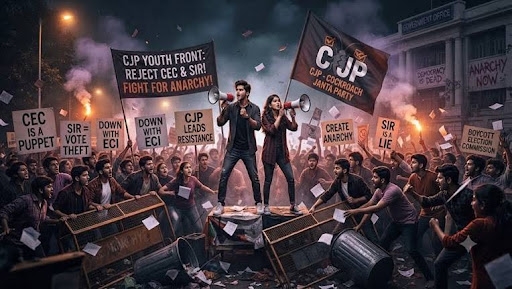
The ongoing manufactured outrage orchestrated by opposition parties, the INDIA bloc, and peripheral pressure groups such as the so-called "Cockroach Janta Party" (CJP) against Chief Election Commissioner (CEC) Gyanesh Kumar and the Special Intensive Revision (SIR) of electoral rolls represents a dangerous low in Indian public life. Behind the veneer of defending civil liberties lies a coordinated campaign designed not to protect democracy, but to manufacture widespread anarchy, delegitimize constitutional institutions, and cast unmerited doubt on the foundational integrity of India's electoral architecture.
The Imperative of Electoral Purity: Demystifying the SIR
To understand why the current protests are profoundly misguided and malicious, one must first examine the core mechanics and necessity of the Special Intensive Revision (SIR). Operating under the expansive mandate of Article 324 of the Constitution of India and Section 21(3) of the Representation of the People Act, 1950, the Election Commission of India (ECI) is duty-bound to maintain clean, accurate, and error-free electoral rolls.
In a judgement delivered by a bench led by Chief Justice of India Justice Surya Kant, the Supreme Court has ruled that the SIR exercise advances the constitutional imperative of free and fair elections and does not reverse the presumption of citizenship.
Over time, any electoral database accumulates systemic flaws. Rapid urbanization, internal demographic migration, duplicate registrations across state boundaries, and the unfortunate reality of deceased individuals remaining on voter lists distort the true mandate of the electorate. The SIR is a comprehensive, time-bound administrative exercise executed through meticulous house-to-house enumeration by Booth Level Officers (BLOs). Its fundamental objective is straightforward: ensure that no eligible citizen is disenfranchised, and no ghost or ineligible voter remains on the rolls.
Before a final roll is published, the ECI provides a window for public review. No name is deleted from the draft roll without issuing a show-cause notice and providing a reasonable opportunity for a hearing. If an individual’s name is deleted from the electoral roll due to doubt during the SIR, he has a multi-tier statutory remedy and judicial recourse available.
When political figures describe this clean-up as "vote theft" or an attempt at disenfranchisement, they insult the intelligence of the Indian voter. A bloated, inaccurate voter list does not serve democracy; it compromises it. By rooting out anomalies, the ECI reinforces the sacred democratic tenet of "one person, one vote".
Historical Precedent: SIR as a Time-Tested Administrative Standard
The opposition’s core narrative rests on a deliberate falsehood: that the current SIR is an unprecedented, malicious tool cooked up overnight to serve partisan ends. History tells an entirely different story. Intensive and special revisions of electoral rolls have been a routine, recurring feature of Indian electoral management since the very dawn of the Republic. Between 1951 and 2004, this exercise has been conducted eight times prior to the current cycle.
The Post-Independence Era (1952–1956): Under India’s first Chief Election Commissioner, Sukumar Sen, intensive revisions were mandated immediately after Partition and the first general election to account for massive population movements and correct omissions, particularly of women whose names had not been recorded during initial enumerations.
The Decadal Standard (1957–1966): Throughout the 1950s and 1960s, the ECI regularly ordered intensive revisions of fractions of state areas annually to keep pace with rapid border migrations and shifting urban demographics.
The Seshan Era (1992–1995): Under the legendary CEC T.N. Seshan, comprehensive summary and intensive revisions were deployed alongside the introduction of Electoral Photo Identity Cards (EPIC) to overhaul a compromised system.
The 2002–2004 Cycle: A massive, multi-phased "special revision of an intensive nature" was carried out across various states to cleanse legacy databases well before modern technological integration.
The current cycle of SIR is being carried out after a gap of over two decades. After this unexplained delay, to label the 2026 nationwide SIR exercise as an "autocratic conspiracy" is to display historical illiteracy or, worse, deliberate deceit. The ECI is merely executing an administrative duty that previous commissions have performed for over seven decades whenever demographic shifts demanded structural calibration.
Manufacturing Anarchy: The Political Theatre of the CJP and Opposition
Despite the clear legal framework and historical precedent, political opportunists and digital influencers have transformed a standard administrative correction into a spectacle of civil disobedience. The protests spearheaded by opposition stalwarts alongside fringe civil society outfits like the CJP—featuring synchronized rallies in Mumbai, Bengaluru, and New Delhi—are not spontaneous expressions of public grief; they are calculated exercises in political theatricality.
We have witnessed absurd spectacles: leaders scaling barricades, staging prolonged sit-ins complete with specialized food deliveries, hurling vulgar personal abuses at constitutional authorities, and weaponizing courts to grind governance to a halt. Prominent actors, YouTubers, and dynasty-led political parties have banded together under hollow slogans, claiming that the ECI is acting as a puppet. This is nothing but a preemptive alibi-building.
When political formations realize they cannot connect with the grassroots aspirations of a rising, confident Indian youth, they resort to discrediting the referee. By attacking CEC Gyanesh Kumar personally, demanding his resignation, and painting a transparent verification process as a fascist plot, these entities are laying the groundwork to cry "rigged election" whenever the electorate rejects them. It is a textbook recipe for creating social unrest, eroding public trust in state institutions, and plunging the nation into avoidable anarchy.
National Sovereignty and Institutional Resilience
A nation is only as strong as the reverence it accords to its constitutional pillars. The Judiciary, the Armed Forces, and the Election Commission are the tridents of Indian democracy. When political actors turn these institutions into punching bags for daily headlines, they strike directly at the heart of national stability.
The nation demands that we look beyond short-term political posturing and stand up for institutional autonomy. The ECI owes its allegiance to the Constitution of India—not to any individual, political party, or transient government. By attempting to intimidate election commissioners through kangaroo "people's tribunals" and street agitations, the opposition is setting a dangerous precedent where independent regulators can be bullied into submission by mob pressure.
The Indian citizen sees through this smokescreen. The public recognizes that a clean electoral roll protects their individual franchise from being diluted by ghost voters and illegal entries. They recognize that stability and order are prerequisites for economic growth and national progress.
The protests against the CEC and the Special Intensive Revision are destined to fail because they are built on a foundation of manufactured panic and political desperation. History will record these agitators not as defenders of democracy, but as obstructionists who tried to burn down the house of cards they built when the electoral winds stopped blowing in their favor.
True democratic participation requires respecting the rules of the game, honoring administrative continuity, and trusting the collective wisdom of the Indian electorate. It is time for the nation to reject this orchestrated chaos, uphold the authority of the Election Commission, and march forward toward a cleaner, stronger, and more transparent democratic future.