Yugo Sako once said, “Because Ram is God, Animation was the best medium...”; Has Bollywood proven him right?
As Sasaki humbly remarked, his greatest wish was simply that Indians would embrace the film and say, "This is my favourite Ramayana". Decades later, against the noise of modern CGI extravaganzas, his wish stands fulfilled.
NewsBharati 13-Nov-2026 20:21:46 PM
Total Views |


As Nitesh Tiwari’s mega-budget ‘Ramayana: Part 1’ dominates festive multiplex schedules across India, the cinematic conversation has sharply divided audiences. While box office registers ring loudly, sharp criticism has emerged over artificial-looking VFX, pacing issues, and a perceived lack of spiritual depth. Amid this debate, millions of Indians find themselves returning to an unlikely cultural touchstone: the 1993 Indo-Japanese animated classic, ‘Ramayana: The Legend of Prince Rama’, co-directed by Japanese filmmaker Koichi Sasaki, producer Yugo Sako, and Indian animation pioneer Ram Mohan.
In order to understand why a 33-year-old hand-drawn anime commands deeper reverence among Dharmic audiences than modern multi-crore spectacles, it is important to examine the extraordinary devotion of its Japanese creators.
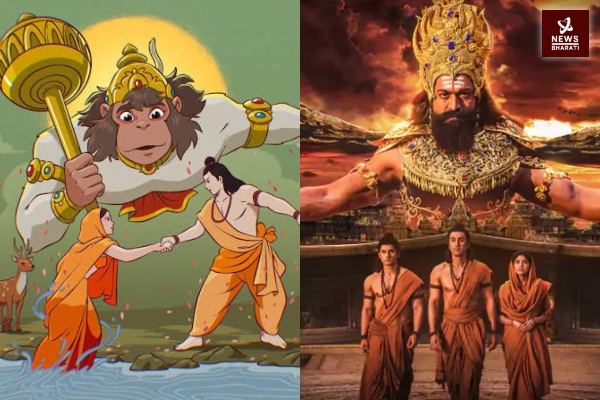
The project was born in 1983 when producer Yugo Sako visited India to film a documentary titled ‘The Ramayana Relics’, covering archaeological excavations led by renowned ASI Director General Prof. B.B. Lal at sites linked to the epic. Deeply moved by India’s living civilizational heritage, Sako read ten Japanese translations of Valmiki’s Ramayana. He quickly realized that live-action cinema could never do justice to Maryada Purushottam. In his own words, "Because Ram is God, I felt it was best to depict him in animation, rather than by an actor". Sako was equally thrilled by the epic's larger-than-life grandeur; Hanuman uprooting a mountain, the valour of Jatayu, and the righteous war against Ravana, which he recognized as the true fabric of universal legend.
Sako brought in veteran anime director Koichi Sasaki for the task to execute this sacred vision. For Sasaki, animation was not merely a children's medium; it was a vessel capable of conveying divine grace and emotional nuance without human vanity. Working alongside Ram Mohan, widely revered as the ‘Father of Indian Animation’, Sasaki oversaw a massive team of over 450 artists who painstakingly crafted nearly 100,000 hand-drawn cels. Rejecting shortcuts, the team chose traditional hand-drawn art specifically to preserve human warmth and spiritual dignity.
Mastering the cultural and scriptural nuances of Sanatan Dharma required rigorous Indo-Japanese collaboration rather than superficial appropriation. While Sasaki and his Japanese team handled storyboarding, fluid movement, and battle choreography, drawing inspiration from the kinetic energy of Studio Ghibli’s Nausicaa, they relied entirely on Indian masters for cultural authenticity.
Legendary poet and lyricist Narendra Sharma, alongside screenwriter Rani Burra, shaped the narrative directly from Valmiki’s text. Pune-based architects Nachiket and Jayoo Patwardhan contributed initial concept designs, while Maestro Vanraj Bhatia composed a soul-stirring score rooted in Indian classical traditions.
Sasaki himself emphasized that visual craft alone could not carry the epic. Reflecting on the film’s enduring legacy ahead of its 4K theatrical re-release, Sasaki stated, "We are proud of the high level of animation that was achieved, including movement, timing, and character expressions. A film is not only about the visuals. It's only with sound and lively dialogue that a film shines. The sound for this film was created 100% in India. I feel it's a wonderful sound of the best of India".
Ironically, in the early 1990s, the project faced initial skepticism in India from groups worried that foreign animators might trivialize Hindu deities. Yet, once released, the sheer sincerity of Sasaki, Sako, and Mohan silenced all doubts. Without resorting to crass commercialization or modern distortions, they delivered a timeless tribute to Dharma. As Sasaki humbly remarked, his greatest wish was simply that Indians would embrace the film and say, "This is my favourite Ramayana". Decades later, against the noise of modern CGI extravaganzas, his wish stands fulfilled.
Himali Nalawade
Himali Nalawade is associated with News Bharati as an Author since a considerable period. She is mostly linked with researched articles from the areas of Defence, Defence Infrastructure and Culture-Religion. Along with her Masters in Mass Communication and Journalism after her graduation in History, she has also studied Diploma in Underwater Archaeology and Diploma in Indology.