1984: A Far-Reaching Model of the Politics of Violence
Terrifying slogans such as "Blood for Blood" continued to spread fear through the streets of Delhi. Could such an organised operation have been carried out so quickly in 1984 without a pre-planned conspiracy?
Total Views |


Prior to the assassination of former Prime Minister Indira Gandhi, only the murder of Mahatma Gandhi was followed by community-specific targeted violence. Even Tamils were not targeted after the assassination of Rajiv Gandhi. Unlike most communal riots, Hindu-Sikh riots are never witnessed after this genocide. This makes it important to study the model that lay behind the violence of 1984.
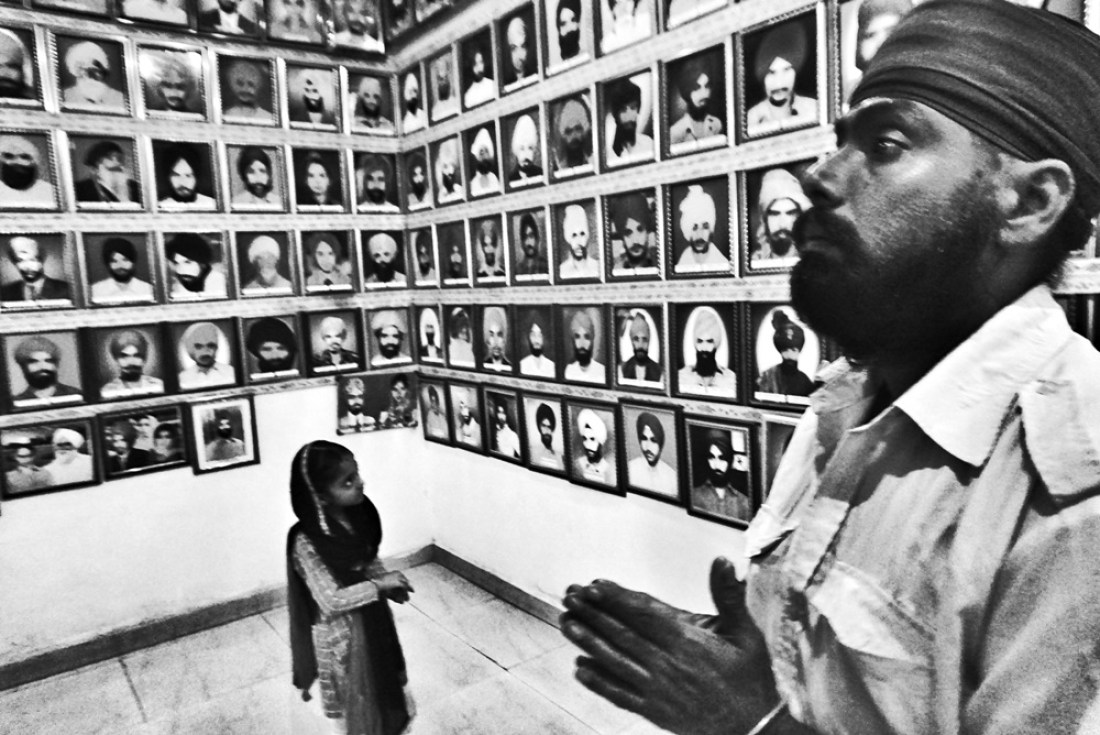
Since after the partition, the political conflict between the Akali Dal and Congress began with the Punjabi Suba Movement. Later, during the Emergency, Indira Gandhi faced one of her strongest challenges from Punjab, alongside Bihar. It is often said in Punjab's political circles that Indira Gandhi took this challenge as a personal rivalry. She continued to pursue wrong policies, a view shared by most historians. Her biggest mistake was the unnecessary use of military force at Sri Harmandir Sahib.
After Operation Blue Star, the government remained in action. By bringing the media completely under its control, the Congress government continuously tried to establish that the military operation was unavoidable. The Congress government's control over the media had a major impact on public discourse.
Congress leaders describing Sri Harmandir Sahib as a "fortress of terrorism", an "arsenal", a "battlefield", and so on was an act that deeply hurt a large section of society. At the same time, the narrative that Sikhs would certainly avenge the attack was repeatedly emphasised. By giving momentum to the narrative of “Sikh retaliation”, the Congress party played a significant role in increasing bitterness and mistrust within society. Indira Gandhi herself stated on 30th October that she did not care whether she lived or was killed. However, the assassination of Indira Gandhi next morning pushed the country into an even deeper crisis. She was assassinated by her own bodyguards, Satwant Singh and Beant Singh.
The Congress party could have taken some time to choose its next leader. It could have followed a democratic process. The government could have set an example by taking firm action against terrorism in Punjab. But the Congress party reacted to everything in haste and in a reactionary manner. Rajiv Gandhi was sworn in as Prime Minister on the very night of 31st October.
News broadcasts on Doordarshan, AIR and other platforms repeatedly highlighted the religious identity of the assassins by referring to them as “Sikh assassins”. The public broadcasters then mocked the ethics of not revealing the religious identity of the killers. Angry crowds began gathering at different places, but until then, no Sikh had been specifically targeted and killed.
From the very next morning, leaders such as Sajjan Kumar, Kamal Nath, Jagdish Tytler, Yashpal and Bhagat, among others, handled different parts of Delhi. According to H.P.S. Saran, an IAS officer posted in Delhi at that time, the same type of chemical was used at different locations to set buildings on fire and burn Sikhs alive. Lathis of almost identical specifications reached Congress workers. In an age without the internet, copies of voter lists somehow reached all these leaders, enabling them to identify Sikh households and organise attacks.
Eye witnesses recount how Sajjan Kumar and others travelled in an open jeep, delivering inflammatory speeches, arranging money and planning the attacks. Terrifying slogans such as "Blood for Blood" continued to spread fear through the streets of Delhi. Could such an organised operation have been carried out so quickly in 1984 without a pre-planned conspiracy?
The Congress party turned Indira Gandhi's assassination into a tool for political polarisation. Even if the party had done nothing, it could have won the next election on the basis of sympathy votes. Young Rajiv Gandhi's appeal was also attractive and effective. However, to establish one-sided control over Punjab's politics, the party allegedly chose to divide society itself through a shameful conspiracy.
The suffering faced by Sikhs in other parts of the country was presented as Hindu-Sikh riots, thereby poisoning the minds of Sikhs in Punjab with deep resentment. At the same time, by repeatedly branding Sikhs as traitors, anti-nationals, separatists and other such labels, an atmosphere of mistrust against them was created among Punjab’s Hindus. By the 1970s, terrorism had already devastated Punjab’s industrial sector. The entire Sikh community was then branded as terrorist, further driving industries away from the state.
By polarising Hindus in Punjab, Congress repeatedly achieved electoral success. On two occasions, it did not even allow the Akali Dal government to complete its tenure. The Anti-Khalistan Force, Amritpal, sacrilege-related controversies, numerous “Shiv Senas” and other such developments are all part of a continuing chain of Congress's divisive political conspiracies. Otherwise, why it is unprecedent that a political party repeatedly returns to power after carrying out military and civil violence against a particular community?
The policies of INC have also benefited the ISI and developed countries from time to time in their efforts to put pressure on India. Whether the prolonged India-Canada dispute or decades-long cross-border drug citadel, the consequences of such divisions have been evident.
On the 42nd anniversary of the 1984 Sikh Genocide, we must identify those truly responsible for it. This was not a Hindu-Sikh riot; it was a Sikh genocide sponsored by the Congress party.
- Devanshu Mittal, Research Associate, Centre for Socio-Cultural Studies, Delhi.