Modi hails Sheshadri Ji's contribution to nation-building; Hosabale recalls his simplicity, scholarship and dedication to RSS work
Sheshadri Ji would say that society should learn from a mother, who stays awake throughout the night to care for her child and works without expecting anything in return.
Total Views |


Bengaluru, November 14: Prime Minister Narendra Modi and RSS Sarkaryavah Dattatreya Hosabale on Friday (Nov 13) paid rich tributes to veteran Sangh thinker, writer and former Sarkaryavah H. V. Sheshadri Ji at the golden jubilee celebrations of Prashanti Kutiram, organised by Swami Vivekananda Yoga Anusandhana Samsthana (S-VYASA) in Bengaluru. The occasion also marked Sheshadri Ji's birth centenary.
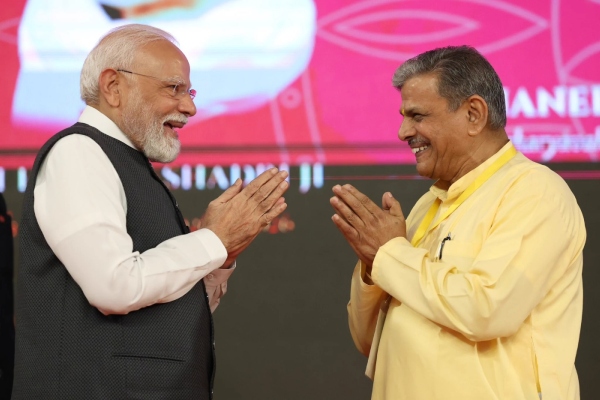
While Modi highlighted Sheshadri Ji's contribution to character-building and nation-building, he used the occasion to underline the growing global acceptance of yoga and Ayurveda, India's traditional knowledge systems and their integration with modern scientific research. Hosabale, who shared personal memories of Sheshadri Ji, described his life as an example of the sattvik Karma Yoga expounded in the Bhagavad Gita.
Modi: Sheshadri devoted his life to building individuals and the nation
Paying homage to Sheshadri Ji, Modi said he had dedicated his entire life to advancing the mission of "Vyakti Nirman se Rashtra Nirman" (nation-building through character-building).
Sheshadri Ji understood that taking the country to the pinnacle of success required dedicated, capable and disciplined citizens. He devoted himself to preparing such individuals, the Prime Minister said. The objectives he pursued during his association with the RSS continued to inspire millions of swayamsevaks.
Recalling Sheshadri Ji's personality, Modi particularly emphasised his simplicity and humility despite his extensive experience and stature. He said Sheshadri Ji preferred to remain in the background, allowing others to move forward, bringing people together and preparing them to work for the country. The Prime Minister recalled Sheshadri Ji's example of a mother's selfless service. Sheshadri Ji would say that society should learn from a mother, who stays awake throughout the night to care for her child and works without expecting anything in return. If the same spirit were extended to society, it would benefit the entire community.
Modi said he had been fortunate to receive Sheshadri Ji's affection and guidance. His memories and conversations remained precious to him. He also recalled another principle often emphasised by Sheshadri Ji - if one gives to society with both hands, society returns that contribution with millions of hands. Modi said he had repeatedly experienced this in his own public life, adding that the blessings of the people while serving them constituted one of his greatest assets.
He praised H. R. Nagendra and Dr R. Nagarathna for carrying forward Sheshadri Ji's mission through their work.
Yoga has become a gateway to knowing India
Turning to the golden jubilee of Prashanti Kutiram, Modi described its 50-year journey as an extraordinary story of service and dedication. The transformation of an ordinary yoga centre into a major movement was an inspiration, he said. He noted that Karnataka had been a centre of yoga for centuries and had produced several teachers and scholars who enriched the tradition. He also recalled the contribution of Kannada film icon Dr Rajkumar, who practised yoga and contributed to its promotion.
The Prime Minister said the institution had gone beyond popularising yoga. It had undertaken research on modern scientific parameters and developed teachers, trainers, doctors, researchers and philosophers. S-VYASA has emerged as an important institution in yoga education, scientific research and healthcare. He appreciated its holistic wellness ecosystem, which integrates yoga with Ayurveda, naturopathy and modern medical science. Research into stress-related challenges and lifestyle diseases, he said, was helping people across the world.
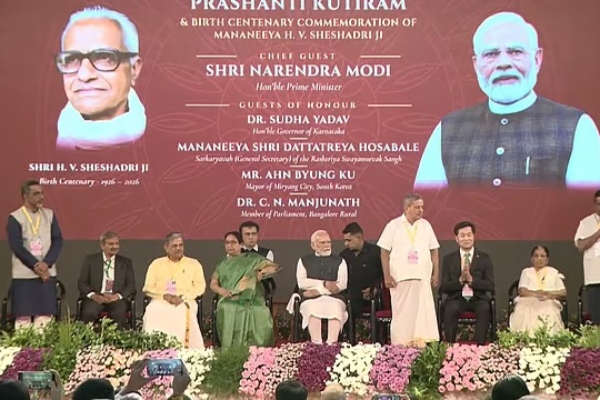
Modi said that over the past 12 years India had presented its culture, identity, knowledge and science to the world with confidence. The global celebration of International Day of Yoga, initiated by India, was one of the results. He cited the spread of yoga from Australia and Africa to the United States, with millions participating in programmes. Yoga had entered schools, institutions and workplaces in several countries.
As an example, he mentioned Saudi Arabia, where yoga had been recognised as a sporting activity and the country's sports ministry had entered into an agreement with India's Ministry of AYUSH to promote it. The Prime Minister also shared his personal experience of discussing yoga with foreign leaders. He said that during meetings and meals with international dignitaries, yoga frequently became a subject of conversation. Several leaders had told him that their wives or daughters travelled to India to learn yoga or were themselves teaching it.
He observed that yoga had become a gateway to understanding India. As people across the world became familiar with yoga, their curiosity about India's culture and traditional knowledge also increased. Modi added that more than 150 Ayurveda training courses had received recognition in different countries and India had signed memoranda of understanding with 28 countries to facilitate the expansion of Ayurveda.
Ayurveda, AYUSH and traditional medicine
The Prime Minister said the government was working to ensure that the benefits of yoga and Ayurveda reached every citizen. Holistic healthcare had emerged as a global movement, increasing interest in Ayurveda and naturopathy. He pointed out that India had established a separate Ministry of AYUSH for the first time. The government had encouraged research in Ayurveda and Ayurvedic-based patents, while exports of AYUSH and herbal products had been increasing.
He also referred to the growing international demand for turmeric, which had traditionally been used in Indian households for generations. The National Turmeric Board had been established to strengthen production, quality and exports. Modi said the government had introduced the e-Ayush visa facility to make it easier for foreign nationals to travel to India for treatment. The WHO Global Centre for Traditional Medicine at Jamnagar was another initiative intended to promote research and international cooperation in traditional medicine.
Yoga asanas had also been recognised as a competitive sport in India, creating opportunities through events such as Khelo India and the National Games. He referred to the international yoga competition held in Ahmedabad and the participation of successful competitors from countries such as Uzbekistan.
Yoga as a zero-cost approach to healthcare
Linking yoga with the broader objective of Viksit Bharat 2047, Modi said India was working towards making healthy lifestyles a priority for every family.
Referring to a recent World Bank report, he said nearly 50 crore Indians had moved out of extreme poverty over the preceding 12–13 years. This had opened up new opportunities for families to improve their living standards and pay greater attention to health and wellbeing. Yoga could play a significant role in this transformation, he said, describing it as a major healthcare intervention that did not require a financial budget.
He urged S-VYASA to prepare a detailed roadmap for the next 25 years, so that when Prashanti Kutiram completed 75 years, the institution would have made a significant contribution to the goal of Viksit Bharat. He also laid the foundation stone of the Golden Jubilee Administrative Block and launched the university's off-campus centre at Thiruvananthapuram.
Hosabale: Sheshadri Ji inspired thousands of swayamsevaks
In his address, Hosabale recalled Sheshadri Ji as a person deeply influenced by patriotism from childhood who inspired countless swayamsevaks to dedicate their lives to national work. Describing him as an embodiment of the sattvik Karma Yoga as said in the Bhagavad Gita, Hosabale said his life demonstrated how austerity, sacrifice, simplicity and dedication could influence thousands of people.
He highlighted Sheshadri Ji's contribution as a writer, thinker and organiser. Sheshadri Ji authored 32 books in Kannada, English and Hindi, covering Indian culture, society, history and national life. His writings were based on extensive study, personal experience, observation and reflection. Hosabale said Sheshadri Ji's work was not restricted to academic or theoretical discussions. His writings offered guidance to people from different walks of life, including teachers, farmers, traders and ordinary citizens.
Delighted to join the Golden Jubilee celebrations of Prashanti Kutiram in Bengaluru. Its efforts to integrate modern science with India's spiritual wisdom are commendable. https://t.co/CRe0lrSZZl
— Narendra Modi (@narendramodi) November 13, 2026
He also recalled Sheshadri Ji's extensive correspondence. The former RSS Sarkaryavah had written more than 10,000 letters to swayamsevaks, guiding them not only in organisational matters but also in their personal difficulties and circumstances. Sheshadri Ji travelled extensively across the country, visiting even small villages and maintaining personal contact with thousands of workers. His contribution to strengthening the RSS's service activities in Karnataka and helping extend such work nationally was also significant, Hosabale said.
The broken mirror and the shoelaces: two episodes that reveal his personality
Hosabale narrated two personal incidents to illustrate Sheshadri Ji's extraordinary simplicity and humility. On one occasion, he noticed Sheshadri Ji shaving while looking into a broken mirror. Hosabale suggested that he replace it with a new one. Sheshadri reportedly replied that the mirror showed him as much as he needed to see and there was no reason to see anything more. When Hosabale pointed out that looking into a broken mirror was traditionally considered inauspicious, Sheshadri Ji responded with a smile: "What more auspicious thing is left to happen in my life? Everything that had to happen has happened."
In another incident, Sheshadri Ji noticed that an RSS worker's shoelaces were not properly tied. He personally bent down and tied them. The worker was so deeply touched by this gesture that he later said Sheshadri Ji had not merely tied his shoelaces but had bound him to the Sangh and the nation for the rest of his life.
Hosabale said these incidents reflected the combination of intellectual brilliance, humility and personal warmth that characterised Sheshadri Ji. Despite being an MSc gold medallist and having served as Sarkaryavah of a large organisation, his dress and lifestyle never suggested his academic achievements or organisational position.
Yoga as a means of social transformation
Hosabale also recalled Sheshadri Ji's understanding of yoga. For him, yoga was not limited to physical fitness or mental wellbeing; it was a means of improving the whole of human life and transforming society.
He referred to Sheshadri Ji's book 'Yoga: The Social Imperative' and said he believed that a yogic way of life should inspire individuals to serve others and contribute to social change.
Hosabale cited the Bhagavad Gita's description of a sattvik karta—a person who works without attachment or ego, acts with determination and enthusiasm, and remains balanced in success and failure.
He said Sheshadri Ji's life reflected this ideal. He remained committed to his responsibilities without being disturbed by success or failure and displayed affection and compassion towards people. Sheshadri Ji had also guided S-VYASA and the yoga movement. Hosabale appreciated the institution's work in establishing the role of pranayama and yoga through scientific research in medicine, healthcare and the study of the human body and mind.
He welcomed the proposed Ritambhara laboratory, which will undertake research into higher dimensions of yoga, particularly Samadhi, using modern scientific methods. The 10-day golden jubilee celebrations of Prashanti Kutiram, established in 1975, are being held from November 13 to 23 under the theme "Towards Viksit Bharat 2047." The programme also announced the distribution of 1,000 artificial limbs free of cost in memory of Sheshadri Ji.