Selective Arithmetic: Why DK Shivakumar’s 84% Namma Metro Claim Doesn’t Add Up
As Namma Metro"s Pink Line pushed Bengaluru past 100 km, CM DK Shivakumar falsely claimed Karnataka pays 84% and the Centre just 16%.
Total Views |


Politics is often the art of selective arithmetic. When numbers are inconvenient, politicians simply rearrange the columns until the balance sheet tells a comforting story.
His big claim? The Karnataka government is single-handedly carrying 84% of Namma Metro’s financial burden, while New Delhi contributes a measly 16%.
It’s a bold narrative. It’s dramatic. It’s designed to cast Karnataka as the neglected victim of central apathy. There’s just one problem with this math: it completely collapses the moment you open an actual balance sheet or look at a map of India.
Blaming Delhi for Local Lapses
The 1,000-Kilometer Reality Check: Zooming Out on the Map
The Congress playbook here is predictable: stand under the banner of a centrally backed mega-project, take full credit for the ribbon-cutting, and simultaneously cry step-motherly treatment.
That script might work if Bengaluru existed in a vacuum. It falls apart the second you look at India’s national urban transit revolution over the last twelve years.Prior to 2014, India’s entire operational metro footprint crawled along at a sluggish 248 kilometers across just a handful of cities—expanding at a glacial pace of less than a kilometer a month. Since 2014, India’s operational metro network has surged past 1,000 kilometers across more than two dozen cities.
On 11 November, Prime Minister Narendra Modi flagged off the elevated stretch of Namma Metro’s Pink Line officially pushing Bengaluru’s operational network past the coveted 100-kilometer milestone you might have expected a moment of shared pride. Instead, Karnataka Deputy Chief Minister DK Shivakumar stepped up to the podium and served a masterclass in selective arithmetic.
His big claim? The Karnataka government is single-handedly carrying 84% of Namma Metro’s financial burden, while New Delhi contributes a measly 16%.
It’s a bold narrative. It’s dramatic. It’s designed to cast Karnataka as the neglected victim of central apathy. There’s just one problem with this math: it completely collapses the moment you open an actual balance sheet or look at a map of India.
The Great Ledger Illusion: How 47% Magically Becomes 84%
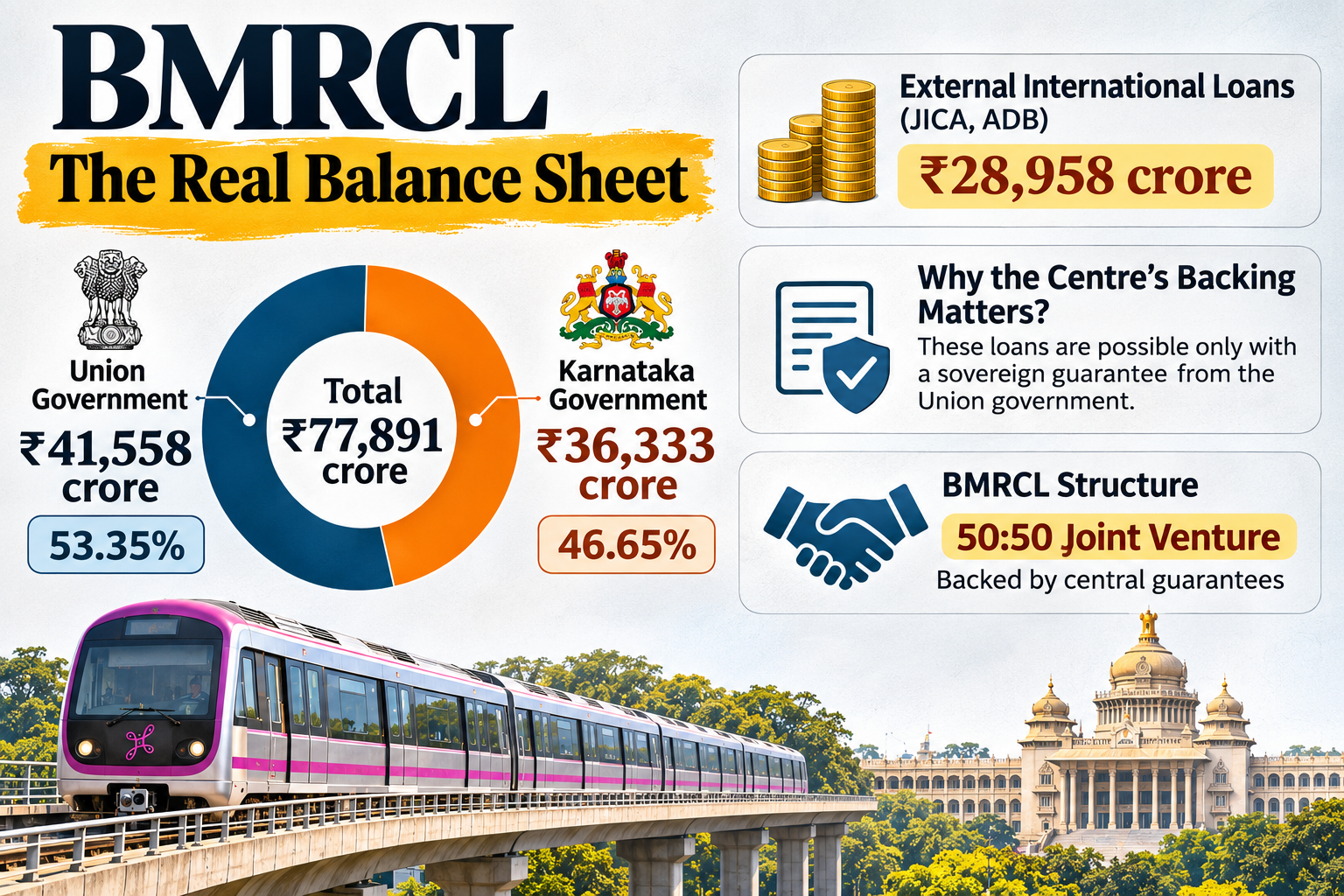
To arrive at its magical 84 per cent figure, the Karnataka government pulled off a classic accounting trick: it quietly adopted nearly ₹28,958 crore of international bilateral and multilateral loans as its own personal contribution.
Anyone remotely familiar with Indian public finance knows that major metro projects across the country are funded largely through long-term, low-interest loans from global agencies like the Japan International Cooperation Agency (JICA) and the Asian Development Bank (ADB). More importantly, under India’s constitutional framework, no state government can walk up to a foreign sovereign lender and borrow tens of thousands of crores on its own word. Those loans exist solely because the Union government in New Delhi provides a sovereign guarantee, negotiates the terms, and routes the capital to BMRCL an equal 50:50 joint venture.
When you strip away the political spin and place that ₹28,958 crore in Centre-facilitated external debt where it rightfully belongs, the actual balance sheet flips entirely. Official BMRCL records show the Union government’s effective financial backing stands at ₹41,558 crore or 53.35 per cent of the approved funding compared to Karnataka’s 46.65 per cent (₹36,333 crore). Far from starving Bengaluru, New Delhi actually underwrites more than half the network.
Blaming Delhi for Local Lapses
The second pillar of Shivakumar’s complaint rests on adding ₹14,404 crore of land acquisition costs into Karnataka’s core share. Yet, under the uniform National Metro Rail Policy applied from Delhi to Chennai, land acquisition and rehabilitation are strictly a state responsibility. Bengaluru’s sky-high real estate prices naturally inflate that bill, a reality every state government signed up for when the policy was framed.
What the Chief Minister conveniently skipped over is how much of that land bill ballooned due to local administrative lethargy. A report by the Comptroller and Auditor General (CAG) laid bare how delays in acquiring land and flawed initial estimates in Bengaluru caused ₹6,603 crore in avoidable extra expenditure. In Phase 2 alone, land costs shot up from an estimated ₹2,000 crore to ₹7,458 crore. Turning self-inflicted cost overruns into a weapon against the Centre takes a special kind of political audacity.
Even on project clearances such as the Sarjapur–Hebbal Red Line Shivakumar attempted to paint New Delhi as an obstacle. Yet the paper trail reveals that state-level flip-flops on alignment and inflated budgeting caused major delays. In fact, when Karnataka submitted its Phase 3 proposal pegged at ₹28,405 crore, it took a rigorous central review to trim ₹2,406 crore in excess fat, bringing the cost down to ₹25,999 crore and saving taxpayers thousands of crores.
The 1,000-Kilometer Reality Check: Zooming Out on the Map
The Congress playbook here is predictable: stand under the banner of a centrally backed mega-project, take full credit for the ribbon-cutting, and simultaneously cry step-motherly treatment.
That script might work if Bengaluru existed in a vacuum. It falls apart the second you look at India’s national urban transit revolution over the last twelve years.Prior to 2014, India’s entire operational metro footprint crawled along at a sluggish 248 kilometers across just a handful of cities—expanding at a glacial pace of less than a kilometer a month. Since 2014, India’s operational metro network has surged past 1,000 kilometers across more than two dozen cities.
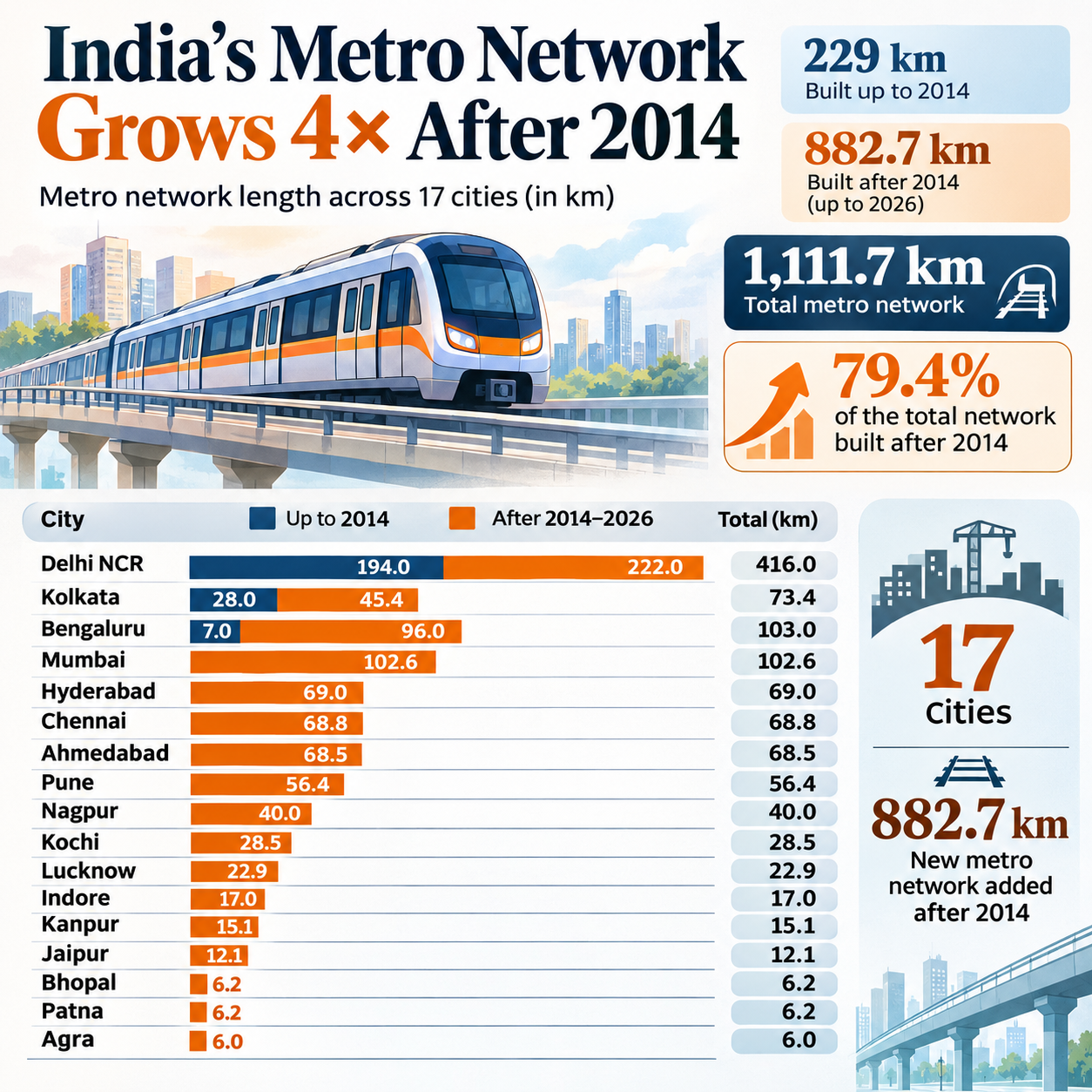
Look at how much of India’s major metro infrastructure was built and commissioned after 2014:
When fourteen major cities owe their entire metro networks to a decade-long national infrastructure push and when 93% of Bengaluru’s own tracks were laid in that exact same window portraying Karnataka as an isolated victim of central neglect doesn’t just bend the truth; it ignores basic geography.