Chhathi Maiya: Ancient Goddess behind Bihar’s most sacred festival
The relationship between the Sun and Chhathi Maiya brings together two powerful dimensions of Hindu religious thought, being the cosmic source of life and the maternal power that protects it.
Total Views |


वरदायै पुत्रदायै धनदायै नमो नमः ।
सुखदायै मोक्षदायै षष्ठीदेव्यै नमो नमः ॥
Every year, as millions of devotees gather along riverbanks, ponds and reservoirs to offer arghya to the setting and rising Sun, one divine presence which they call the “Chhathi Maiya”, occupies a special place in their prayers. For millions across Bihar, Jharkhand, eastern Uttar Pradesh and from the Indian diaspora, ‘Chhath Puja’ is an expression of faith, gratitude and familial devotion. Yet, behind this deeply rooted regional tradition lies a fascinating connection with one of Hindu Dharma’s ancient goddesses, the Shashthi Devi, the divine protector of children, childbirth and family prosperity.
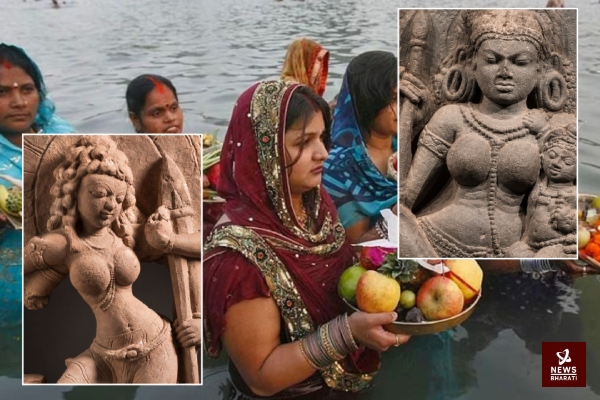
This association is far older than the contemporary cultural landscape of eastern India might suggest. It finds references in the Sanskrit epics, Puranic literature and early Indian sculpture, revealing how an ancient understanding of divine motherhood continues to find expression in living Hindu traditions.
Goddess recognised in the Mahabharata
One of the most significant textual references to Shashthi appears in the 'Vana Parva' of the Mahabharata (3.218.47). The epic identifies Devasena, the divine consort of Bhagwan Skanda (Kartikeya), with Shashthi Devi.
The verse reads:
एवं स्कन्दस्य महिषीं देवसेनां विदुर्बुधाः ।
षष्ठीं यां ब्राह्मणाः प्राहुर्लक्ष्मीमाशां सुखप्रदाम् ॥
The passage describes Devasena as the wife of Skanda and identifies her with Shashthi, whom Brahmanas also recognise through attributes associated with Lakshmi, hope and the bestowal of happiness.
This identification is particularly significant as it establishes that Shashthi was not simply a local village deity but a goddess recognised within the larger Sanskritic religious tradition. Her association with Skanda also connects her to the wider pantheon of divine powers associated with protection, motherhood and the preservation of life.
Puranic understanding of divine motherhood
The Brahmavaivarta Purana, particularly its Prakriti Khanda (Chapter 43), provides a more elaborate account of Shashthi's divine nature.
According to the text, she manifests as the sixth portion of the primordial Prakriti, the feminine creative principle of the universe. She is invoked as the giver of children, prosperity, happiness and spiritual liberation.
A verse from the Priyavrata-krita Shashthi Devi Stotram (43.58) states:
वरदायै पुत्रदायै धनदायै नमो नमः ।
सुखदायै मोक्षदायै षष्ठीदेव्यै नमो नमः ॥
The prayer salutes the goddess as the bestower of boons, children, wealth, happiness and liberation. The accompanying narrative describes the worship of Shashthi on the sixth day after childbirth and during important ceremonies associated with children's wellbeing. The goddess is thus presented as a divine guardian accompanying families through the vulnerable stages of infancy and childhood, transcending beyond the symbolism of fertility.
This maternal dimension is central to understanding her continued worship as 'Chhathi Maiya'.
From ancient iconography to living traditions
The antiquity of Shashthi worship is also reflected in early Indian art. Archaeological and art-historical scholarship has documented representations of the goddess in the Mathura sculptural tradition during the Kushan period (approximately first to third centuries CE).
Art historian Ratna Chandra Agrawala's research, particularly his study of Goddess Shashthi in Mathura Sculptures (1969), examines the goddess's representation in early Indian iconography. Some depictions associate her with Skanda and Vishakha, while independent representations also exist.
Such evidence is important because it demonstrates that the worship and visual representation of protective mother goddesses were established features of religious life in ancient India. These traditions were not confined to literary descriptions. They also found expression in sculptural practices and devotional imagery.
Chhathi Maiya (Ṣaṣṭhī Devī) is the ancient goddess of children and protection who is, worshipped during Chhath Puja. She is associated with the ancient Hindu goddess Ṣaṣṭhī (षष्ठी), the benevolent goddess of fertility, childbirth and the protection of children who is also… https://t.co/kA6pHAMhR6 pic.twitter.com/xW1QpTBirY
— Savitri Mumukshu - सावित्री मुमुक्षु (@MumukshuSavitri) November 14, 2026
More importantly, what is lesser known to many, is that Shashthi is additionally associated with Kaumari and the wider tradition of the Matrikas, the divine mother figures of Hindu religious iconography. Her identity, however, evolved across different textual and regional traditions, reflecting the diverse ways in which the divine feminine was understood and worshipped.
Why 'Chhathi Maiya' matters to 'Chhath'
Over centuries, the worship of Shashthi became deeply embedded in the folk religious traditions of eastern India. In Bihar, Jharkhand and eastern Uttar Pradesh, she came to be revered with extraordinary affection as 'Chhathi Maiya'.
'Chhath' itself is primarily a festival of Surya worship. Devotees observe rigorous fasts, maintain ritual purity and offer arghya to both the setting and rising Sun. The observance is popularly known as Surya Shashthi, with its principal rituals falling on the sixth day of Kartik Shukla Paksha.
The relationship between the Sun and Chhathi Maiya brings together two powerful dimensions of Hindu religious thought, being the cosmic source of life and the maternal power that protects it. While Surya represents the universal energy sustaining existence, 'Chhathi Maiya' is invoked for the health, longevity and wellbeing of children and families.
This convergence of solar worship and maternal devotion gives 'Chhath' its distinctive religious character. It is also a reminder that Hindu traditions have historically accommodated interconnected forms of worship without necessarily separating the cosmic, natural and familial dimensions of divinity.
Ancient tradition that lives on
The story of 'Chhathi Maiya' speaks about an important characteristic of Hindu civilization. The continuity of religious traditions through the interaction of sacred texts, regional practices, artistic expressions and collective memory.
A goddess invoked in the Mahabharata, praised in the Puranas and represented in ancient Indian sculpture continues to receive prayers from millions of households today. Her name may have acquired a distinct regional expression, but the underlying reverence for divine motherhood, fertility and the protection of children remains recognisable.
Therefore, 'Chhath' is more than a festival of gratitude to the Sun. It is a living expression of India's civilizational memory, where ancient theological ideas continue to shape everyday faith.