Dalip Tahil Calls Sonia Gandhi’s Memoir Belonging an ‘Own Goal,’ Says It Exposes Congress Leadership
According to Tahil, Belonging strips away the carefully maintained mystique surrounding India’s most prominent political family.
Total Views |


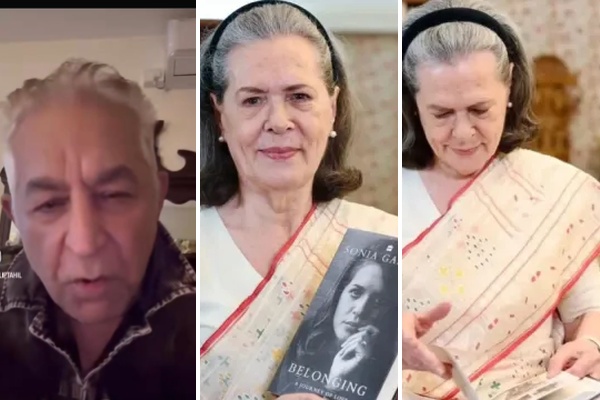
Veteran Bollywood actor Dalip Tahil has leveled sharp criticism against Congress leader Sonia Gandhi’s memoir, Belonging, characterizing the book as an unintended exposure of the Gandhi family’s political limitations. In a video posted to his Instagram account on Saturday, November 14, Tahil scrutinized the Congress party’s legacy, the internal dynamics of its leadership, and the factors behind its electoral decline.
A Self-Inflicted Exposure
According to Tahil, Belonging strips away the carefully maintained mystique surrounding India’s most prominent political family. Speaking in his video message, the Baazigar actor stated that the public had long assumed the dynasty operated with deep ideological substance and strategic foresight—an impression he argues the memoir itself dismantles.
"We all felt, and we believed there was a lot of depth. There was a lot of substance. There was a lot of political vision in this family, only to discover that really it was all feet of clay and, funnily enough, Sonia Gandhi has revealed this," Tahil said, labeling the book the "best own goal."
Tahil further contended that the lack of social media during the height of Congress rule shielded the leadership's true decision-making processes from public scrutiny. With the book now offering an inside look at their mindset, Tahil stated that many observers were taken aback by what he described as a lack of depth, adding, "So I think they deserve to be gone."
Opportunism and the Collapse of a Power Structure
Addressing the broader trajectory of Indian politics, Tahil contrasted the Congress party’s rapid loss of influence with the rise of the Bharatiya Janata Party (BJP) under Prime Minister Narendra Modi. Tahil noted that he had once questioned how Modi would manage to dismantle an entrenched political apparatus like the Congress, describing the shift in stark terms: "He came and he just laughed and puff and blow your house down. And he did."
Actor Dalip Tahil just dropped a political truth bomb!
— Comman Man (@CommanMan777589) November 15, 2026
He takes the gloves off while discussing Sonia Gandhi! pic.twitter.com/RQZsVSql7j
Reflecting on how a once-dominant party unraveled so quickly, Tahil attributed the collapse to a culture of political opportunism rather than genuine ideological commitment. He argued that the inner circle surrounding the Congress during its years in power consisted largely of self-serving loyalists who abandoned the party once its access to state power diminished.
"Now we realize that at the time, it was very clear that they were just sycophants who hovered around like flies around the pot of honey," Tahil remarked. "And then the pot of honey was not there or began to leak. So they all fled, never to be seen again."
Questioning Political Pedestals
Tahil also pointed to what he viewed as a cultural tendency in India to place political figures—particularly those of foreign origin—on an unquestioned pedestal. Having grown up during decades of Congress governance, the actor stated that his perspective was shaped by watching the party's ecosystem operate over time.
Concluding his remarks, Tahil noted that while the memoir may have been intended as a personal and political reflection, it serves a different purpose for readers today: acting as a revealing historical document of the governance and political culture India experienced over the past 45 to 50 years.