Challenging caste discrimination through shared meals: Savarkar’s historic social reform experiment 100 years back
On April 17, 1924, Savarkar deliberately chose the Vitthal Temple in the village of Parshuram to launch his social reform experiments.
NewsBharati 16-Nov-2026 14:40:23 PM
Total Views |


The inter-caste community meal organised by Swatantryaveer Savarkar in Ratnagiri on November 16, 1930, was a milestone step toward dismantling the walls of caste discrimination.
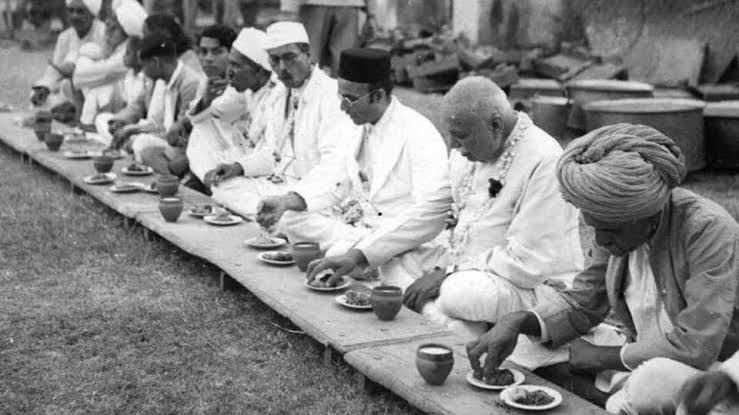
Savarkar at an inter-caste community meal in Ratnagiri.
Revolutions rarely announce themselves over lunch. Yet on November 16, 1930, inside a packed theater in Ratnagiri, the clatter of plates and the sharing of a meal delivered a direct jolt to centuries of entrenched caste orthodoxy. Organised by Swatantryaveer Vinayak Damodar Savarkar, that historic Sahabhojan, an inter-caste community meal, did what speeches and resolutions alone rarely can: it turned the abstract ideal of equality into a lived, visible reality. Nearly a hundred years on, that gathering stands as a powerful reminder that deep-rooted social barriers do not crumble through rhetoric; they yield only when people step across the line and act.
It was an era when caste discrimination was not merely a matter of social identity. Strict caste restrictions dictated whose food one could eat, whose home one could enter, beside whom one could sit, and whom one could touch. In particular, Rotibandi, the prohibition against inter-caste dining, enforced rigid social distance across communities. Under such circumstances, having people from all castes sit together in a single row (pangat) to share a meal was no ordinary feat; it demanded immense courage to confront fierce societal backlash.
Between 1924 and 1937, Savarkar was interned in Ratnagiri under conditions imposed by the British government. Barred from active politics, he channeled his entire energy into uniting Hindu society by eliminating divisions and discrimination among its castes and sub-castes.
On April 17, 1924, Savarkar deliberately chose the Vitthal Temple in the village of Parshuram to launch his social reform experiments. This temple held profound significance for several reasons: it was revered as an exceptionally sacred site by Chitpavan Brahmins, Peshwa Bajirao I had drawn inspiration from here, and it had been established by his spiritual guru, Brahmendra Swami.
Savarkar delivered his first major public address following his release from prison (subsequent internment in Ratnagiri) at this spiritually and politically prestigious venue. The theme he chose was “Shuddhikaran and Asprushyoddhar” (Social inclusion and the upliftment of the oppressed). His stance triggered a barrage of criticism from orthodox Hindus, yet Savarkar remained resolute, refusing to let opposition weaken his determination.
The first major hurdle before Savarkar was generating widespread social awareness. During the 1925 Ganeshotsav, he organised lectures and public discussions, alongside publishing articles arguing that untouchability was both unjust and detrimental to Hindu society. He recognised that while people might agree with his ideas in principle, translating them into practice was far harder, since centuries-old conditioning and deeply ingrained customs could not be erased overnight.
However, these obstacles did not shake Savarkar’s resolve. In a move that shocked Ratnagiri’s orthodox establishment, he walked directly into the settlement of the Mahar community, who were then treated as untouchables. Because members of the Mahar community were barred from entering the town to sing devotional hymns (bhajans), Savarkar chose not to wait for the town's gates to open for them; instead, he went to their neighborhood, the Maharwada, himself. There, he sang bhajans alongside his Mahar brethren, danced with them, and shared in their joy.
The most pivotal pillar of this social reform movement was Sahabhojan, community dining across caste lines.
In building the Sahabhojan movement in Ratnagiri, Savarkar struck his first direct blow at rigid orthodoxy. In his view, a person’s religion resided in their heart and conscience, not in their stomach; the belief that eating food prepared by someone of another caste defiled one’s faith was baseless. He firmly believed that sharing a meal could foster closeness, dissolve mutual hesitation, and turn social equality into a lived reality.
The groundwork for this initiative was equally significant. In December 1929, roughly a hundred youths from diverse castes had dined together under the banner of the Tarun Hindu Mandal. Following this, a decision was made not to restrict the initiative to activists alone, but to open it to the general public. Securing a venue, finding cooks willing to prepare the meal, and braving social hostility posed formidable hurdles. Eventually, arrangements were made at the theater owned by the Khatu family. Turnout far exceeded expectations, and several people had to return home because capacity was full. The community dinner of November 16, 1930, stands as a defining milestone in this broader social experiment.
At this gathering, Brahmins, Marathas, Bhandaris and Vaishyas sat side by side in the same dining row with Mahars, Chambhars and other marginalized communities. This was far more than a meal; it was an effort to give a society conditioned by centuries of segregation a direct experience of togetherness. Savarkar also initiated the practice of publishing the names of all participants, insisting there should be no secrecy or hesitation behind such a righteous act. Although participants faced severe consequences such as social ostracisation, acceptance gradually began to grow.
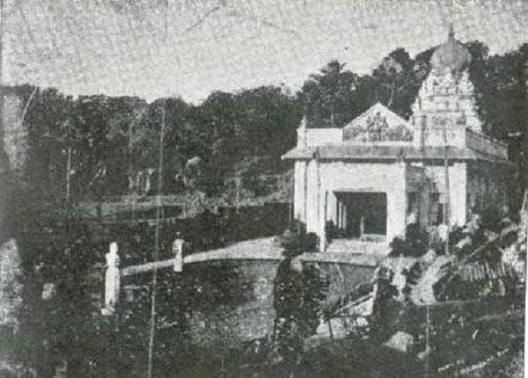
Patit Pavan Mandir, Ratnagiri. Source: NewsBharati
To institutionalise these efforts toward social transformation, the Patit-Pavan Mandir was constructed in Ratnagiri in 1931 with the generous support of Bhagojisheth Keer. Its foundational principle was granting Hindus of all castes equal rights to temple entry, worship, and prayer. Following its consecration, the temple regularly hosted inter-caste community meals and social programs aimed at strengthening communal harmony, translating Savarkar’s vision of social integration into everyday practice.
Also read: Veer Savarkar and Patitpavan Temple
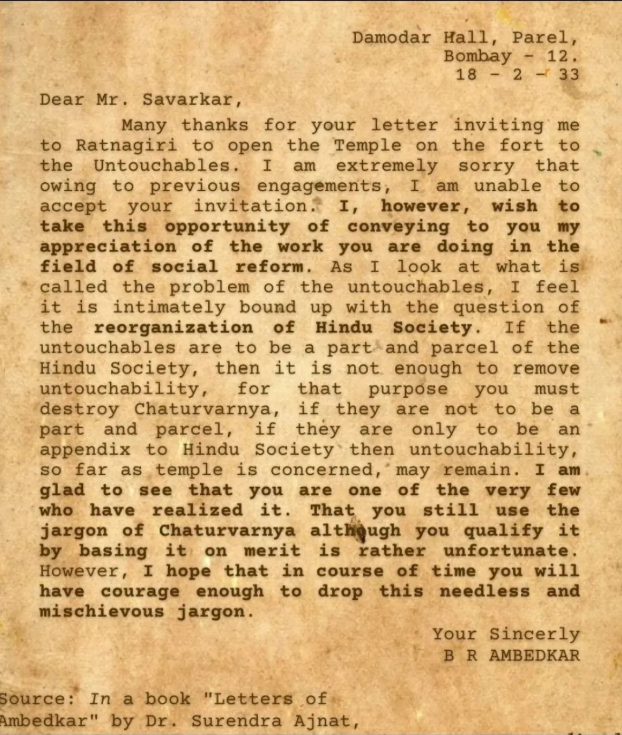
Dr. Babasaheb Ambedkar also took note of this work. Savarkar had invited Ambedkar to preside over an event at the Patit-Pavan Mandir. Due to prior commitments, Ambedkar was unable to attend, and he wrote a letter to Savarkar expressing his regrets. In the letter, Ambedkar praised Savarkar’s efforts in social reform while candidly stating his ideological disagreement regarding the Chaturvarna system:
“I take this opportunity to express my appreciation of the work you are doing in the field of social reform... If the Untouchables are to become an integral part of Hindu society, merely abolishing untouchability will not suffice; the Chaturvarna system itself must be dismantled... I am glad that you are among the very few who have realized this.
However, it is regrettable that while you argue that Chaturvarna should be based on merit rather than birth, you still insist on retaining the concept itself. I hope that in time, you will show the courage to abandon this unnecessary and misleading terminology.” — Reference: Dhananjay Keer, Veer Savarkar, p. 190.
Source: Veer Savarkar book by Dhananjay Keer
Ambedkar’s letter illuminates both the common ground and the fundamental divergence between the two leaders. Both were uncompromising in their demand to abolish birth-based caste discrimination and untouchability. Yet, they differed on the concept of Chaturvarna. Drawing on Hindu scriptures, Savarkar interpreted Chaturvarna as a system based on individual qualities and deeds (guna and karma) rather than birth, using this argument to steer society away from hereditary casteism. Conversely, Ambedkar maintained that redefining Chaturvarna by merit was insufficient, the entire framework needed to be discarded. Thus, while applauding Savarkar’s reformist actions, Ambedkar did not hesitate to offer a principled critique of his ideological stance, highlighting both their shared goal of social transformation and their differing paths toward achieving it.
The movement also received active backing from figures in the arts. Pandit Deenanath Mangeshkar, a close friend of Savarkar, regularly participated in these community dinners and brought his young daughter, Lata, along with him. According to historical accounts, at just five years old, Lata Mangeshkar was among the youngest participants in Savarkar’s inter-caste dining initiatives, a remarkable chapter of social history linked to the childhood of a singer who would later achieve global acclaim.
That community meal of November 16, 1930, continues to draw attention to a vital truth: social harmony cannot be built through slogans alone. It takes shape through sharing one another’s joys and sorrows, ensuring equal rights in public life, and eliminating discrimination in daily conduct. Sharing a meal may only be the beginning, yet the mutual trust and fraternity born from it matter far more.
Standing on the threshold of its centenary, the significance of that Sahabhojan extends well beyond historical memory. True social harmony means ensuring equal dignity, equal opportunity, and equal participation for every section of society. That dining row in Ratnagiri marked a decisive stride in that direction and the truest tribute to that effort lies in bringing its spirit of equality into our social conduct today.
Rajesh Korde
Journalist having more than three decades of experience with many newspapers in Goa, Pune, Karnavati (Ahmedabad) and Abu Dhabi (UAE). A visting faculty at many Journalism Schools, is now pursuing third Masters – MA in Indology. Also an avid traveller and a photographer