Deconstructing the Myth: How Colonial Historiography Invented the Aryan-Dravidian Divide
The categorization of Bharat into Aryan and Dravidian races is a remnant of colonial governance. Colonial historians confused language families with biological ancestry.
NewsBharati 17-Nov-2026 14:43:42 PM
Total Views |


For more than 150 years, a major divide in Bharatiya historiography has involved categorizing the subcontinent's population into two opposing racial groups: the "Aryan" North and the "Dravidian" South. This classification originated as a 19th-century European linguistic theory but was quickly adopted by colonial officials, missionary linguists, and orientalist academics into a strict racial narrative. In today's context, where regional politics, cultural discussions, and social media increasingly exploit food, festivals, and language to assert claims of racial superiority or cultural alienation, it is critical to revisit historical, textual, and scientific evidence. The division of Bharat into Aryan and Dravidian is not an ancient or indigenous concept; rather, it is a construct arising from colonial motivations, misguided 19th-century racial theories, and the convenience of administration.
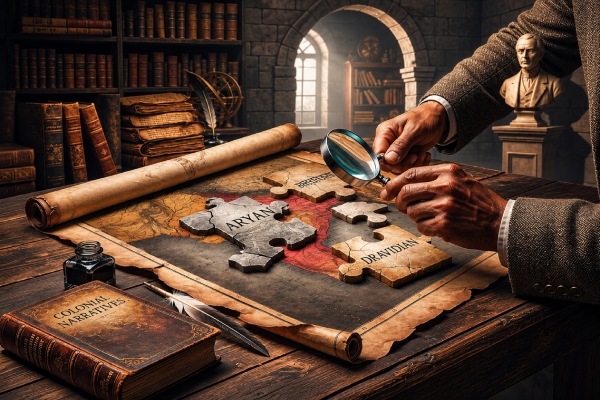
AI generated image
The Imperial Context: Divide, Categorize, and Rule
To grasp how a linguistic framework contributed to a civilizational divide, it's essential to explore the socio-political landscape of 19th-century British Bharat. After the 1857 uprising, the British Crown identified a unified Bharatiya identity as its principal threat to dominance. Managing a vast and diverse territory necessitated systematic categorization. Colonial officials sought an intellectual framework that could explain Bharat's intricate social dynamics while simultaneously justifying imperial rule.
At that time, European scholars were captivated by racial science and philology. Linguists such as William Jones noted significant structural and lexical resemblances among Sanskrit, Latin, Greek, and Persian, leading them to correctly identify a shared ancestral language family known as Indo-European. However, 19th-century European thought made a critical mistake by equating language families with biological races.
Orientalists like Max Müller helped popularize the term "Aryan," derived from the Sanskrit word Arya (आर्य), to refer to speakers of Indo-European languages. Initially, Müller warned that "Aryan" was intended as a linguistic term, not a racial classification. Nevertheless, in his public writings and lectures, he frequently employed vivid racial imagery, portraying fair-skinned "Aryans" migrating from Central Asia into the Gangetic plains and conquering darker-skinned indigenous peoples. Colonial ethnographers like Sir Herbert Hope Risley further entrenched this narrative, using craniometry to classify Bharatiyas into distinct racial categories in official census documents.
In South Bharat, missionary scholars like Bishop Robert Caldwell played a similar role. In his 1856 book, A Comparative Grammar of the Dravidian or South-Bharatiya Family of Languages, Caldwell offered significant insights into South Bharatiya linguistics but also made theological and political claims that portrayed South Bharatiya languages and cultures as entirely separate from, and historically oppressed by, northern "Aryan" invaders.
The colonial rulers found great value in this narrative. By framing the British as just the latest in a succession of civilizing foreign conquerors, following the "Aryans," the Empire presented its presence not as a foreign occupation, but as part of an established historical continuum.
The Semantic Hijacking of "Arya"
The main flaw of the Aryan Invasion Theory (AIT) stems from a misinterpretation of the term Arya, which is never used in Vedic, Epic, or Classical Sanskrit literature to refer to a biological race, physical attributes, or skin color. In its original context, Arya signifies ethical, behavioral, and cultural qualities, translating to "noble," "respectable," "cultured," or "someone who follows a code of righteousness (Dharma)."
In the Rigveda, the concept of Arya is contrasted with Dasyu or Dasa based on moral behavior and ritual practice, not race. In the Ramayana, Sri Rama embodies the qualities of being noble, equal in treatment to all, and pleasing in appearance. Similarly, in classical Sanskrit plays by authors like Kalidasa and Bhasa, wives refer to their husbands as Aryaputra ("son of a noble one") irrespective of their regional or caste backgrounds.
Moreover, in Buddhist and Jain literature, the term remains integral to spiritual ethics, as evident in the Buddha's key teachings known as the Cattāri Ariya Saccāni (The Four Noble Truths) and the Ariyo Aṭṭhaṅgiko Maggo (The Noble Eightfold Path). Transforming this ethical term into a racial label reflects a misunderstanding. It imposed a foreign 19th-century European racial concept onto an ancient society that understood itself through shared values, rituals, and philosophical exploration rather than lineage.
The Fallacy of Racial Hegemony: Classical Tamil Evidence
Contemporary interpretations of colonial historiography claim that Southern culture, particularly Tamil culture, developed either in complete isolation from or in direct contrast to Northern traditions. However, the oldest surviving layer of Tamil literature, known as the classical Sangam corpus (traditionally dated from 300 BCE to 300 CE), reveals a reality of rich cultural integration rather than conflict between races or civilizations.
Rather than depicting a society threatened by an outside "Aryan" culture, Sangam poetry consistently celebrates a common civilizational heritage:
Vedic Practices and Royal Patronage : In the Purananuru, a collection of 400 heroic poems, the Chola, Chera, and Pandya kings are often lauded for conducting Vedic sacrifices (Yagnas). King Palyagasalai Mudukudumi Peruvaludhi, a Pandya ruler, derived his title ("Palyagasalai," which means "he of many sacrificial halls") from his support of Vedic rituals.
Shared Deities and Sacred Geography : Sangam poetry weaves together the worship of deities found throughout the Bharatiya subcontinent. Central figures include Mayon (the dark-complexioned Vishnu), Seyon (Murugan/Skanda), Vendhan (Indra), and Korravai (Durga). The Tirumurugatrupadai, written by Nakkeerar, portrays Lord Murugan in a manner that harmoniously combines indigenous Tamil beliefs with puranic narratives of Skanda. Additionally, the Himalayas (Imaiyam) are frequently mentioned as the northern edge of a collective sacred territory.
Intellectual Traditions : Agastya, regarded as the father of Tamil grammar (Agathiyar in Tamil tradition), is honored in classical texts as a Vedic sage who migrated south, representing the intellectual connection between the Gangetic and Cauvery regions. The Tolkappiyam, an ancient Tamil grammar work, organizes its poetic classifications (Agam and Puram) in ways that align with classical Bharatiya aesthetic theories, holding Vedic scholars (Antanar) in the highest regard.
The historical perspective reflected in classical Tamil literature indicates a society actively engaged within a dynamic, pan-Bharatiya cultural framework rather than one marked by isolationism.
Dismantling the Myth with Modern Science
In the last twenty years, progress in empirical science—particularly in archaeogenetics and satellite archaeology—has made the 19th-century invasion theory scientifically invalid.
The Genetic Continuum: Groundbreaking studies in population genetics, such as those by Reich et al. (2009), reveal that all indigenous South Asian groups are genetically composed of two ancient ancestral populations: Ancestral North Bharatiya (ANI) and Ancestral South Bharatiya (ASI). Importantly, both ANI and ASI are found throughout nearly all Bharatiya populations today, with their proportions varying smoothly along a geographic spectrum, devoid of any clear biological divide between North and South.
The Rakhigarhi Evidence: A 2019 DNA analysis of a 4,500-year-old skeleton from Rakhigarhi (Haryana), conducted by Prof. Vasant Shinde and Dr. Niraj Rai, established that the people of the Harappan civilization had genetic links that still exist in contemporary South Asians. The lack of genetic indicators from Anatolia or the Central Steppe in this ancient genome debunks the notion of a catastrophic invasion that uprooted the Harappan urban centers.
The Hydrological Reality: Satellite data and geological core samples have verified the presence and eventual desiccation of the Sarasvati River around 1900 BCE due to tectonic changes. This environmental occurrence, rather than an invasion by foreign horse-riders, accounts for the gradual movement of urban populations to the east and south after the decline of the Harappan civilization.
Reclaiming a Unified Narrative
The categorization of Bharat into Aryan and Dravidian races is a remnant of colonial governance. Colonial historians confused language families with biological ancestry and mischaracterized ethical principles as racial identifiers, creating divisions that still affect public conversations today. Challenging this artificial separation does not necessitate diminishing regional pride, linguistic diversity, or local customs. Tamil culture, renowned for its exquisite poetry, stunning temple architecture, and significant philosophical ideas, is a vital part of world heritage. Acknowledging that this culture evolved through ongoing, respectful exchanges with other parts of the Bharatiya subcontinent enhances its distinctiveness rather than detracting from it. It is time to move away from outdated 19th-century racial theories and embrace the clarity of 21st-century science and accurate text interpretation. The variety of languages, cuisines, clothing, and rituals in Bharat reflects not conflicting racial backgrounds, but the rich and intricate flowering of a single, deeply rooted civilization.
Pankaj Jayswal
Pankaj Jagannath Jayswal, an Electrical Engineer, has spent 14 years working with MNCs at various levels. He is a prolific author who has written a book called "Modi Era..." about Prime Minister Narendra Modi. He has also written books about youth both in English and Hindi – a) "Youth: Universe Reflection" and b) "Yuva: Bramhand Ka Pratibimb."
He is a regular writer with the Times of India Readers Blog, Organiser, Hindi Vivek, Tarun Bharat, Swadesh, Hindusthan Samachar, Opindia, Kretely, TheHindi, Speaking Tree, and several other news portals. He written over 145 articles in English, Marathi, and Hindi.
He has extensive experience working on various Art of Living projects and is a Happiness course faculty member. He takes courses on personality development for all ages. He provides free career counselling to youths suffering from depression, anxiety, and suicidal ideation.
Email: Pankajjayswal1977@gmail.com
Website : http://www.sharencare.in