India, ASEAN Adopt Joint Statement on Disaster Management; PM Modi Proposes Nine Initiatives to Deepen Strategic Ties
India has been seeking better market access for its goods in ASEAN countries and a more balanced trade arrangement.
Total Views |


India and the Association of Southeast Asian Nations (ASEAN) have adopted a joint statement on cooperation in disaster management during the 23rd India-ASEAN Summit in Manila, Philippines. Prime Minister Narendra Modi also proposed nine initiatives to strengthen cooperation in maritime security, nuclear energy, space technology, critical minerals, tourism and people-to-people exchanges.
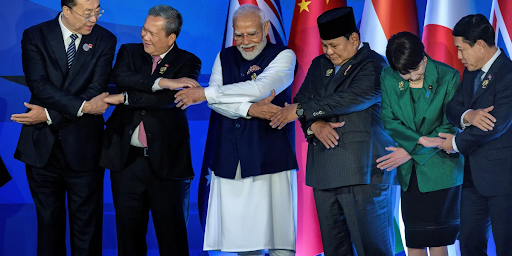
Addressing the summit on November 17, Modi reiterated India's commitment to ASEAN unity and centrality, stating that the country's Act East Policy had provided fresh momentum to bilateral and regional relations. He highlighted the growing partnership between India and ASEAN in digital technology, defence, space and economic cooperation.
"Together, India and ASEAN represent nearly one-fourth of the world's population. That is why it is essential to ensure that our future is shaped not by competition, but by cooperation," Modi said.
Nine Initiatives to Strengthen India-ASEAN Partnership
During the summit, the Prime Minister outlined nine proposals to expand cooperation between India and the 11-member regional grouping.
Other initiatives include a joint cyber forensics training programme, technical exchanges in nuclear energy, an ASEAN-India Space Hackathon and cooperation in mining and critical minerals.
Modi also proposed strengthening youth engagement through youth summits, young parliamentarian exchanges and startup hackathons. Additional scholarships for ASEAN students at Nalanda University, an ASEAN-India Creative Partnership Pavilion at WAVES 2027 and free e-visas for ASEAN tourists visiting India were also among the proposals.
These initiatives aim to expand cooperation beyond traditional diplomatic and economic engagement and create opportunities in emerging technologies, education, tourism and regional security.
Joint Statement on Disaster Management
A major outcome of the summit was the adoption of the ASEAN-India Joint Statement on Cooperation in Disaster Management.
Under the agreement, both sides will work towards strengthening early warning systems, improving coordination between disaster management agencies and expanding the use of space-based technologies for disaster preparedness and response.
The cooperation will also include regular consultations, joint training exercises, simulation drills and exchanges of disaster-response personnel.
The initiative is expected to strengthen regional preparedness against natural disasters, including earthquakes, tsunamis, floods, cyclones and landslides.
PM Modi proposes enhancing scholarships for ASEAN countries at Nalanda University, ASEAN-India Nuclear Energy Technical Exchanges at India, Asean summit pic.twitter.com/zI30V8Xl3j
— Sidhant Sibal (@sidhant) November 17, 2026
India's Growing Strategic Engagement with Southeast Asia
India's engagement with ASEAN remains an important pillar of its Act East Policy, which aims to strengthen economic, cultural and strategic relations with Southeast Asian countries.
Over the past 12 years, India has undertaken more than 100 initiatives to strengthen people-to-people connections, implemented over 250 Quick Impact Projects and provided more than 10,000 skill-development scholarships across the region.
Defence cooperation has also emerged as an important part of this partnership. Vietnam and the Philippines have both procured the BrahMos supersonic cruise missile system, jointly developed by India and Russia. India has also expanded its engagement with regional partners in maritime domain awareness and security.
The growing importance of ASEAN is also linked to the changing strategic environment in the Indo-Pacific, where major powers, including China, the United States and India, are seeking stronger regional partnerships.
Latest Developments and Upcoming Cooperation
The Ministry of External Affairs confirmed that the Manila visit resulted in three important documents. Apart from the disaster management statement, these include the East Asia Summit Leaders' Statement on Strengthening Cooperation Against Online Scams and Related Offences and the East Asia Summit Declaration on Navigating Our Future Together: Stability and Renewal.
Another important development is the ongoing review of the ASEAN-India Trade in Goods Agreement (AITIGA), which came into force in 2010. The 15th meeting of the AITIGA Joint Committee was held in Jakarta, Indonesia, from October 6 to 9, 2026, to advance negotiations on the agreement's review.
India has been seeking better market access for its goods in ASEAN countries and a more balanced trade arrangement.
With the latest initiatives, India is looking to expand its engagement with ASEAN across trade, technology, maritime security, disaster management and regional connectivity.