Beyond the Viral Conspiracy Theories: What The Economist’s ‘The World Ahead 2027’ Actually Predicts
The Economist’s cryptic 2027 cover sparks viral theories, revealing six strongmen reshaping global power, Trump’s combative post-midterm finale, and Marine Le Pen’s looming French earthquake.


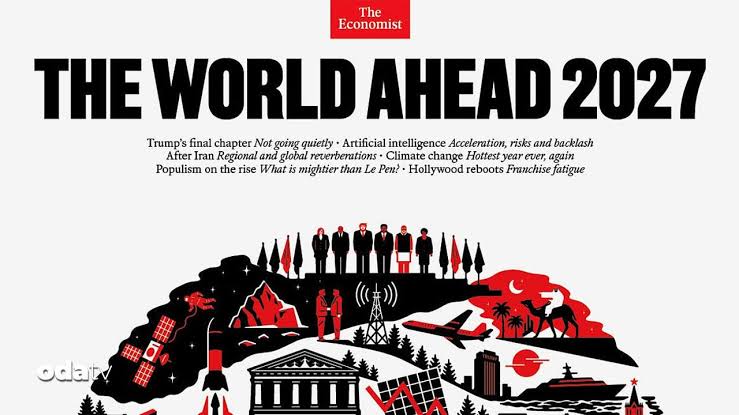
Every November, The Economist releases its flagship forecasting edition, enveloping its annual calendar assessment in a striking crimson, black, and white mosaic of cryptographic imagery that maps out the trajectory of the next twelve months. Much like the pop-culture phenomenon of The Simpsons long celebrated for uncanny retroactive parallels with real-world events this annual visual exercise has triggered a massive wave of digital interpretation. As soon as the cover drops, social media platforms flood instantly with speculative decoding, viral threads, and competing conspiracy analyses, transforming a traditional journalistic exercise into an open-source global guessing game.
Below is an in-depth breakdown of the primary themes, symbols, and twelve-month trajectories encoded within the visual and editorial layout of The World Ahead 2027.
1. The New World Order: Six Leaders at the Summit of Power
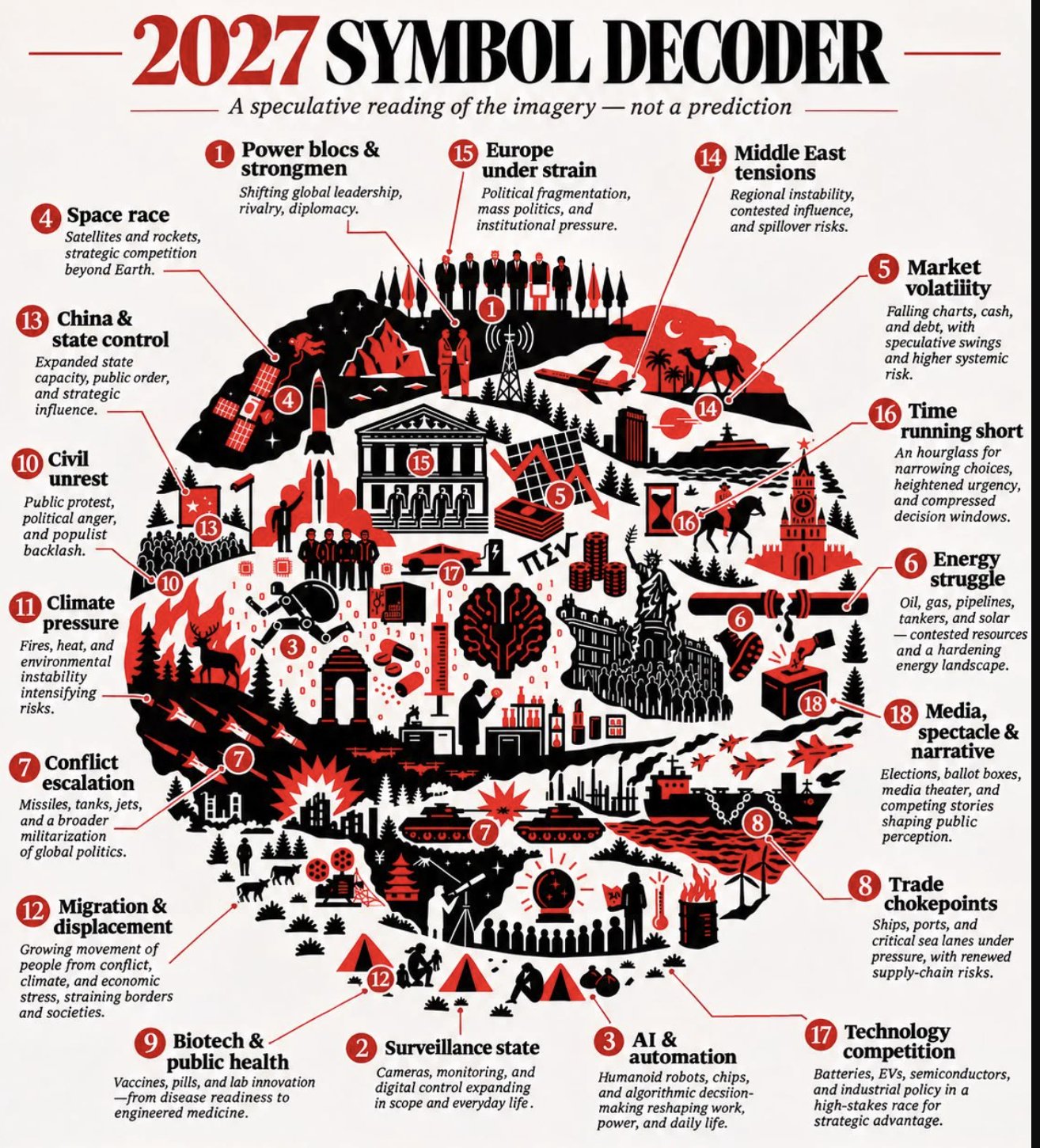
At the very apex of the cover’s circular globe stands a row of six silhouetted world leaders, flanked by cypress trees and positioned directly above a broadcasting tower. Although The Economist intentionally leaves these figures unnamed fueling intense online debate visual analysts and geopolitical observers widely identify the lineup as representing the six decisive power brokers shaping 2027: Giorgia Meloni (Italy), Vladimir Putin (Russia), Donald Trump (United States), Xi Jinping (China), Narendra Modi (India), and Sanae Takaichi (Japan).
Giorgia Meloni (Italia)
— Eduardo Menoni (@eduardomenoni) November 17, 2026
Vladimir Putin (Rusia)
Donald Trump (Estados Unidos)
Xi Jinping (China)
Narendra Modi (India)
Sanae Takaichi (Japón)
El nuevo orden mundial tal como se representa en la revista The Economist en su más reciente edición de análisis para este 2027. pic.twitter.com/lZ3AkQhrQZ
2. The Post-Trump Twilight and America’s Erratic Exit
The Economist highlights the onset of a new political phase as Washington braces for the post-Trump era. Following mid-term electoral shifts that handed Democrats control of congressional chambers, President Donald Trump’s final chapter is predicted to be anything but quiet. Rather than acting as a lame duck, analysts warn he may operate with the unpredictability of a "destructive Angry Bird," leaning heavily on executive overreach, legal battles, and aggressive foreign policy maneuvers.
3. AI, Automation, and Financial Backlash
At the center of the design sits a glowing red human brain intertwined with server nodes, binary code, and digital graphs. This visualizes the editorial warning for 2027: a growing AI backlash driven by financial overextension. Massive capital expenditures poured into data centers and computing infrastructure are increasingly backed by complex, opaque debt arrangements. If commercial returns fail to match staggering initial outlays, the tech sector faces a potential valuation correction, corporate debt stress, and a credit crunch.
4. Middle Eastern Tensions and Energy Vulnerabilities
Moving across the canvas, cargo ships bound in heavy chains adjacent to regional symbols highlight the enduring fallout of conflict involving Iran. The publication emphasizes that these geopolitical tremors will continue to reconfigure energy supply flows, disrupt vital maritime trade lanes, and exert pressure on global agricultural inputs, particularly fertilizer availability and food security.
5. Sovereign Debt Pressures and European Political Strain
Across Europe, fiscal stability faces mounting threats. The potential political rise of figures such as Marine Le Pen in France introduces severe political fragmentation, mass protests, and strain on the Franco-German alliance that underpins the European Union. Concurrently, industrialized nations globally are grappling with unsustainable public spending, translating into rising bond yields, persistent fiscal deficits, and growing pressure on sovereign balance sheets.
My Analysis of The Economist's The World Ahead 2027 Cover
— Geo Panda (@Geotactix) November 17, 2026
Here is what I could interpret from the illustration. These are my personal observations and predictions based on the symbols and their placement.
1. Top Section – World Leaders and Geopolitics
Six influential world… pic.twitter.com/NafV0AtOLn
6. Taiwan’s Strategic Moment of Peril
The inclusion of military hardware, naval vessels, and strategic positioning points directly to East Asia. Observers note that 2027 marks a frequently cited milestone for Chinese military readiness regarding Taiwan. However, the publication highlights that lessons drawn from contemporary conflicts—where asymmetric tech, autonomous drones, and agile defense systems complicate traditional military dominance—will fundamentally alter strategic calculations, risking semiconductor supply-chain disruptions.
7. Surveillance, Climate Pressure, and Micro-Trends
Away from hard geopolitics, the visual imagery touches on systemic structural shifts. The widespread adoption of weight-loss pharmaceuticals (the "Ozempic effect") is steadily altering consumer spending patterns and healthcare systems. Simultaneously, commercial space activity enters a more practical phase of reusable rockets, private stations, and satellite infrastructure competition, even as record-breaking climate pressures, drought, and wildfires intensify environmental instability.