Assam’s Land: Detect, Delete & Deprt
The consequences are visible in the continuing contest over land and demographic space.
NewsBharati 19-Nov-2026 12:55:57 PM
Total Views |


Assam Chief Minister Himanta Biswa Sarma’s determined campaign against illegal immigration marks an important departure from the politics of postponement that has allowed this problem to persist for decades. His message, “Detect, Delete and Deport”, is not simply an administrative slogan. It represents an attempt to address a historical challenge that has threatened Assam’s demographic balance, land ownership patterns, indigenous identity and territorial security. The state’s latest action, including the apprehension and expulsion of 38 alleged illegal immigrants on November 18, must be viewed against this larger historical background. Sarma deserves support for confronting an issue that successive governments have either failed to resolve or lacked the political will to tackle decisively.
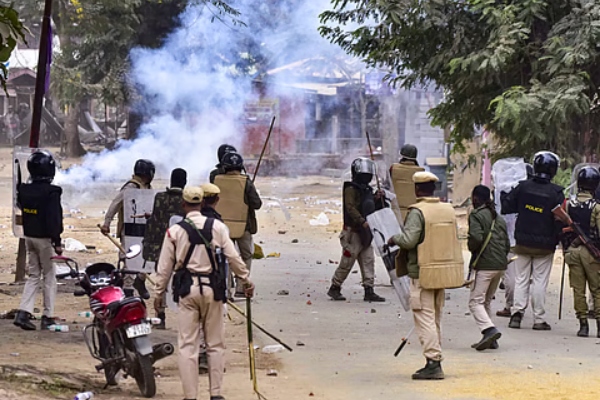
The issue exploded into a mass movement in 1979. The All Assam Students’ Union (AASU) and the All Assam Gana Sangram Parishad (AAGSP) mobilised people against the presence of illegal foreigners and demanded their identification, deletion from electoral rolls and deportation. The immediate provocation was the discovery of suspected foreign nationals in electoral rolls during the Mangaldoi by-election process. The agitation reflected a widespread fear that indigenous Assamese communities could lose their political influence, land and cultural identity in their own homeland. It was not merely an agitation over voting rights; it was a struggle over the future character of Assam.
The six-year movement exacted a terrible human cost. More than 850 people lost their lives. Its conclusion came with the signing of the Assam Accord on August 15, 1985, by the Rajiv Gandhi government and the representatives of AASU and AAGSP. The Accord established March 25, 1971, as the cut-off date. Those who entered Assam before January 1, 1966, were to be regularised; those who arrived between January 1, 1966, and March 24, 1971, were to be detected and subjected to the prescribed registration and electoral restrictions; and those who entered on or after March 25, 1971, were to be detected, deleted from electoral rolls and expelled. The agreement also promised constitutional safeguards for Assamese identity, border security and protection against encroachment on government and tribal land.
But what happened after the Accord? The AGP, born out of the Assam Movement, came to power in 1985 under Prafulla Kumar Mahanta. It had received an extraordinary political mandate from a people who expected it to fulfil the promises for which an entire generation had struggled. Yet, its two spells in office, 1985–1990 and 1996–2001, did not produce the promised resolution. The party could not translate the movement's historic mandate into an effective and comprehensive system for identifying and deporting illegal immigrants. Political instability, insurgency, administrative weaknesses and the complexities of implementation further weakened its record. The tragedy was that a party created by the movement itself could not deliver its central promise.
Congress governments that followed did little to restore public confidence. The most controversial step was the enactment of the Illegal Migrants (Determination by Tribunals) Act, 1983, by the Indira Gandhi government. Applicable only to Assam, it created a separate and cumbersome mechanism for identifying illegal migrants. In 2005, the Supreme Court struck it down in the Sarbananda Sonowal case, holding that the legislation and its procedures were unconstitutional. The Court's judgment exposed the practical obstacles that had made the detection and expulsion of illegal migrants so ineffective. The subsequent Congress years, including the long tenure of Tarun Gogoi from 2001 to 2016, did not resolve the problem. The Assam Accord remained an unfinished commitment, while border management, detection machinery and the protection of vulnerable land continued to demand attention.
The consequences are visible in the continuing contest over land and demographic space. Assam's indigenous communities have repeatedly raised concerns about encroachment on forest land, grazing reserves, government land and protected tribal areas. These are not abstract anxieties. Land is the foundation of livelihood, community identity and political security. When illegal settlement becomes entrenched, the consequences extend beyond the occupation of a particular plot. It can alter local population balances, influence electoral constituencies, intensify competition for public resources and weaken the traditional position of indigenous communities. The Assam Accord itself recognised these dangers through its provisions on land protection, border security and safeguards for cultural identity.
This is where geographical and territorial integration becomes paramount. National integration cannot be reduced to emotional slogans, official ceremonies or the celebration of diversity. It must begin with the protection of the country's territorial integrity. Assam occupies a strategically sensitive position in India's Northeast, sharing a long international boundary with Bangladesh and serving as the gateway connecting the region with the rest of the country through the narrow Siliguri Corridor. Unregulated migration and the gradual establishment of illegal settlements in sensitive border areas cannot be treated as a routine law-and-order issue. The integrity of the national territory, the security of its borders and the protection of indigenous communities are inseparable national responsibilities. A country that fails to protect its frontier regions risks creating vulnerabilities that may eventually have consequences far beyond the affected state.

What, then, has prompted Sarma to act with greater urgency? The answer lies in the cumulative failure of the past, the continuing pressure on land and the opportunity to use legal provisions more effectively. Since taking office in May 2021, his government has undertaken large-scale eviction drives against encroachments on government and forest land. In July 2025, Sarma reported that 1,19,548 bighas approximately 160 square kilometres—had been cleared, affecting around 50,000 people. He has also drawn attention to the scale of remaining encroachments. His government has increasingly used the Immigration (Expulsion from Assam) Act, 1950, and the legal powers available to district authorities to accelerate action against foreigners.
The urgency is reinforced by the scale of the unresolved cases. The Gauhati High Court has drawn attention to the large number of declared foreigners who remain unapprehended or unexpelled. Sarma has also adopted a two-front approach: dealing with fresh infiltrators as well as illegal immigrants who entered after the 1971 cut-off and have since settled in the state. This marks a shift from merely identifying the problem to attempting enforcement. The Supreme Court's October 2024 judgment upholding Section 6A of the Citizenship Act also brought the historical settlement under the Assam Accord back into national focus.
Sarma's campaign must be judged by results, but its underlying objective is legitimate and deserves unequivocal support. Firm enforcement must, of course, rest on verified nationality, established legal procedures and safeguards against the wrongful identification of Indian citizens. Such safeguards do not weaken the campaign; they give it constitutional credibility. Nor should legitimate concern about illegal immigration be converted into hostility towards any religious or linguistic community. The target must be unlawful entry and settlement, not identity.
Assam has waited long enough. The sacrifices of the Assam Movement cannot be honoured merely through memorials and annual tributes while the central demand of that historic struggle remains unfulfilled. The AGP failed to convert its mandate into lasting results; Congress governments failed to provide an effective solution; and the consequences of this prolonged indecision continue to confront the state. Himanta Biswa Sarma has chosen to take on a politically sensitive and administratively difficult challenge. His government must pursue it consistently and lawfully, with the Centre providing the necessary support and diplomatic coordination. India's national integration begins with the security of its territory. Assam's land, identity and geographical integrity are not bargaining chips in electoral politics. Detect, Delete and Deport must no longer remain an unfulfilled promise.

Editor's Desk
Editor's Desk