Rahul Gandhi's Columbia University visit and the possible Soros network behind it
Rahul Gandhi"s Columbia University appearance brought together academic programmes, international media professionals and institutions with documented connections to the global philanthropic ecosystem with notorious profile.
NewsBharati 19-Nov-2026 18:27:03 PM
Total Views |


When Rahul Gandhi, Leader of the Opposition in the Lok Sabha, travelled to New York for an interaction at Columbia University on Nov 17, 2026, the immediate headlines focused on his criticism of India's economy, unemployment and democratic institutions. But there is another dimension to this visit that deserves closer examination, that is the the institutional and professional networks surrounding the event.
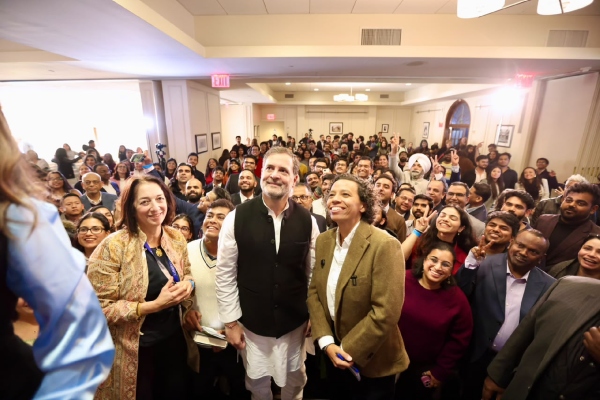
Who introduced Gandhi? Who moderated the conversation? Which academic programmes and institutions co-sponsored it? And what are the documented relationships between these individuals and organisations associated with George Soros's Open Society Foundations (OSF)? These are legitimate questions, particularly when an Indian political leader uses an international academic platform to discuss the functioning of India's democratic institutions. However, the answers must emerge from documentary evidence rather than assumptions about political coordination.
An examination of publicly available institutional biographies, event announcements and media reports reveals several overlapping professional associations. They do not, by themselves, establish a coordinated political operation. But they do provide a starting point for investigating the international networks through which narratives about India are discussed and amplified.
1. The Columbia connection: Who introduced and moderated Rahul Gandhi?
The Columbia University interaction featured two prominent American media and academic figures: Anya Schiffrin, who introduced Rahul Gandhi, and Lydia Polgreen, who moderated the conversation.
The event was organised through Columbia University's School of International and Public Affairs (SIPA), with five co-sponsors:
- Technology, Policy, and Innovation Concentration
- Simon and June Li Center for Global Journalism
- Columbia World Projects
- Committee on Global Thought
- Initiative for Policy Dialogue (IPD)
The event listing restricted attendance to Columbia University identification-card holders, requiring registration through a university email address. This was an academic-campus event, not an open public rally. However, the available reporting does not establish the claim that only a handful of students attended.
Now, while we keep a note of the sponsors, let us move ahead in the nexus.
2. Anya Schiffrin and her documented Open Society Foundations associations
Anya Schiffrin is a senior lecturer at Columbia University's School of International and Public Affairs and faculty co-director of its Technology Policy and Innovation concentration. She also directs journalism programmes at the Initiative for Policy Dialogue.
Her institutional biography on IPD's official website contains some particularly relevant information. It explicitly states that IPD's journalism training programme received support from three philanthropic organisations:
- Rockefeller Brothers Fund
- Ford Foundation
- Open Society Institute (OSI), the former name of the Open Society Foundations.
More importantly, the same biography records that Schiffrin was a member of the sub-board of the Open Society Foundation's Media Program. Her Columbia Journal of International Affairs biography separately identifies her as a member of the Global Board of Open Society Foundations.
These are documented professional associations, not merely speculative connections based on photographs or social-media interactions. This distinction is crucial in the case study. OSF is an international philanthropic organisation founded by George Soros, with an extensive grant-making network spanning media, governance, human rights and civil society.
Schiffrin's professional association with its structures therefore deserves to be part of any examination of the institutional ecosystem surrounding the Columbia event.
3. Lydia Polgreen: The moderator and her institutional affiliations
The second important figure is Lydia Polgreen, the journalist who moderated Rahul Gandhi's conversation. Polgreen is an opinion columnist at 'The New York Times' and has held senior editorial positions in American journalism.
Her institutional association with the Committee to Protect Journalists (CPJ) is also documented. According to CPJ's Oct 24, 2018 announcement, Polgreen joined its Board of Directors when she was Editor-in-Chief of HuffPost. She currently serves as the organisation's Vice Chair.
CPJ is an international non-profit organisation working on press freedom and journalist safety. Its funding comes from individual donors, corporations and foundations.
The organisation's public disclosures establish that it is funded through philanthropic contributions. However, no further details are available on the donors.
4. Five co-sponsors and the wider institutional ecosystem
Coming back, the Columbia event had five co-sponsors. Out of these, three deserve particular attention because of their institutional relationships with the individuals and organisations discussed above.
1. Technology, Policy, and Innovation Concentration
Anya Schiffrin is the faculty co-director of this concentration at Columbia SIPA. Her role establishes a direct academic connection between the event's organisational structure and one of the principal speakers.
2. Initiative for Policy Dialogue
Schiffrin directs journalism programmes at IPD. Its official biography documents historical support for its journalism training programme from the Open Society Institute, alongside the Ford Foundation and Rockefeller Brothers Fund.
3. Committee on Global Thought
Another interesting institutional connection emerges from Columbia's separately announced programme, New Visions of Globality, scheduled for December 1, 2026.
The event is being organised by the Committee on Global Thought in collaboration with Open Society Foundations. Its announced speakers include Leonard Benardo, Senior Vice President at OSF, and LuHan Gabel, Associate Director at OSF. Adam Tooze, Chair of the Committee on Global Thought, is listed as moderator.
This establishes a documented institutional collaboration between the Committee and OSF. It is worth examining because the Committee also co-sponsored Gandhi's November 17 interaction.
Rahul Gandhi at Columbia University
— STAR Boy TARUN (@Starboy2079) November 18, 2026
(OSINT Investigation)
Why would someone fly 13,000 km just to speak in front of a handful of university students?
I investigated:
- People associated with the event
- Sponsors of the event
- Other similar events happening around the same time… pic.twitter.com/04ToybFPXI
5. The SIR controversy: From India's electoral debate to international headlines
The larger political context makes the Columbia interaction particularly significant. India's Special Intensive Revision (SIR) of electoral rolls has become a major political controversy. The Election Commission maintains that the exercise is intended to update electoral rolls and remove duplicate, deceased and otherwise ineligible registrations.
Opposition parties, including the Congress, have questioned its implementation, alleging arbitrary exclusions and procedural irregularities. On October 13, 2026, Reuters published an explainer titled What is fuelling India's protests over changes to voter lists?
The report discussed protests against the Election Commission, the opposition's allegations concerning voter deletions, and claims that the exercise disproportionately affected certain communities. It also included the Election Commission's position and recorded that the poll body and the BJP denied allegations of political wrongdoing.
The report was subsequently republished by Pakistan's Dawn.
There is a crucial distinction here, that deserves attention. The Reuters report is not established to be fabricated merely because it carries allegations critical of the Indian government or Election Commission. Its claims and figures must be evaluated individually, including the distinction between draft-roll deletions, actual disenfranchisement and allegations made by political actors.
Nevertheless, its international reach is relevant. A domestic electoral controversy was now being discussed through international media platforms, with the potential to influence how overseas audiences understood India's electoral institutions.
6. The international amplification question
The Columbia interaction took place against this larger backdrop of protests, electoral controversies and international media coverage. Rahul Gandhi used the platform to discuss India's political situation, youth-led protests and electoral accountability. During the interaction, he also criticised the government's economic record, manufacturing performance and employment situation.
The event therefore provided an international academic platform for an Indian opposition leader to present his assessment of the country's political and economic circumstances. The question is whether the subsequent international discussion of these issues represents independent journalistic interest, the natural convergence of institutional networks, or a more coordinated effort to shape perceptions of India.
The available evidence does not settle that question. The X investigation referred for this article, also points to commentary by American economist Steve Hanke, who has an established public profile as a critic and commentator on economic policy. However, there are still a lot of things that remain unanswered and cannot be concluded with, without any substantial evidence.
7. Why India must pay attention to international narrative-building
The larger issue extends beyond one Columbia University event. India is a major democratic power with an increasingly consequential international presence. Its electoral processes, institutions, economic policies and social developments naturally attract global scrutiny. International scrutiny is neither inherently illegitimate nor something India should seek to avoid.
But scrutiny must be accompanied by transparency, context and accountability. When an Indian opposition leader discusses domestic electoral disputes on an overseas platform, the audience deserves to know the institutional context in which the conversation takes place. Similarly, when international media organisations report on Indian democratic processes, their claims deserve examination against official records, judicial observations and independent evidence.
The existence of philanthropic networks connecting academics, journalists, media programmes and civil society organisations is a legitimate subject of public investigation. The Open Society Foundations itself publicly acknowledges its extensive grant-making activities across countries and institutions.
Therefore, the important questions that demand institutional follow-up in this case for further clearer picture are:
- Which organisations receive funding, and for what specific programmes?
- What institutional relationships exist between event organisers, speakers and philanthropic foundations?
- Are the funding arrangements and institutional affiliations adequately disclosed?
- Are allegations concerning India's democratic institutions being independently verified before being amplified internationally?
- Is there documentary evidence of coordination between political actors, media organisations and international institutions, or are observers connecting otherwise independent activities?
Follow the institutions, examine the evidence
Rahul Gandhi's Columbia University appearance was more than a conversation between an Indian opposition leader and an American journalist. It brought together academic programmes, international media professionals and institutions with documented connections to the global philanthropic ecosystem with notorious profile.
Anya Schiffrin's recorded associations with Open Society Foundations, IPD's historical OSI-supported journalism programme, and Columbia's separate collaboration with OSF are all matters of public record. Taken together, these facts provide a basis for further investigation into the networks through which India's political and democratic controversies are discussed internationally.
But the next stage must go beyond tracing professional biographies. It must examine funding records, event correspondence, sponsorship arrangements, editorial decisions and verifiable instances of coordinated amplification. India's democratic institutions should not be above criticism. Equally, criticism of India should not be above scrutiny.

Himali Nalawade
Himali Nalawade is associated with News Bharati as an Author since a considerable period. She is mostly linked with researched articles from the areas of Defence, Defence Infrastructure and Culture-Religion. Along with her Masters in Mass Communication and Journalism after her graduation in History, she has also studied Diploma in Underwater Archaeology and Diploma in Indology.