Rahul Baba Seeks Divine Endorsement for His Immaturity
Hindu philosophy is far greater than the political ambitions of any individual or party.
Total Views |


Hindu religious symbolism cannot be reduced to a political prop. Invoking the profound imagery of Shiva and Parvati to defend a personal remark raises questions about the understanding, context and political appropriation of ancient philosophy.
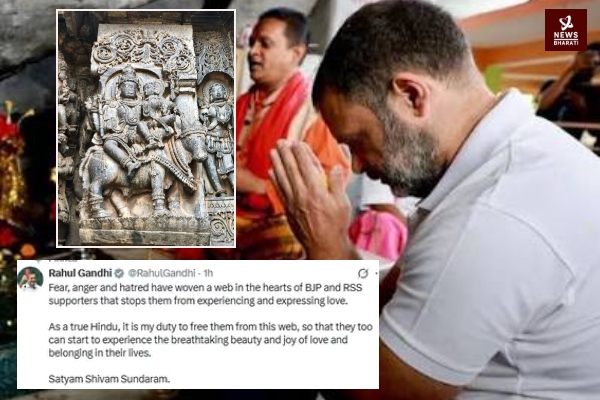
Rahul Gandhi has once again brought Hindu religious symbolism into a political controversy. Following criticism of his remarks about the relationship between his parents, Sonia and Rajiv Gandhi, he invoked an image of Bhagwan Shiva and Parvati Maata to defend his understanding of love and affection. The image, depicting the divine couple together on Nandi, was accompanied by a message accusing BJP and RSS supporters of being trapped in fear, anger and hatred. He also declared that, as a true Hindu, it was his duty to free them from this condition.
The episode raises a larger question that goes beyond the original controversy - does invoking Hindu deities automatically establish the philosophical validity of a political argument? And can the profound spiritual symbolism of Sanatan Dharma be casually enlisted to settle a political dispute?
The Divine Couple and the Political Argument
The sculpture Rahul shared is from the 12th-century Hoysaleshwara Temple at Halebidu, a remarkable example of Hoysala architecture. It depicts Shiva and Parvati together on Nandi. The image represents much more than an expression of affection between a husband and wife. Shiva and Shakti represent profound philosophical principles - Purusha and Prakriti, consciousness and creative energy. Their union is a fundamental expression of cosmic existence. It is this philosophical depth that makes the imagery sacred and enduring.
Rahul's argument, however, was considerably narrower. He used the image to suggest that his critics were incapable of understanding love because their hearts were consumed by hatred. He then assumed the mantle of a true Hindu whose duty was to liberate them from this supposed psychological condition. This is where his political argument deserves scrutiny. Why should disagreement with a political leader be interpreted as an inability to understand love? And why should a religious identity be invoked to establish moral superiority over political opponents?
The selective invocation of Sanatan symbolism
This is not the first occasion on which Rahul Gandhi has invoked Bhagwan Shiva to articulate his political understanding of Hinduism. During his July 2024 Lok Sabha speech, he presented Shiva as a symbol of fearlessness and non-violence, arguing that Hinduism should not be associated with hatred and fear. His subsequent references to Shiva suggest an attempt to distinguish his understanding of Hinduism from the BJP's political articulation of Hindutva.
There is nothing objectionable about presenting a personal interpretation of Hindu philosophy. Hinduism has accommodated diverse interpretations, philosophical debates and spiritual paths for centuries. But the question is whether such references represent a sustained engagement with eternal philosophy or become particularly prominent when political circumstances demand them.
The BJP has questioned Rahul's understanding of the historical significance of the Hoysala capital, pointing to the destruction of its temples by invading armies. That historical dimension also deserves recognition. India's magnificent temples are not merely architectural monuments; they are repositories of civilisational memory, artistic excellence and spiritual inheritance. Their history cannot be separated from the need to preserve and understand India's cultural heritage.
Religion Is Not a Political Costume
The larger issue is the increasing tendency to use Hindu religious symbols as instruments of political positioning. A leader cannot invoke Hindu deities to claim moral authority over opponents while treating the philosophical and civilisational inheritance represented by those deities as merely a convenient political language.
Ancient India philosophy does not require political certification. Nor does it belong exclusively to any political party. Its philosophical foundations precede modern political formations by centuries. Its strength lies in its capacity to accommodate inquiry, disagreement, devotion and multiple interpretations of truth.
Rahul Gandhi is perfectly entitled to express his understanding of Hindu ideas. But the same freedom applies to those who question his interpretation. Criticism of his political argument cannot automatically be dismissed as hatred towards Hinduism, just as his invocation of Shiva cannot automatically be treated as proof of philosophical understanding.
There is also a distinction between preaching love and practising the spirit of tolerance. Love cannot be made a political monopoly, and religious symbolism cannot be used to divide society into those who supposedly understand it and those who do not.
Fear, anger and hatred have woven a web in the hearts of BJP and RSS supporters that stops them from experiencing and expressing love.
— Rahul Gandhi (@RahulGandhi) November 17, 2026
As a true Hindu, it is my duty to free them from this web, so that they too can start to experience the breathtaking beauty and joy of love and… pic.twitter.com/U5LDJ6MZ4z
Hindu philosophy is far greater than the political ambitions of any individual or party. Shiva and Parvati are not props in a political exchange, nor is their divine relationship an instrument for settling partisan scores. Their symbolism belongs to a civilisation whose philosophical depth has endured across millennia. Those who invoke it should recognise the responsibility that comes with doing so. Hindu civilization does not need political leaders to authenticate its greatness. It needs its inheritance to be understood, respected and preserved.
Rahul Gandhi’s Selective Hindutva: Faith or Political Convenience?
Rahul Gandhi’s public engagement with Hindu identity has followed a pattern that invites scrutiny. In the run-up to the 2017 Gujarat elections, he undertook an extensive temple-visiting campaign, declared himself a devotee of Lord Shiva and subsequently described himself as a “Shiv bhakt”. In 2018, the Congress projected him as a “janeu-dhari Hindu” during the Madhya Pradesh election campaign. Rahul himself said he did not need the BJP’s certificate to visit temples. These episodes marked a visible attempt to assert Hindu credentials in an increasingly competitive political environment.
But the question is whether this symbolism represents a sustained ideological commitment. In November 2021, Rahul drew a sharp distinction between Hinduism and Hindutva, alleging that Hindutva was associated with violence against minorities. At a Jaipur rally, he declared, “I am a Hindu but not a Hindutvawadi,” . This was not merely a philosophical distinction; it was also a political attack on the ideological tradition associated with the RSS and BJP.
The contradiction became more visible in January 2024, when the Congress leadership declined the invitation to the Prabhu Ramchandra temple consecration, describing the ceremony as an RSS-BJP event. Rahul defended the decision by calling it a political programme, even while millions of Hindus regarded the consecration as a historic religious occasion.
His subsequent invocation of Shiva and Parvati to defend his political remarks raises another question - is Hindu symbolism being embraced as a matter of conviction or deployed when it serves a political argument? Critics can reasonably interpret this sequence as selective engagement with Hindu identity rather than an unambiguous ideological commitment.
The larger issue is consistency. Hindu faith cannot be reduced to temple visits, sacred symbols and carefully timed declarations. Nor can Hindutva be dismissed as an alien political label while its cultural and civilisational foundations are selectively invoked. Rahul is entitled to his personal faith, but the public record also invites scrutiny of the political uses to which he puts it. The distinction between conviction and electoral positioning must ultimately be judged by consistency of words and actions, not by the frequency with which religious symbols appear in political speeches.