Our history is not one of defeats, but of struggle and resistance
This narrow approach to history was not confined merely to the selection of dynasties. Our textbooks accorded considerable importance to foreign invasions and the defeats suffered by Indian kingdoms, but the stories of resistance, courage, sacrifice, martyrdom, and the civilisational continuity didn"t receive the attention they deserved.
Total Views |


- Pranay Kumar
On September 29, NCERT released the new Class IX Social Science textbook, "Understanding Society and Beyond, Part II." There had been a degree of discontent among a section of informed opinion over the slow pace of changes in curricula and textbooks in keeping with the recommendations of the National Education Policy (NEP) 2020 and the National Curriculum Framework (NCF) 2023. The new textbook appears to be a significant step towards addressing this disillusionment. Drawing upon intensive study and extensive research, the curriculum committee has incorporated historical episodes, personalities and dynasties that, for a long time, were felt to deserve adequate representation. From this perspective, the book is not merely a revision of the curriculum but also a noteworthy attempt at reinterpreting and rewriting history. What distinguishes it is that it moves beyond the confines of Delhi-centric historiography and presents the historical and civilisational journey of India's diverse regions in a broader perspective. Indeed, it would be more appropriate to say that, for the first time, an attempt has been made to present history in school education in its entirety, embracing its full scope and diversity.
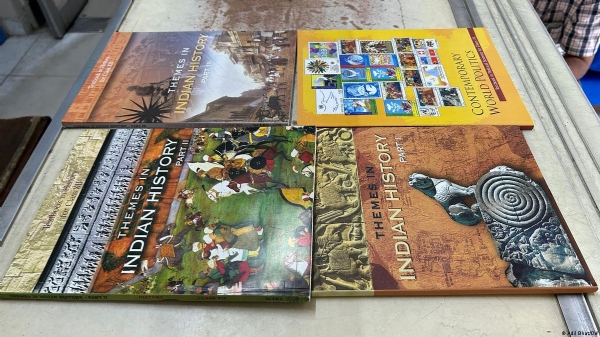
Until now, history textbooks, in the name of a composite culture and the so-called Ganga-Jamuni tehzeeb, have tended to devote disproportionate attention to the Gulam, Khalji, Tughlaq, Sayyid and Lodi dynasties of the Delhi Sultanate, as well as the Mughals. In contrast, powerful dynasties from other parts of the country were often confined to the margins under the label of regional history. The question, therefore, is: what should determine the distinction between national and regional history? The significance of a dynasty cannot be determined merely by the location of its capital or its geographical position. Its political influence, cultural contribution, duration of rule and historical achievements are equally important. On what basis, then, was Delhi-centric history accorded national significance, while the history of the rest of India was categorised as regional and its importance correspondingly diminished?
The Ahom kingdom, which preserved its independence for nearly six centuries and defeated the Mughals on approximately seventeen occasions; Mewar, which waged an extraordinary struggle to defend its independence; the Maratha power, which laid the groundwork for the eventual collapse of the Mughal Empire and gave political expression to the idea of Swaraj; and the Vijayanagara Empire, which ushered in an extraordinary flowering of art, architecture, literature and music in southern India: was it not a narrowing of the vast expanse of Indian history to view these powers merely through the prism of regional history? The same question arises in the context of numerous other dynasties, including the Cholas, Chalukyas, Palas, Pratiharas, Pallavas, Paramaras, Maitrakas, Rashtrakutas, Vakatakas, Karkotas, Kalingas, Kakatiyas and Satavahanas. To this day, the nation has not received a substantive and rational answer to the question of why these Indian dynasties were pushed into the background of school textbooks?
This narrow approach to history was not confined merely to the selection of dynasties. Our textbooks accorded considerable importance to foreign invasions and the defeats suffered by Indian kingdoms, but the stories of resistance, courage, sacrifice, martyrdom, and the civilisational continuity and traditions of Sanatan Bharat did not receive the attention they deserved. Yet, the history of India is not merely a chronicle of defeats; it is an account of extraordinary struggles waged to defend freedom, self-respect and cultural identity. The rulers, saints, Bhakti poets, Sikh Gurus, intellectuals and various sections of society fought formidable battles to protect their culture, traditions and ideals. Following the advent of Islam, the political and cultural character of many ancient civilisations underwent profound transformations, while several ceased to exist altogether. Yet, despite enduring horrific bloodshed, plunder, arson and, indeed, widespread destruction and fragmentation, India's Sanatan cultural tradition preserved its civilisational continuity and cultural integrity. To understand this continuity and resilience, it is essential to place the diverse currents of resistance and the role of Sanatan society at the centre of historical inquiry.
It is worth reflecting that the same Islamic onslaught which swept away thousands of years of civilisation in Persia, Egypt, Mesopotamia and almost the entire region of West Asia within a mere two to three decades encountered a very different response in India. India stood its ground against this onslaught for nearly seven centuries and continues to stand firm even today. Surely, this endurance must have rested on certain formidable strategic and cultural foundations. Why, then, should it be considered inappropriate to give voice to this legacy of pride, resistance, courage, struggle and self-respect? The new NCERT textbook seeks to bring this historical dimension, neglected for nearly five to six decades, to the fore in a more comprehensive, reasoned and balanced manner.
As part of this illustrious tradition of resistance, the textbook covers the Battle of Dewair between Maharana Pratap and Akbar, the Ahom kingdom's prolonged independence, the defeat of the Mughals under the leadership of Lachit Borphukan at the Battle of Saraighat in 1671, the achievements of the Vijayanagara Empire, and Maratha rule and the concept of Swaraj. It also refers to Aurangzeb's imposition of the jizya tax, the revolt led by Gokula Jat against his hardline religious policies, and the unwavering faith, tradition of sacrifice and extraordinary struggle of the Sikh Gurus against Mughal religious persecution.
Particularly noteworthy is the fact that the textbook does not confine this tradition of resistance to male rulers alone but also presents, in considerable detail, the contributions of three valiant women. Prominent among them is Rani Naiki Devi, who defeated Muhammad Ghori at the Battle of Kasahrada in 1178. Rani Rudrama Devi of the Kakatiya dynasty ruled from 1262 to 1289 and defended the independence of her kingdom. Similarly, Rani Abbakka of Ullal, in the coastal region of Karnataka, resolutely resisted Portuguese colonial expansion. The inclusion of these courageous women highlights not only the role of women in Indian history but also the geographical breadth and diversity of the struggles waged across India to defend freedom and self-respect.
As always, certain Leftist historians and intellectuals have lost no time in launching a vitriolic attack on this change. Having found little else to criticise, they have now begun arguing that the textbook's assertion that the practice of "purdah or ghoonghat" among Hindu women emerged after the advent of Islam in India is historically incorrect. To substantiate their claim, some of them have cited the Sanskrit poet and playwright Bhaas, arguing that his works contain references to the ghoonghat. These Leftist historians and intellectuals are so adept at constructing narratives to suit their ideological positions that they do not hesitate to distort facts and misrepresent evidence. Are they unaware that Bhaas was a poet and playwright, not a historian, and that his purpose was not to write history? The irony is striking.
On the one hand, they dismiss the Ramayana and the Mahabharata as fiction, refuse to recognise the Puranas as historical sources, and never tire of describing the Indian knowledge systems enshrined in the Vedas and Upanishads as outdated. On the other hand, they resort to arbitrary interpretations of historical sources and references whenever it suits their ideological convenience. More importantly, are they not aware of the fundamental contrast between civilisations in which religious restrictions (Shariyat) are imposed on everything from dance, music and painting to the free expression of art and life, and Sanatan culture, which regards liberation from all forms of bondage as its ultimate goal? Another illustration of this ideological double standard emerges in the new textbook's treatment of the relationship between popular faith, Dharmik consciousness and the history of Indian resistance and struggle. These Leftist critics object to the textbook's references to traditions in which the king of Bastar receives a sword from Maa Danteshwari, Kumar Kampana of the Vijayanagara Empire receives a sword from a goddess, or Chhatrapati Shivaji Maharaj receives a sword from Maa Tulja Bhavani.
They seek to dismiss such traditions as superstition. History, however, is not merely a record of wars, treaties, dynasties and political events; it is also the study of the beliefs, symbols and collective sentiments that inspired societies to fight, organise resistance and remain resolute in extraordinary circumstances. Mentioning a religious tradition associated with a historical event and declaring every detail of that tradition to be a literal historical fact are two entirely different things. A historian's responsibility is to critically examine available evidence, popular memories and cultural contexts, not to exclude a tradition from a textbook simply because it does not conform to the historian's ideological convictions. Without understanding the role of dharmik faith and the worship of goddesses in the lives of warriors such as Maharana Pratap, Rana Kumbha and Chhatrapati Shivaji Maharaj, it is impossible to adequately assess the cultural consciousness of their times. Recording the presence of faith in history is not an attempt to promote superstition; it is an effort to understand the mindset of the past and the sources of inspiration that shaped historical action.
What is astonishing is that these very Leftist intellectuals readily accept references to religious symbols and faith-based narratives as part of cultural heritage when discussing Western history and folk traditions. Yet, when the same perspective is applied to Bharat, it suddenly becomes synonymous with unscientific thinking. Whether it is the study of the religious inspiration behind Joan of Arc's actions in European history or the cultural significance of the legend of King Arthur's sword, Excalibur, such episodes are examined in their historical and literary contexts. Why, then, is there such reluctance to understand the consciousness that regards Goddess Durga, Kali or Maa Bhawani as symbols of power, courage and victory in Indian tradition? Does a scientific approach to history mean looking at Indian traditions of faith exclusively through the lens of suspicion? Is the idea of feminine power acceptable only when its expression conforms to Western intellectual frameworks? Is it not true that, in the Sanatan tradition, the Goddess is not merely an object of worship but also a symbol of power, freedom, courage and resistance to injustice? Any interpretation of Indian history and society that fails to understand this cultural conception will inevitably remain incomplete.
The textbook also provides concrete examples of the extensive efforts undertaken to rebuild temples, alongside its account of their destruction. By highlighting the historical contributions of figures ranging from Raja Todar Mal and Raja Man Singh to Devi Ahilyabai Holkar, it makes clear that temple reconstruction was not merely an exercise in architectural restoration. It was also an effort to restore collective faith, cultural identity and civilisational self-respect. The book further highlights how the uninterrupted and sacred current of the Bhakti movement played a vital role in keeping India's cultural consciousness alive when places central to faith and community life, including temples, libraries and dharmashalas, were being targeted by Mazahabi zealotry. Saints and poets such as Surdas, Tulsidas, Kabir and Mirabai carried the message of devotion to the masses, embedding faith deep within people's hearts rather than confining it to external symbols. As temples were being destroyed, they transformed every home and every heart into a temple of faith. A remarkable example of this form of cultural resistance is the movement led by Chaitanya Mahaprabhu in Bengal. When a Qazi imposed a ban on sankirtan, Chaitanya Mahaprabhu took to the streets with thousands of people and organised collective sankirtan in defiance of the prohibition. This mobilisation may well be regarded as an early instance of a movement resembling civil disobedience.
One of the major strengths of this textbook is that it places Indian traditions of governance, policymaking and nation-building at the heart of political science. It traces the roots of Indian democracy, good governance and the constitutional system not merely to Western models and standards, but also to the Vedas, the Upanishads, the Ramayana, the Mahabharata, Kautilya's Arthashastra, and the systems of governance and values embodied in ancient Indian republics, particularly Vaishali and the Lichchhavis. The National Education Policy (NEP) 2020 is presented as an example of consultative, evidence-based policymaking, while the Khelo India Policy 2025 serves to explain the role of sports in nation-building. References to "Satyameva Jayate" from the Mundaka Upanishad, the Supreme Court's motto, "Yato Dharmastato Jayah", inspired by the Mahabharata, and the "Sengol", a symbol associated with the Chola dynasty, along with its installation in the new Parliament building in 2023, underscore the connection between India's ancient heritage and contemporary traditions of governance. Another significant feature of the textbook is its emphasis on preparing students for practical life. Alongside information on personal income tax calculations, tax slabs, health insurance, personal financial management and government welfare schemes, it presents the timely payment of taxes as a civic responsibility. The chapter 'From Ideas to Startups' draws on examples such as Lijjat Papad, Oberoi Hotels and the historical trading traditions of the Chettiar community to highlight the importance of Indian entrepreneurship, local economies, cooperatives and financial literacy.
The textbook also identifies six major contributions of businesses: generating employment and income, producing goods and services, paying taxes, promoting innovation, improving quality of life, and fulfilling corporate social responsibility. Taken together, this textbook brings Indian knowledge systems, cultural consciousness, traditions of governance and the practical requirements of everyday life into a common framework. Moving beyond a critique of the perspectives and limitations of Leftist historians, it offers students an opportunity to understand history and society through Indian contexts and alternative perspectives. Its significance lies not merely in presenting facts that challenge prevailing historical narratives, but, more importantly, in cultivating among students an understanding of the interconnections between India's civilisational continuity, intellectual heritage and contemporary national life.
The author of this article is an educationist & Founder of the social organisation "Shiksha Sopan"