Bangladesh: From Revolution to Revenge
The developments on November 19 expose the fragility of the new political order.
Total Views |


Bangladesh's latest turmoil is a reminder that overthrowing a government is not the same as establishing democracy. The student-led uprising of August 2024, which forced Sheikh Hasina out of power after 15 years, was celebrated as a popular revolt against authoritarianism. But more than two years later, Bangladesh is still struggling to find political stability. The country has a new elected government under Prime Minister Tarique Rahman, but violence, political vendetta, institutional uncertainty and hostility towards India continue to cloud its future. The revolution that promised democratic renewal risks becoming another chapter in Bangladesh's long history of political confrontation.
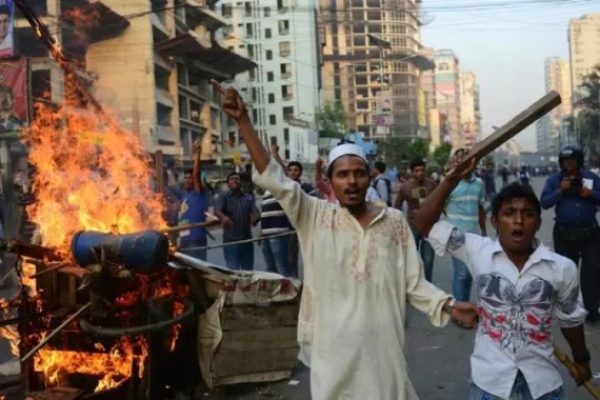
The developments on November 19 expose the fragility of the new political order. Supporters of the banned Awami League attempted a nationwide shutdown to protest the government's rejection of Hasina's request for a passport and identity documents to facilitate her proposed return from India in December. The protests were accompanied by bomb blasts, arson, attacks on political opponents and disruption of public transport. Two members of the ruling Bangladesh Nationalist Party (BNP) were killed, while houses belonging to BNP legislators were attacked. The ancestral home of Nobel laureate Muhammad Yunus, who headed the interim administration after Hasina's departure, was also set ablaze. The deployment of 97 platoons of the Border Guard across seven districts and the arrest of more than 100 people in Dhaka indicate the seriousness of the situation.
These are not isolated incidents of lawlessness. They reveal a political culture in which the transfer of power is accompanied by the desire to eliminate the previous establishment rather than replace it through democratic competition. The Awami League, which governed Bangladesh for 15 years, has been barred from political activity. Its leadership faces serious allegations relating to the violent suppression of the 2024 uprising. Hasina herself was sentenced to death in absentia by a Bangladeshi tribunal for crimes against humanity connected with the crackdown. Accountability for state-sponsored violence is essential, and no political leader should be above the law. However, the prosecution of individuals and the exclusion of an entire political organisation are two different propositions. Democracy cannot be strengthened by denying a substantial political constituency the opportunity to participate in legitimate politics.
The Awami League cannot escape responsibility for its own record. But the shortcomings of the previous regime cannot become a justification for political persecution under its successor. If the new dispensation believes that democratic legitimacy comes from defeating an authoritarian government, it must demonstrate that it understands the obligations that accompany that mandate.
Tarique Rahman's government faces its first major test here. The BNP returned to power through the February 2026 elections, but electoral victory is not an unlimited licence to exercise authority. Its responsibility is to restore confidence in democratic institutions, ensure the rule of law and create conditions in which political opponents can function without fear. The continuing attacks on political workers, properties and institutions raise uncomfortable questions about the government's ability to maintain order. The targeting of Grameen Bank offices, founded by Yunus, is particularly disturbing. At least 37 of its branches and offices have faced arson attacks or attempted attacks since November 10, according to the bank. An organisation associated with microfinance and economic empowerment should not become a casualty of political retaliation.
The question of Hasina's return is emerging as another flashpoint. Her presence in India has complicated bilateral relations, and Dhaka has sought her extradition. India, understandably, cannot treat an extradition request involving a former head of government and a death sentence as a routine administrative matter. Due process, the credibility of judicial proceedings and the implications of the punishment must be considered. At the same time, Hasina's political statements from Indian soil have become a source of friction. New Delhi must handle this sensitive issue with diplomatic restraint, without allowing it to become an excuse for hostility towards India.
More troubling is Tarique Rahman's allegation that Awami League leaders are conspiring against Bangladesh with the support of a neighbouring country, an apparent reference to India. Such insinuations may serve domestic political purposes, but they cannot substitute for evidence. India and Bangladesh share a border of more than 4,000 kilometres, common rivers, deep cultural connections and substantial economic interdependence. Neither country can afford to reduce this relationship to the political fortunes of one individual or party. Bangladesh's geographical position makes stable relations with India indispensable, irrespective of the government in Dhaka.
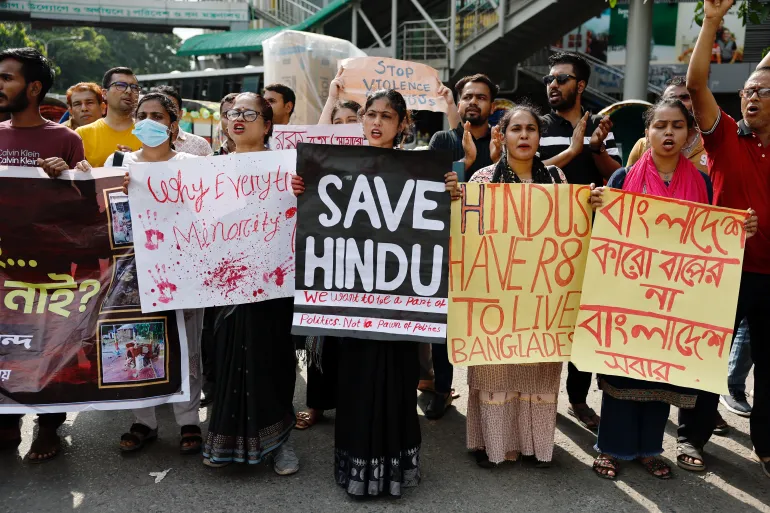
There is, however, a larger concern that New Delhi cannot afford to overlook - the security of Hindus and other religious minorities. The political upheaval following Hasina's departure was accompanied by reports of attacks on Hindu homes, businesses and places of worship. The vulnerability of minorities in a period of political transition is not merely a domestic law-and-order issue. It is a test of the new government's commitment to equal citizenship. Bangladesh was born out of a liberation struggle against discrimination and the denial of political and cultural rights. Its founding ideals cannot be selectively invoked while the security of a religious community remains uncertain.
The growing influence of Islamist political forces also deserves scrutiny. Bangladesh's political future must not be determined by religious majoritarianism or by forces seeking to redefine its national identity through exclusion. The country's liberation in 1971 was rooted in the Bengali language, cultural identity and the aspiration for political self-determination. Its constitutional and political evolution must preserve that pluralistic foundation. Any attempt to marginalise minorities or weaken the secular and inclusive character of the state would undermine the very principles on which Bangladesh was established.
The international dimension adds another layer to the challenge. Bangladesh's engagement with China, Pakistan and other powers is its sovereign choice. But geographical realities cannot be wished away. Its trade, energy requirements, connectivity, water resources and security arrangements are closely linked with India. The renewal of the Ganges water-sharing treaty, due on December 12, 2026, is one immediate test of bilateral cooperation. A deterioration in relations would hurt both countries, but Bangladesh would have much to lose by allowing domestic political compulsions to dictate its external policy.
The lesson of the 2024 uprising should be clear to every political stakeholder in Dhaka. A government can be removed through popular mobilisation, but democratic institutions cannot be built through street power, revenge or the suppression of political opponents. Hasina's mistakes should not be repeated by those who replaced her. Tarique Rahman has an opportunity to demonstrate that Bangladesh can move beyond its cycle of political vendetta. If he fails, the country may discover that its revolution changed the occupants of power without changing the politics of power. Bangladesh needs democratic reconciliation, not another round of political revenge; institution-building, not the perpetuation of street confrontation. A revolution that cannot deliver these essentials has yet to fulfil its promise.
Those in India who repeatedly invoke Bangladesh as a model of popular revolt must learn from its present predicament. Anarchists who romanticise street power must also learn from Nepal, where political upheaval carries its own consequences. Most importantly, Indians must recognise that democracy is strengthened through constitutional institutions, not weakened through mob pressure, political vendetta or manufactured disorder.