Government laid the foundation: Industry must now convert strength into jobs and shared prosperity
Prime Minister Modi explicitly called on Indian industry to accept new risks, raise investment, create jobs, and give priority to wage growth.
NewsBharati 20-Nov-2026 19:03:58 PM
Total Views |


Prime Minister Narendra Modi’s sharp political response to Rahul Gandhi’s claim of a severe economic crisis in India, made from American soil, has once again placed the contrast between pre-2014 governance and the working of the present government at the centre of public debate. Modi rejected the crisis narrative outright, observing that continuous insults directed at the country’s industrial leadership from morning till night contribute nothing to national progress. Instead, he pointed to concrete, measurable changes in the policy environment and economic architecture since 2014.
The differences he highlighted are structural. Before 2014, under the Congress-led UPA, industry operated under high corporate tax rates and elevated interest rates, persistent policy uncertainty, prolonged administrative delays, and repeated hurdles in project clearances. Infrastructure was inadequate, and both liquidity and credit availability remained constrained. The 2008 global financial crisis further disrupted the investment cycle, slowing capacity expansion and job creation for years. These conditions produced repeated complaints from industry and a visible hesitation to invest.
After 2014 the approach changed. Digital administration reduced discretion and delay. Sustained ease-of-doing-business reforms simplified procedures. The Goods and Services Tax created a single national market by unifying indirect taxes. Credit access for micro, small and medium enterprises was expanded through the Mudra scheme and related measures. Production Linked Incentive programmes offered targeted support to manufacturing. In 2019 the basic corporate tax rate for eligible domestic companies was lowered from 30 percent to 22 percent. Simultaneously, large-scale public investment rebuilt highways, modernised railways, expanded ports, strengthened defence production, and reinforced the energy sector. The cumulative effect has been a more predictable, lower-friction environment in which private capital can expand.
India today ranks among the world’s fastest-growing major economies. This growth has occurred alongside enduring labour-market challenges that no government can ignore. Long-term unemployment pressures persist, a large share of work remains informal, and gains in regular incomes have been gradual. Before the pandemic, roughly 24 percent of workers held regular wage jobs; Citi’s 2024 assessment placed the share at about 21 percent. Of the country’s 58.8 crore workers, more than half are self-employed. Absorbing new entrants into the labour force requires approximately 1.2 crore jobs each year. At an assumed 7 percent GDP growth rate, Citi reports estimated that 80–90 lakh jobs would be created annually, leaving a gap of 30–40 lakh. These figures describe an unfinished task of formalisation and absorption, not an economy in free fall.
Corporate balance sheets have strengthened markedly under the post-2014 framework. According to ACE Equities data covering 3,611 listed Indian companies, cash and bank deposits rose from roughly ₹5.5 lakh crore at the end of FY2020 to ₹10.67 lakh crore by the end of FY2025. Free cash flow has approximately doubled since 2020 to around ₹15 lakh crore. An independent estimate for FY2026 indicates that cash reserves are growing by about 12 percent and now exceed $200 billion. Geopolitical tensions, cautious domestic demand, investment restraint, and relatively modest dividend distributions help explain the accumulation. The cash is real; the question is whether it is being put to productive use.
CRISIL’s analysis of the period from FY2022 to FY2024 shows private corporate capital expenditure rising 8.7 percent, household investment growing 13.4 percent, and government and public-sector investment advancing 13.9 percent. Public capital formation has therefore led. Private firms, despite higher profits and larger cash holdings, have not matched this pace with new factories, expanded production lines, accelerated hiring, or broad-based wage increases. The asymmetry is visible and widely noted.
Public programmes continue to support employment. The Prime Minister’s Employment Generation Programme, MGNREGA, and various MSME schemes, together with large infrastructure projects, generate both direct and indirect jobs. These measures form a necessary floor. They cannot, however, meet the full national requirement. That depends on active private-sector participation—precisely the area where strengthened balance sheets and an improved policy environment create opportunity.
Companies now possess both the means and the enabling conditions to channel available funds into new production facilities, technology adoption, research and development, domestic supply-chain deepening, and systematic skill development. Priority should attach to creating regular wage employment for young entrants and to raising wages for existing workers. A working assumption of roughly 15,000 direct and indirect jobs per $1 billion of investment suggests that directing about half of the more than $200 billion cash stock into capital expenditure over the next three years could support 15–18 lakh additional jobs. Actual outcomes will vary by sector, region, and the capital intensity of individual projects, yet the order of magnitude illustrates the potential scale.
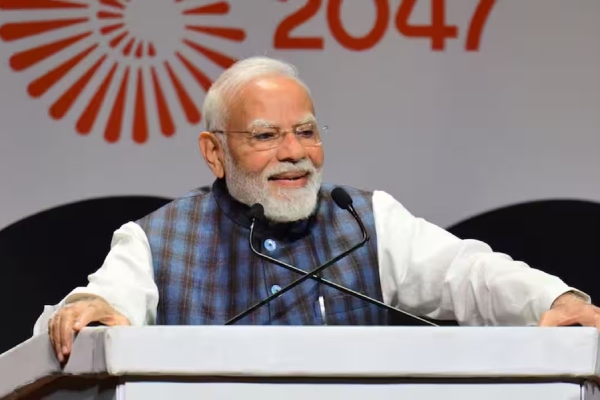
On 19 November 2026, addressing FICCI’s centenary session, Prime Minister Modi explicitly called on Indian industry to accept new risks, raise investment, create jobs, and give priority to wage growth. The gains from tax reductions, improved ease of doing business, and sustained public capital formation should return to the country in the form of higher production, greater employment, and rising incomes. In the larger project of a developed India, the test of industrial leadership lies exactly here.
Profits measure corporate performance. Job creation remains a national responsibility. The government has rebuilt the enabling architecture—lower taxes, unified markets, digital systems, targeted incentives, and physical infrastructure—that was deficient before 2014. The next decisive phase belongs to Indian industry: converting record cash reserves and restored confidence into factories on the ground, skills in the workforce, regular employment for the young, and wages that rise with productivity. That conversion will determine how fully the foundation already laid is translated into broadly shared prosperity and how convincingly India continues its advance toward developed-nation status. The policy conditions have changed; the responsibility to use them productively now rests with those who hold the capital.

Amita Apte
Amita Apte is a research scholar studying on South China Sea, CPEC and Indian engagement in region vis-a-vis China. She used to study and write about the socio cultural issues in North East India with a nationalist perspective. She is involved with an organisation that specially works for tribals in India. Amita works as an analyst and convener for ICRR.