From 'Headmaster's son' to 'Bread maker': Why are media outlets softening the image of terror operatives?
ThePrint’s repeated description of slain Lashkar-e-Taiba operative Umer Nisar Dar as a “bread maker” has raised serious questions about the editorial priorities and credibility of sections of the Indian media.
Total Views |


ThePrint, founded by Shekhar Gupta, has drawn criticism for repeatedly describing slain Lashkar-e-Taiba (LeT) operative Umer Nisar Dar as a 'bread maker' in its coverage of a terror attack in Jammu and Kashmir that left three Central Reserve Police Force (CRPF) personnel injured.
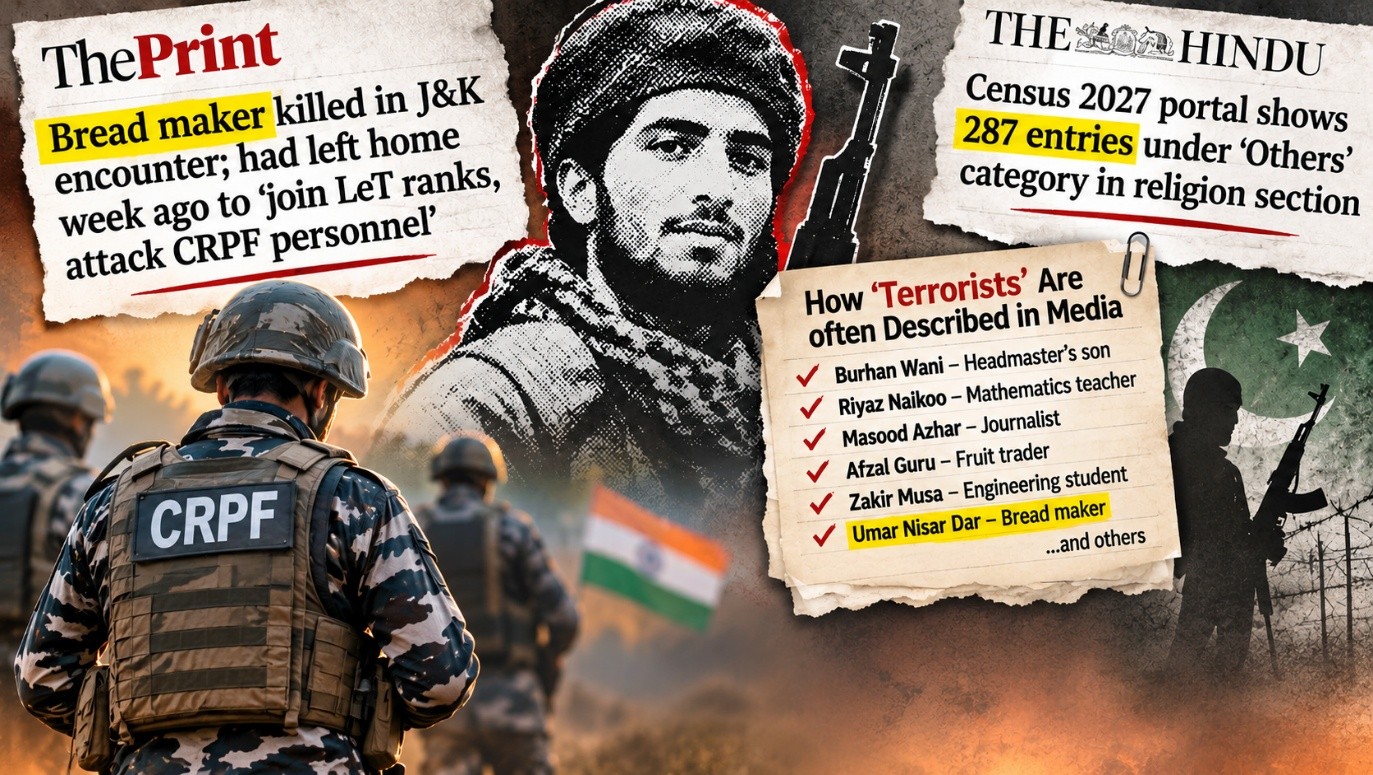
(A representative image generated using AI)
In its November 16 report, the digital news outlet carried the headline: 'Bread maker killed in J&K encounter; had left home week ago to “join LeT ranks, attack CRPF personnel”.'
The headline introduced the 19-year-old Dar through his former occupation. This was despite the report detailing his association with a Pakistan-backed terror network, his links with a terror handler and his role in reconnaissance before an attack on security personnel.
The description did not end with the headline. ThePrint repeated the 'bread maker' reference in subsequent reports, even while detailing allegations that Dar had provided shelter and logistical assistance to a terror handler for several months.
This raises a fundamental question about the publication's editorial priorities. When a report itself carries details of terror activities, why does the individual's former occupation repeatedly become the defining description?
Why is the emphasis on what the operative did for a living rather than what investigators found he did for a terror network?
Three CRPF personnel injured, but the operative's occupation gets the spotlight
According to ThePrint's own reporting, Dar, a resident of Arreh village in Kulgam, was associated with Lateef Bhatt, a handler of The Resistance Front (TRF), a proxy of the Lashkar-e-Taiba.
Dar had been providing shelter and logistical assistance to Bhatt for around five to six months. He went missing from his home on November 10 and joined the terror ranks.
ThePrint reported that Dar and Bhatt conducted reconnaissance at several locations, including Mir Bazar, Akhran, Hablish and Kilam, to identify potential targets and plan attacks against security forces.
On November 11, assailants opened fire on a CRPF bridge guard party near Mir Bazar. Three personnel were injured.
They were identified as Constable Rakesh Dass, who suffered injuries to his legs; Constable Santosh Chadru, who sustained injuries to his abdomen and spine; and Head Constable Somveer Singh, who was wounded in his left arm.
These were personnel who were performing their duties and putting themselves in harm's way to protect the country. Their injuries were the direct consequence of an attack by armed assailants.
Yet, in the headline and repeated descriptions, the occupation of the slain operative received attention.
What about the CRPF personnel? What about the men who faced bullets while carrying out their duties? Why should the personal background of a terror operative become the dominant human-interest element when the story concerns security personnel injured in an attack?
The sacrifices of India's security forces deserve more than a passing mention in the body of a report.
From Burhan Wani to Umer Dar: Why does this pattern keep recurring?
The controversy is not limited to Dar. It brings back memories of how sections of the media covered Burhan Wani, the Hizbul Mujahideen commander killed in 2016.
Following his death, attention was given to his family background. He was repeatedly described as the 'son of a headmaster'. His academic performance, interest in cricket and personal life also became prominent elements of the coverage.
Other individuals associated with militancy and terrorism have similarly been introduced through their professional or educational identities.
Riyaz Naikoo was described as a mathematics teacher, Mohammad Rafi Bhat as a university professor, Mannan Bashir Wani as a PhD scholar and Majid Irshad Khan as a footballer. Zakir Musa's background as an engineering student also featured in descriptions of him.
A social media post questioning this pattern lists 27 individuals whose professional, educational or personal identities have often been highlighted in public discourse despite their links to terrorism. The list includes Burhan Wani, described as a headmaster’s son; Riyaz Naikoo, a mathematics teacher; Mohammad Rafi Bhat, a professor; and Mannan Bashir Wani, a PhD scholar. It also mentions Majid Irshad Khan, a footballer; Afzal Guru, described as a fruit trader; Masood Azhar, a journalist and religious scholar; Abdul Subhan Qureshi, a software engineer; Zakir Musa, an engineering student; and Umar-un-Nabi, a doctor. Another individual, Ramachandra Reddy alias Chalapathi, is identified as an avid reader.
The compilation also refers to individuals introduced through descriptions such as student, academic, athlete and journalist. While these identities may provide biographical context, their repeated prominence raises questions about editorial priorities. Why do professional backgrounds and educational qualifications so often become the defining descriptions of individuals accused or convicted in terror-related cases, while their roles in violence, recruitment, radicalisation and attacks receive comparatively less attention?
The issue is not whether these descriptions are factually correct or whether journalists can report a person's profession. It is about the emphasis placed on them. A person’s former occupation does not erase involvement in terrorism, nor should it overshadow the victims of terror attacks and the security personnel who risk their lives to stop them. When such descriptions dominate headlines and reports, media organisations must explain whether they are providing essential context or unintentionally softening the public portrayal of those accused of grave crimes.
A professional background does not erase the consequences of involvement in terrorism. Being a teacher, engineer, doctor, student or small business owner does not make an attack on security personnel any less serious.
Why are media organisations giving less prominence to the terror angle?
This is where the credibility of news organisations comes under scrutiny.
Media houses are expected to inform readers about what happened, who was involved, the nature of the crime and its consequences. In terrorism-related reporting, the links with terror organisations, the role of handlers, the planning of attacks and the victims deserve clear prominence.
However, when headlines repeatedly introduce terror operatives through their professions, educational qualifications or family backgrounds, they risk shifting the focus away from the central issue.
Why should readers first encounter a LeT operative as a 'bread maker' rather than through the allegations concerning his association with a terror handler and an attack on CRPF personnel?
Why should the personal background of a militant receive repeated attention while the security personnel injured or killed in attacks struggle to occupy the same space in the narrative?
Why do some publications appear more interested in explaining the ordinary lives these individuals once led than examining the terror activities they became involved in?
These are legitimate editorial questions. They deserve answers from the newsrooms concerned.
Journalism does not require reporters to strip individuals of their personal histories. But it does require them to maintain perspective and ensure that human-interest details do not overshadow the central facts of a serious security incident.
The Hindu's 287 religions coverage raises questions about context
The controversy surrounding ThePrint has emerged shortly after The Hindu faced criticism over its November 17 coverage of the Census 2027 self-enumeration portal.
The newspaper reported that 287 entries had appeared under the 'Others' category in the religion section of the portal.
An Organiser report questioned the presentation of these entries as 287 separate religions, pointing out that the Registrar General and Census Commissioner of India had clarified that they were predictive-text suggestions intended to standardise spellings and record responses. They were not 287 officially recognised religious categories.
The list included names associated with religious organisations, sects, traditions and devotional identities. Their appearance in the portal did not mean that the government had recognised each as a separate religion.
The criticism centred on the need to place the government's clarification and the technical purpose of the entries prominently alongside the reported number.
The Census controversy and ThePrint's coverage of the Kulgam encounter are separate issues. However, both have brought attention to the importance of editorial context and the responsibility of publications to present information without leaving readers with a misleading or incomplete impression.
The men defending the country must not become an afterthought
India's security personnel operate in difficult and often dangerous conditions. They face armed terrorists, cross-border networks and threats to their lives while carrying out their duties.
When they are injured or killed in the line of duty, their sacrifices deserve to remain central to the reporting.
A terror operative's former profession cannot be more important than the actions that led to an encounter. Nor should the personal background of an individual become a convenient way of softening the public understanding of a terror-related incident.
The families of injured and fallen personnel deserve recognition. The public deserves to know the complete circumstances of attacks against security forces. And readers deserve reporting that places the facts, victims and consequences in their proper context.
The question for ThePrint and other publications facing similar criticism is not whether a terrorist had once been a student, teacher, engineer, doctor or bread maker. It is whether their coverage gives adequate prominence to the terror activities, the organisations behind them and the security personnel who pay the price.
When India's security personnel are facing bullets from terrorists, why should the headlines be more concerned with the terrorists' former professions than with the men and women risking their lives to defend the country?