The Hindu's Census Propaganda: How 287 predictive-text entries were turned into a religious controversy?
A list of 287 names appeared briefly under the “Others” option on the Census 2027 portal. The Hindu reported that the list was removed after it questioned the classification. However, the report did not adequately explain the government’s clarification that these names were predictive-text suggestions to help respondents enter their religious identities correctly, not a list of 287 officially recognised religions.
Total Views |


The first digital Census in India has run into a controversy over the way religious identities are recorded online. On November 16, when the self-enumeration portal for Census 2027 opened in four states, its religion section briefly displayed a list of 287 names under the “Others” category.
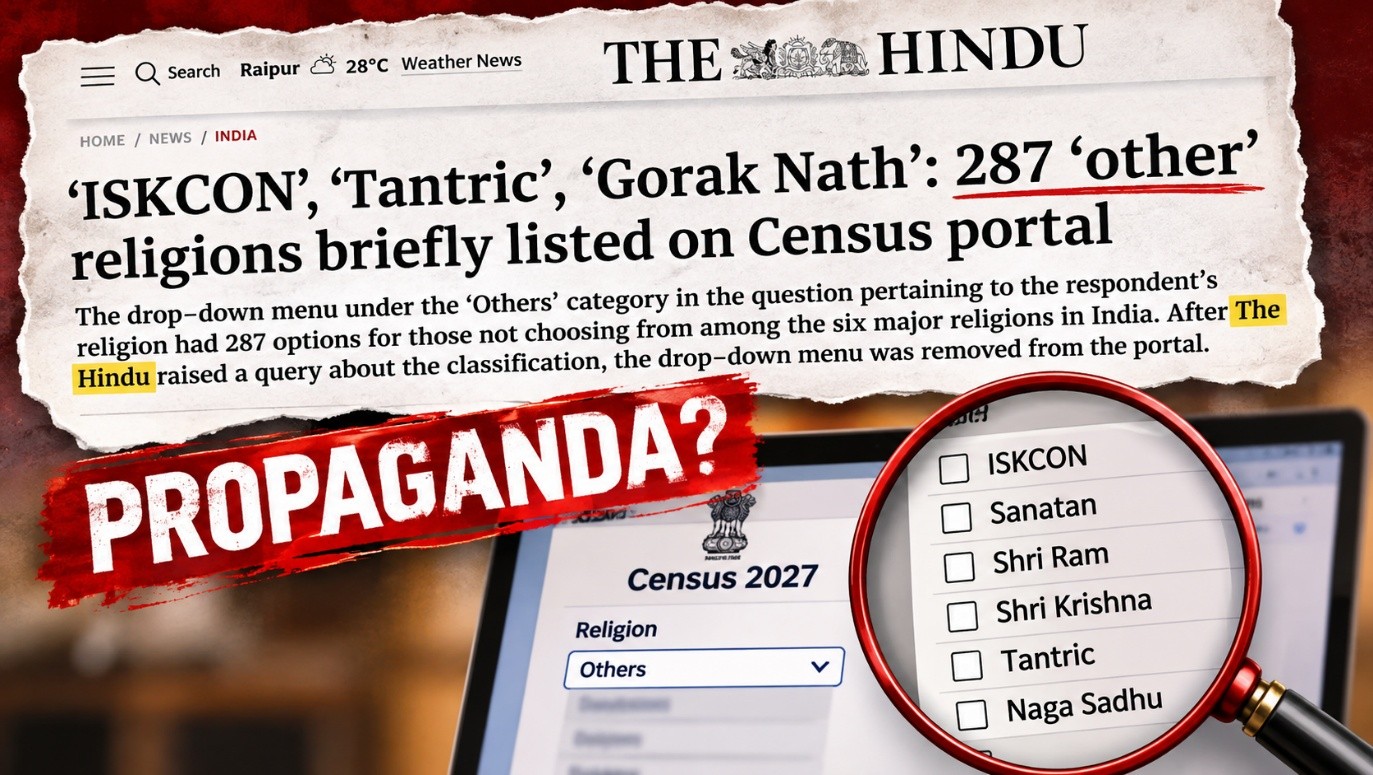
(Image generated using AI with a clipping of The Hindu report)
The list included ISKCON, Ramakrishna Paramahans, Sanatan, Shri Ram, Shri Krishna, Balmiki, Ramdev, Bishnoi, Vaishnaw, Devi Bhakt, Digambar, Adi, Tantric, Naga Sadhu, Yogi, Sufi, Shia, Sunni, Methodist, Pentecostal, Nirankari and Namdhari, among others.
The menu was apparently removed later after The Hindu raised a query with the Union Ministry of Home Affairs. The newspaper presented the development as a case of the government listing 287 “other religions”.
Excl: ISKCON, Ramakrishna Paramahans, Sanatan, Shri Ram, Shri Krishna, Balmiki, Ramdev, Bishnoi, Vaishnaw, Devi Bhakt, Digambar, Adi, Tantric, Naga Sadhu, Yogi, Sufi, Shia, Sunni, Methodist, Pentecostal, Nirankari, Namdhari etc listed among 287 “other” religions on Census…
— Vijaita Singh (@vijaita) November 17, 2026
However, that description leaves out a crucial distinction: the Registrar General and Census Commissioner of India's office said the entries were not being treated as separate religions.
The clarification changes the context of the story. What appeared to be a list of religious classifications was described by officials as a set of predictive-text entries intended to help maintain consistency in recording responses.
Headline misses the distinction between suggestions and official recognition
The central problem with the newspaper's presentation is that it treats every name in the drop-down list as a separate religion without adequately explaining the government's position.
The list brought together very different kinds of identities. ISKCON is a religious organisation. Sanatan refers to a broad religious tradition. Shri Ram and Shri Krishna are revered Hindu deities. Digambar is associated with a major Jain tradition, while Shia and Sunni are branches of Islam. Methodist and Pentecostal refer to Christian traditions. Sufi refers to a spiritual tradition within Islam.
These cannot simply be placed in one category and described as 287 separate religions.
The distinction matters because the Census does not officially recognise every organisation, sect, spiritual path or devotional identity as a separate religion merely because its name appears in a software menu.
The newspaper was right to question why such a list appeared on the portal. But reporting the list as an official classification, without giving sufficient weight to the government's clarification, risks misleading readers about what the Census authorities were actually doing.
What the government clarified
According to reports quoting officials from the Registrar General and Census Commissioner of India, the seven broad choices for recording religion remain unchanged: Hindu, Muslim, Christian, Sikh, Buddhist, Jain and Others.
Officials said the entries appearing under “Others” were intended as predictive-text suggestions. The purpose was to help ensure that names entered by respondents or enumerators were recorded consistently and without spelling variations.
For example, if someone identified with ISKCON, the system could help standardise the spelling instead of allowing the same name to be recorded in multiple ways.
A representative of the Registrar General's office also said it was incorrect to suggest that the listed terms had been presented as separate religions. Respondents, the official maintained, remained free to enter any other religious identity under the “Others” category, as in previous Censuses.
This is an important part of the story that readers need to know. The appearance of the names did not amount to an official decision to recognise 287 additional religions.
But why did the predictive-text list appear as a drop-down menu?
While the government's explanation addresses the question of religious classification, it does not settle the issue of how the portal was designed.
A government official in Uttar Pradesh involved in training Census enumerators reportedly told The Hindu that respondents selecting “Others” could choose from a list of more than 280 names. If their preferred identity was not available, they could enter it manually.
How religion was recorded in earlier Censuses
In earlier Censuses, respondents were given six named religious categories and an additional “Others” option. Those who did not identify with the six listed religions could write their religious identity under the latter category.
The classification of different sects and religious traditions was generally undertaken after the enumeration process. The 2001 and 2011 Census exercises also recorded responses under the category of “other religions and persuasions”.
The new digital portal's appearance of a pre-populated list under “Others” was therefore a departure in the way the response was presented to users. This made it reasonable to ask why the list had been introduced and whether it could influence the way people recorded their identities.
Sarna, sects and the question of religious identity
The list also included Sarna, an identity at the centre of a long-running demand by several Adivasi organisations for a separate religious code in the Census.
Tribal groups in Jharkhand, Chhattisgarh, Odisha and West Bengal have argued that Sarna represents a distinct religious tradition and should be recorded separately. The Jharkhand Assembly passed a resolution in November 2020 seeking a separate Sarna code.
The presence of Sarna alongside organisations, sects and other religious identities made the list particularly sensitive. But its appearance in the menu did not amount to the government's acceptance of a separate Sarna code.
The same principle applies to the other names. A person must be able to state their religious identity accurately, but a software suggestion is not the same as an official decision on how that identity will be classified in the final Census tables.
Newspaper turns census portal glitch into a religious controversy
The episode raises questions not just about the Census portal, but also about the approach to reporting religious issues. Instead of providing the complete context, the newspaper's headline and presentation risk creating the impression that the government had listed 287 separate religions under the “Others” category.
The government clarified that the entries were predictive-text suggestions intended to help respondents enter religious identities without spelling variations. They were not official classifications of 287 separate religions. The list itself contained a mix of organisations, sects, spiritual traditions, communities and devotional identities. Treating all of them as separate religions without explaining these distinctions creates a misleading impression.
This is where the newspaper’s reporting deserves scrutiny. Why present a technical feature of a digital form as a major religious classification controversy? Why foreground the number 287 without giving equal prominence to the government's explanation? And why does the newspaper repeatedly turn issues involving Hindu traditions and identities into controversies without providing readers the full context?
A newspaper cannot claim to inform the public while leaving out facts that materially change the meaning of its headline. When reporting creates confusion rather than clarity, questions about editorial intent are inevitable. This is precisely why many question whether The Hindu is functioning as a newspaper or a propaganda portal when it comes to matters involving religion and Hindu identity.
The census has been digitised for the first time since its inception in India. And hence, the portal's design and layout may have some complexities which will obviously get better with use and updates. But that does not give the right to a newspaper to turn an episode into a narrative, bringing religion to the centre just because the changes have been implemented at a time when BJP is in power. As far as the one-sided story of the newspaper is concerned, readers deserve to know the government's side, and what was the purpose of those 287 names. The larger question which remains unanswered is why the newspaper chose to present the information in a distorted manner and who is benefiting from such acts.