Rahul Gandhi's Campaign to Discredit India
India also emerged as a more articulate voice of the Global South.
NewsBharati 21-Nov-2026 11:59:03 AM
Total Views |


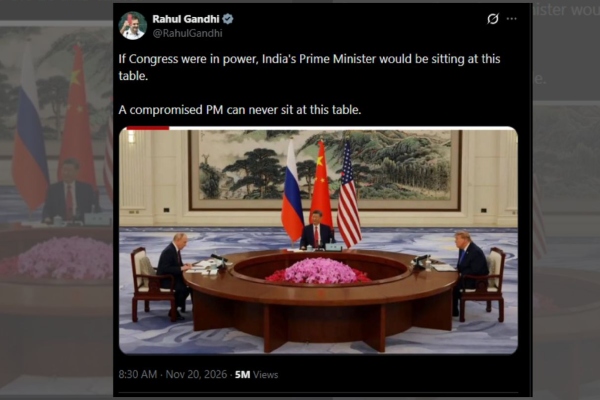
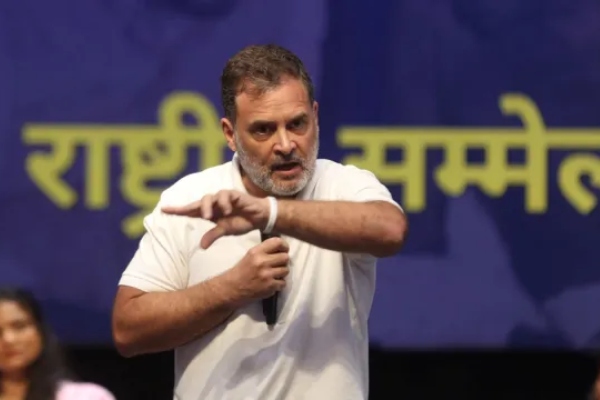
Rahul Gandhi's latest social media post, declaring that a “compromised PM can never sit at this table”, is more than another attack on Narendra Modi. By juxtaposing a photograph of Donald Trump, Xi Jinping and Vladimir Putin with the suggestion that an Indian Prime Minister would have been present had Congress been in power, the Leader of the Opposition has attempted to portray India as a diminished global power and its Prime Minister as internationally isolated. The insinuation is not merely that Modi has failed diplomatically; it is that India's standing has been compromised under his leadership. Such an allegation, made without producing any evidence of compromise, is irresponsible. More disturbing is the opportunity it gives Rahul Gandhi and the political ecosystem around him to amplify a narrative that damages India's international image.
The contrast with the Congress era is particularly revealing. Rahul Gandhi speaks as though his party had bequeathed India an unblemished diplomatic legacy. History tells a different story. Jawaharlal Nehru's China policy, founded on excessive faith in Chinese assurances, failed to anticipate Beijing's strategic ambitions. The slogan of Hindi-Chini Bhai-Bhai could not substitute for military preparedness or a realistic assessment of China's intentions. The 1962 war inflicted a humiliating military and diplomatic setback on India. It exposed the dangers of allowing idealism to replace strategic judgement.
The 1971 victory under Indira Gandhi was undoubtedly a remarkable achievement, but the subsequent Shimla Agreement also left important questions unresolved. India released approximately 93,000 Pakistani prisoners of war and secured the conversion of the ceasefire line into the Line of Control. Yet the Kashmir dispute continued, and Pakistan-sponsored terrorism remained a major challenge. The agreement had its diplomatic merits, but it did not translate India's military advantage into a permanent settlement of the central disputes.
The UPA years produced another episode that deserves scrutiny. Following the 26/11 Mumbai terror attacks, India faced a grave test of its resolve. The Sharm el-Sheikh joint statement of July 2009, issued by Manmohan Singh and Pakistan's Yousuf Raza Gilani, referred to Balochistan and delinked progress on the composite dialogue from action on terrorism. At a time when Pakistan's responsibility for confronting terrorism should have been central to the diplomatic engagement, the statement created an avoidable controversy and gave Islamabad an opening to internationalise Balochistan. It raised serious questions about the UPA government's diplomatic judgement.
There were also questions about the Congress party's relationship with China. The 2008 memorandum of understanding between the Congress and the Communist Party of China attracted renewed attention after the 2020 India-China border crisis. The relationship between the memorandum, the Rajiv Gandhi Foundation and Chinese-linked contributions became a subject of political controversy. These matters warrant transparent answers. They cannot simply be brushed aside when Congress leaders accuse the present government of compromising national interests.
Against this background, what has India achieved since 2014?
The 2023 G20 presidency was a defining moment. India secured the admission of the African Union as a permanent member of the G20, an important step towards making the forum more representative. The New Delhi Leaders' Declaration was adopted by consensus despite sharp international divisions over Ukraine. India brought development concerns, food security, climate finance and the priorities of developing countries into the centre of global discussions. This was not a country waiting for an invitation to the high table; it was a country helping shape the table itself.
The expansion of India's strategic partnerships has been equally significant. Its participation in the QUAD alongside the United States, Japan and Australia has strengthened cooperation in the Indo-Pacific, maritime security and critical technologies. At the same time, India has maintained its defence relationship with Russia and expanded cooperation with France, West Asian countries and other partners. It has refused to accept that its foreign policy must be dictated by the preferences of any one power bloc. This is strategic autonomy practised with confidence, not diplomatic isolation.
India has also moved from being a participant to an initiator of international platforms. The International Solar Alliance, launched with France, the Coalition for Disaster Resilient Infrastructure and the Global Biofuels Alliance are examples of India's efforts to create practical coalitions around global challenges. Vaccine Maitri, through which India supplied vaccine doses to 99 countries during the pandemic, demonstrated its capacity to contribute to international public welfare.
In 2026, India's presidency of BRICS and the hosting of the New Delhi summit further underlined its role in shaping the agenda of emerging economies. The summit's declaration called for a more representative and reformed multilateral system. These are tangible diplomatic initiatives, not merely photographs of leaders standing together.
None of this means that India has no diplomatic challenges. Its relationship with China remains difficult, Pakistan continues to sponsor terrorism, and India has not yet secured permanent membership of the UN Security Council. Nor should every achievement of Indian diplomacy be attributed exclusively to one Prime Minister. India's international standing rests on its economic weight, military capability, democratic institutions, diplomatic service and the contributions of successive governments. But it is equally unreasonable to deny the greater visibility, ambition and agenda-setting role that India has acquired under Modi.
The most troubling aspect of Rahul Gandhi's intervention is therefore not his criticism of Modi. Opposition leaders have every right to question the government's foreign policy, demand explanations and expose failures. But alleging that the Prime Minister is “compromised” is a grave charge. If Rahul possesses evidence, he must place it before the public. If he does not, he must explain why he is making such a serious allegation.
There is a distinction between holding a government accountable and undermining the standing of one's own country. When an Indian political leader repeatedly describes India as a “side player” and suggests that its Prime Minister is unfit to sit with world leaders, the message travels well beyond domestic politics. India's adversaries and those hostile to its rise can readily exploit such statements. Rahul Gandhi and those who shape his political messaging may find them useful for attacking Modi, but they must recognise the national cost of such rhetoric.
The Congress leadership should also remember that it cannot claim diplomatic superiority while avoiding accountability for its own record. Before declaring that a Congress Prime Minister would have occupied a seat at the table with Trump, Xi and Putin, Rahul must explain the strategic miscalculations and diplomatic controversies of the governments his party led.
India's place in the world is not a favour bestowed by three powerful leaders. It is earned through national strength, economic capability, strategic independence and the ability to shape global conversations. The country has made considerable progress on these fronts. Rahul Gandhi may oppose Narendra Modi, but he should not confuse the Prime Minister's political fortunes with India's national standing. A responsible Opposition challenges the government; it does not make the country's image collateral damage in its campaign for power.
There is a fundamental flaw in Rahul's argument. A country's diplomatic standing cannot be measured by whether its Prime Minister is present at one particular meeting of three powerful nations. The United States, Russia and China have their own strategic calculations. Their leaders meeting in Shenzhen does not automatically establish a new global directorate to which every major country must belong. Nor does India's absence from that meeting establish diplomatic irrelevance. International influence is measured by a country's ability to shape decisions, build coalitions, protect its interests and influence institutions. By that measure, India's record under Modi deserves serious examination.
The contrast with the Congress era is particularly revealing. Rahul Gandhi speaks as though his party had bequeathed India an unblemished diplomatic legacy. History tells a different story. Jawaharlal Nehru's China policy, founded on excessive faith in Chinese assurances, failed to anticipate Beijing's strategic ambitions. The slogan of Hindi-Chini Bhai-Bhai could not substitute for military preparedness or a realistic assessment of China's intentions. The 1962 war inflicted a humiliating military and diplomatic setback on India. It exposed the dangers of allowing idealism to replace strategic judgement.
The 1971 victory under Indira Gandhi was undoubtedly a remarkable achievement, but the subsequent Shimla Agreement also left important questions unresolved. India released approximately 93,000 Pakistani prisoners of war and secured the conversion of the ceasefire line into the Line of Control. Yet the Kashmir dispute continued, and Pakistan-sponsored terrorism remained a major challenge. The agreement had its diplomatic merits, but it did not translate India's military advantage into a permanent settlement of the central disputes.
The UPA years produced another episode that deserves scrutiny. Following the 26/11 Mumbai terror attacks, India faced a grave test of its resolve. The Sharm el-Sheikh joint statement of July 2009, issued by Manmohan Singh and Pakistan's Yousuf Raza Gilani, referred to Balochistan and delinked progress on the composite dialogue from action on terrorism. At a time when Pakistan's responsibility for confronting terrorism should have been central to the diplomatic engagement, the statement created an avoidable controversy and gave Islamabad an opening to internationalise Balochistan. It raised serious questions about the UPA government's diplomatic judgement.
There were also questions about the Congress party's relationship with China. The 2008 memorandum of understanding between the Congress and the Communist Party of China attracted renewed attention after the 2020 India-China border crisis. The relationship between the memorandum, the Rajiv Gandhi Foundation and Chinese-linked contributions became a subject of political controversy. These matters warrant transparent answers. They cannot simply be brushed aside when Congress leaders accuse the present government of compromising national interests.
Against this background, what has India achieved since 2014?
The 2023 G20 presidency was a defining moment. India secured the admission of the African Union as a permanent member of the G20, an important step towards making the forum more representative. The New Delhi Leaders' Declaration was adopted by consensus despite sharp international divisions over Ukraine. India brought development concerns, food security, climate finance and the priorities of developing countries into the centre of global discussions. This was not a country waiting for an invitation to the high table; it was a country helping shape the table itself.
India also emerged as a more articulate voice of the Global South. The Voice of Global South summits brought together more than 100 developing countries in each of the 2023 and 2024 editions. The purpose was to ensure that the concerns of poorer and developing nations were not subordinated to the priorities of powerful economies. India was not merely speaking for itself; it was attempting to build a wider constituency for reform of global governance.
The expansion of India's strategic partnerships has been equally significant. Its participation in the QUAD alongside the United States, Japan and Australia has strengthened cooperation in the Indo-Pacific, maritime security and critical technologies. At the same time, India has maintained its defence relationship with Russia and expanded cooperation with France, West Asian countries and other partners. It has refused to accept that its foreign policy must be dictated by the preferences of any one power bloc. This is strategic autonomy practised with confidence, not diplomatic isolation.
India has also moved from being a participant to an initiator of international platforms. The International Solar Alliance, launched with France, the Coalition for Disaster Resilient Infrastructure and the Global Biofuels Alliance are examples of India's efforts to create practical coalitions around global challenges. Vaccine Maitri, through which India supplied vaccine doses to 99 countries during the pandemic, demonstrated its capacity to contribute to international public welfare.
In 2026, India's presidency of BRICS and the hosting of the New Delhi summit further underlined its role in shaping the agenda of emerging economies. The summit's declaration called for a more representative and reformed multilateral system. These are tangible diplomatic initiatives, not merely photographs of leaders standing together.
None of this means that India has no diplomatic challenges. Its relationship with China remains difficult, Pakistan continues to sponsor terrorism, and India has not yet secured permanent membership of the UN Security Council. Nor should every achievement of Indian diplomacy be attributed exclusively to one Prime Minister. India's international standing rests on its economic weight, military capability, democratic institutions, diplomatic service and the contributions of successive governments. But it is equally unreasonable to deny the greater visibility, ambition and agenda-setting role that India has acquired under Modi.
The most troubling aspect of Rahul Gandhi's intervention is therefore not his criticism of Modi. Opposition leaders have every right to question the government's foreign policy, demand explanations and expose failures. But alleging that the Prime Minister is “compromised” is a grave charge. If Rahul possesses evidence, he must place it before the public. If he does not, he must explain why he is making such a serious allegation.
There is a distinction between holding a government accountable and undermining the standing of one's own country. When an Indian political leader repeatedly describes India as a “side player” and suggests that its Prime Minister is unfit to sit with world leaders, the message travels well beyond domestic politics. India's adversaries and those hostile to its rise can readily exploit such statements. Rahul Gandhi and those who shape his political messaging may find them useful for attacking Modi, but they must recognise the national cost of such rhetoric.
The Congress leadership should also remember that it cannot claim diplomatic superiority while avoiding accountability for its own record. Before declaring that a Congress Prime Minister would have occupied a seat at the table with Trump, Xi and Putin, Rahul must explain the strategic miscalculations and diplomatic controversies of the governments his party led.
India's place in the world is not a favour bestowed by three powerful leaders. It is earned through national strength, economic capability, strategic independence and the ability to shape global conversations. The country has made considerable progress on these fronts. Rahul Gandhi may oppose Narendra Modi, but he should not confuse the Prime Minister's political fortunes with India's national standing. A responsible Opposition challenges the government; it does not make the country's image collateral damage in its campaign for power.

Editor's Desk
Editor's Desk