Do you know Sonia Gandhi was Maruti’s technical services MD despite foreign citizenship? Here’s what happened
BJP MP Nishikant Dubey has revived allegations concerning the Gandhi family"s involvement in the establishment and functioning of Maruti companies during Indira Gandhi"s tenure as Prime Minister. Sharing excerpts from a historical government inquiry report, Dubey questioned how Sonia Gandhi, then an Italian national, became managing director of Maruti Technical Services Private Limited and held a 50 per cent stake
Total Views |


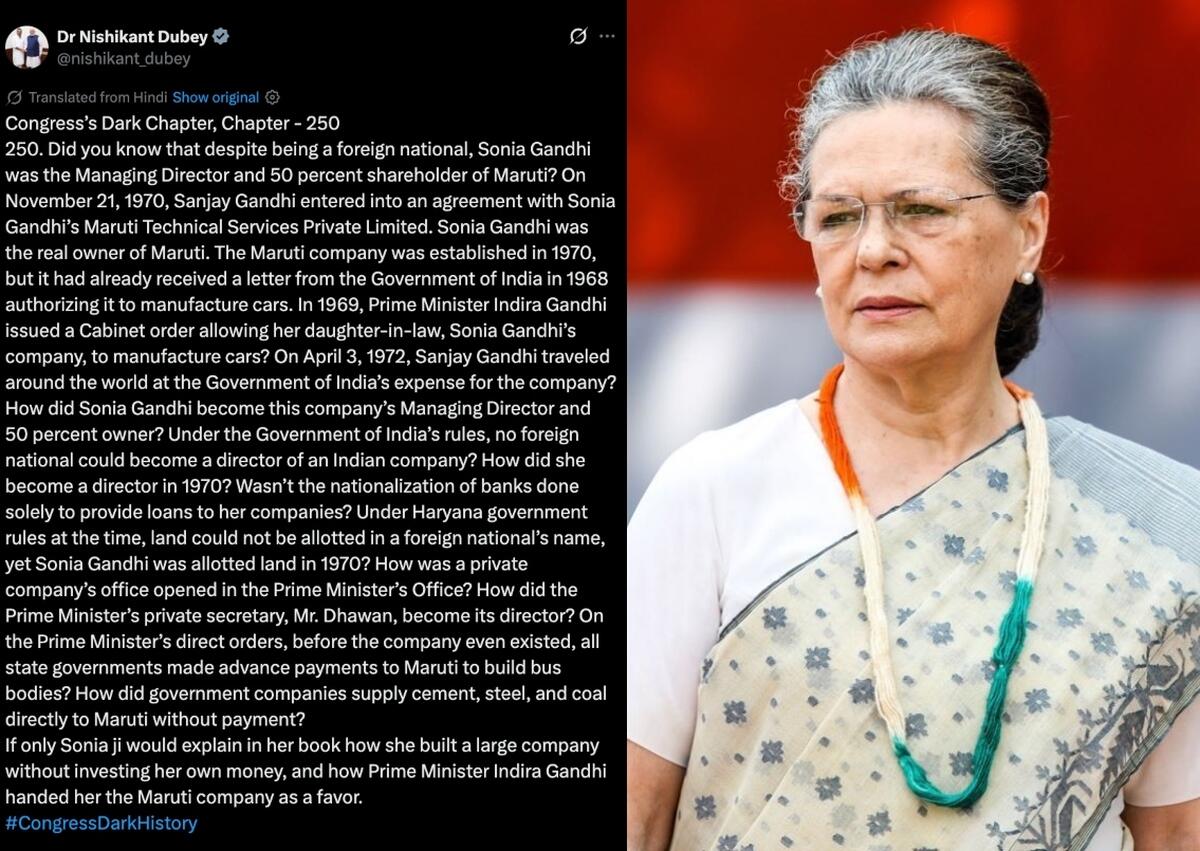
BJP MP Nishikant Dubey has reignited the controversy surrounding the Gandhi family's involvement in the Maruti project during the 1970s, sharing excerpts from a historical inquiry report that detail the business arrangements involving Sanjay Gandhi, Sonia Gandhi and Maruti Technical Services Private Limited.
In a post on social media, Dubey described the episode as a dark chapter in the Congress party's history and raised questions about how Sonia Gandhi, despite being a foreign national at the time, became a director and reportedly held a 50 per cent stake in a company associated with the Maruti project.
Dubey's allegations draw attention to the company's incorporation, shareholding arrangements, technical agreements, financial transactions and Sonia Gandhi's appointment as its managing director. The documents shared by him contain details of agreements executed between 1970 and 1975, including the transfer of technical know-how, share allotments and remuneration paid to Sonia Gandhi.
The excerpts also raise questions about the regulatory restrictions applicable to foreign nationals under the Foreign Exchange Regulation Act (FERA), 1973.
कांग्रेस का काला अध्याय, चैप्टर - 250
— Dr Nishikant Dubey (@nishikant_dubey) November 21, 2026
250. क्या आपको पता है कि विदेशी नागरिक होने के बावजूद सोनिया गांधी जी मारुति की मैनेजिंग डायरेक्टर और 50 प्रतिशत की हिस्सेदार थीं ? 21 नवंबर 1970 संजय गांधी जी ने सोनिया गांधी जी के मारुति टेक्निकल सर्विस प्राइवेट लिमिटेड के साथ समझौता किया… pic.twitter.com/p3gaOIOFiY
Maruti Technical Services incorporated in November 1970
The documents shared by Dubey appear to be excerpts from the Report of the Commission of Inquiry into Maruti Affairs, which examined the establishment, financial arrangements and functioning of companies associated with Sanjay Gandhi.
The report records that Maruti Technical Services Private Limited was incorporated on November 16, 1970, with an authorised share capital of Rs 5 lakh, divided into 50,000 equity shares of Rs 10 each.
Sanjay Gandhi and Sonia Gandhi were named as the company's first directors. The report states that they jointly held 20 equity shares, worth Rs 200, at the time of incorporation.
On November 21, 1970, Sanjay Gandhi entered into an agreement with Maruti Technical Services under which he agreed to provide technical know-how to the company for Rs 3 lakh.
The agreement described Sanjay Gandhi as having designed, manufactured and assembled a wholly indigenous motor car in India. It also provided for the transfer of technical information, designs, drawings, material and part specifications, technical documentation and other manufacturing-related knowledge.
The report further records that on December 15, 1971, 1,500 fully paid-up equity shares of Rs 10 each were allotted to Sanjay Gandhi. Subsequently, on June 2, 1972, Maruti Technical Services entered into another agreement with Maruti Limited to provide technical know-how for Rs 5 lakh.
Maruti Limited paid the amount on July 22, 1972. Out of this, Maruti Technical Services paid Sanjay Gandhi Rs 3 lakh on January 13, 1973, for the technical know-how.
The commission also questioned whether Sanjay Gandhi actually possessed the technical expertise he had agreed to transfer. It recorded that witnesses had stated that he did not possess the technical know-how claimed in the agreement.
Sonia Gandhi appointed managing director in January 1973
One of the significant findings recorded in the report concerns Sonia Gandhi's appointment as managing director of Maruti Technical Services Private Limited.
According to the report, she was appointed managing director at an extraordinary general meeting of the company's shareholders held on January 25, 1973. Sanjay Gandhi and Sonia Gandhi were the company's two directors and its only shareholders at that time.
A formal agreement was executed on February 26, 1973, appointing her to the position for five years, with effect from January 25, 1973.
Under the agreement, Sonia Gandhi was entitled to a monthly salary of Rs 2,000, along with a commission of one per cent on the company's net profits, subject to a ceiling of 50 per cent of her annual salary, in addition to perquisites.
The report also questioned her appointment to a technical company, observing that she did not possess technical qualifications. It recorded that the company's income-tax assessment had subsequently disallowed part of the remuneration paid to her on the grounds that she lacked the qualifications to provide technical services.
According to the report, Sonia Gandhi's income-tax returns showed that she received Rs 26,022 in salary, bonus and commission for the year ended September 30, 1973. For the following year, the reported amount was Rs 39,393, apart from dividends.
The commission also examined her appointment as managing director of Maruti Heavy Vehicles Private Limited. An agreement dated September 28, 1974, was signed for the position, but the report stated that it was never implemented and she did not draw any salary from that company.
Commission flags FERA restrictions on Sonia Gandhi's directorship and shareholding
Another important aspect examined in the report concerns the Foreign Exchange Regulation Act (FERA), 1973.
The commission specifically recorded that Sonia Gandhi was a foreign national. It noted that FERA came into force on January 1, 1974, and that under its provisions she could neither hold shares in an Indian company nor hold an office of profit in such a company without prior approval from the Reserve Bank of India.
The report states that Sonia Gandhi eventually tendered her resignation on January 21, 1975.
This chronology is significant. Her appointment as managing director took place in January 1973, nearly a year before FERA came into force. The commission's observation about the statutory restrictions relates to the period after January 1, 1974, and should not be interpreted as establishing that her original appointment in 1973 was itself prohibited under that Act.
The report nevertheless raises questions about the company's compliance with the regulatory requirements applicable after FERA came into force, including the requirement for prior RBI approval.
Government assistance, bank loans and alleged preferential treatmentDubey has also questioned the financial assistance and government support extended to companies associated with the Gandhi family.
His post raises questions about the nationalisation of banks, loans sanctioned to Maruti companies, land allotment in Haryana, supplies of steel, cement and coal, and alleged advance payments by government departments for bus-body manufacturing.
The Maruti inquiry report examined several of these issues.
Its findings included irregularities in the sanction and supervision of bank credit facilities to Maruti Limited. The report noted that credit limits had been sanctioned without an adequate assessment of the company's financial viability. It also recorded deficiencies in the monitoring of loans, hypothecated stocks and repayment arrangements.
The report discussed loans and financial facilities extended by Punjab National Bank and Central Bank of India. It highlighted instances where banking procedures and safeguards had not been adequately followed.
It also examined the allocation of controlled commodities, including steel, cement and coal, to Maruti Limited, as well as transactions involving government departments, public sector undertakings and state governments.
The commission's findings on bank lending are particularly relevant to Dubey's questions about whether companies linked to the Gandhi family received preferential financial treatment. However, the report does not establish that bank nationalisation itself was undertaken for the purpose of financing Maruti companies.
Questions over Maruti's licence and the role of Indira Gandhi's government
Dubey has also questioned how Sanjay Gandhi's automobile project received government support despite concerns over its technical and financial preparedness.
He specifically referred to the fact that Sanjay Gandhi applied for an industrial licence to manufacture passenger cars on December 11, 1968, and questioned the government's subsequent decisions in favour of the project.
The commission's report provides a detailed chronology of the process:• December 11, 1968: Sanjay Gandhi applied for an industrial licence to manufacture passenger cars.
• September 30, 1970: Maruti Limited received a letter of intent from the government.
• November 16, 1970: Maruti Technical Services Private Limited was incorporated.
• June 4, 1971: Maruti Limited was incorporated.
• July 25, 1974: Maruti Limited received its industrial licence.
The report also examined how the government's policy towards manufacturing an indigenous passenger car changed during the period. It noted that earlier proposals had prioritised manufacturing a low-cost car in the public sector, but the emphasis subsequently shifted towards private-sector proposals claiming to use indigenous designs.
The commission questioned the speed with which Sanjay Gandhi's proposal was processed and the manner in which government officials handled various decisions concerning the project.
What the historical inquiry report establishes
The documents shared by Dubey are particularly relevant because they are not merely political allegations. They contain observations and findings recorded by a government-appointed Commission of Inquiry into Maruti Affairs.
The National Archives of India also lists the Commission of Inquiry on Maruti Affairs among its public records, covering the period 1975-1980. The report examined the following issues:
1. The establishment and licensing of Maruti Limited.2. Financial arrangements and the raising of capital by Maruti companies.
3. Agreements between Sanjay Gandhi and Maruti Technical Services.
4. Sonia Gandhi's appointment as managing director and the remuneration she received.
5. Government assistance and allotment of land.
6. Loans sanctioned by nationalised banks.
7. Allocation of steel, cement and coal.
8. Transactions with state governments and public sector undertakings.
The report also raised questions about the technical expertise claimed by Sanjay Gandhi and the manner in which public resources and government facilities were used by the associated private companies.
The larger issue, therefore, extends beyond Sonia Gandhi's directorship. It concerns the relationship between political influence, private business interests and the use of government machinery during Indira Gandhi's tenure.
Political controversy returns to focus
By sharing the historical documents, Nishikant Dubey has brought renewed attention to a controversial episode in the Congress party's history.
His questions also come amid renewed political exchanges over Sonia Gandhi's recently released memoir, Belonging: A Journey of Love. Dubey has challenged her to explain the origins of the Maruti business arrangements and the role played by the Gandhi family in the project.
While Dubey has alleged that Sonia Gandhi held a 50 per cent stake in the company, the particular excerpts shared establish that she and Sanjay Gandhi were its only shareholders at the time of her appointment as managing director.
The historical report nevertheless documents her directorship, remuneration, foreign-national status and the regulatory restrictions that came into force under FERA in January 1974.
The questions raised by Dubey place the spotlight once again on the Maruti project and the alleged use of political influence to secure business advantages during the Emergency-era political climate.