From Saraswati to Benzaiten: How an Indian Goddess Found a Place in Japanese Culture
Today, Benzaiten continues to be worshipped across Japan, particularly by artists, musicians and people seeking knowledge and prosperity.
Total Views |


One of Japan's most widely worshipped goddesses, Benzaiten, is often depicted holding a musical instrument resembling a guitar. Revered as the goddess of knowledge, music, eloquence and prosperity, Benzaiten has historical connections with the Indian goddess Saraswati. Her journey from Indian religious traditions to Japan reflects centuries of cultural exchange, Buddhist influence and the transformation of religious beliefs across Asia.
 Although the name Saraswati appears in the Vedas, it initially referred to a river rather than a goddess of knowledge. Her association with learning, speech and wisdom developed through subsequent religious traditions.
Benzaiten underwent several transformations after reaching Japan.
Today, Benzaiten continues to be worshipped across Japan, particularly by artists, musicians and people seeking knowledge and prosperity. Her journey from Saraswati to a distinctly Japanese goddess demonstrates how religious traditions travel across geographical boundaries, adapting to local beliefs while retaining elements of their original cultural identity.
Interestingly, Benzaiten's identity extends beyond Saraswati. She is also associated with wealth and fertility, attributes linked to Lakshmi, while her multi-armed warrior form carrying weapons resembles Durga. This form was particularly significant among Japan's Samurai, who worshipped her as a protector.
Origins of Saraswati in Indian Religious Traditions
The origins of Saraswati's identity as a goddess of knowledge can be traced through the evolution of ancient Indian religious traditions. In the early Vedic period, religious practices were predominantly centred on male deities. Female divine figures, including Ushas, Aranyani, Sri and Vach, appeared in the Vedic corpus but occupied a relatively limited position.
The earliest prominent representations of goddesses appeared in Buddhist stupas approximately 2,100 years ago. Among them was Lakshmi, also known as Sri, depicted seated on a lotus and being bathed by elephants. Around the same period, early representations of Saraswati also began emerging.
During the Kushan period, approximately 1,800 years ago, coins featured several female figures holding symbols of prosperity and power. These included Central Asian goddesses such as Ardoksho and Nana, whose imagery influenced the development of Indian goddess traditions.
The emergence of clearly defined Hindu goddesses gained prominence after the 5th century CE, particularly with the development of Tantra. Over time, Saraswati, Lakshmi and Durga became associated with knowledge, wealth and power, respectively. These three feminine representations complemented the divine trinity of Brahma, Vishnu and Shiva.
How Saraswati Reached Japan
Buddhist monks and maritime travellers played an important role in carrying Indian religious ideas towards Southeast Asia, China and Japan. Along with Buddhist teachings, they transported religious symbols, artistic representations and different forms of worship.
The spread of Buddhist traditions across Asia gradually introduced new divine figures into East Asian religious practices. Through these cultural exchanges, the Indian goddess Saraswati eventually reached Japan, where her identity evolved into Benzaiten.
The Sarasvati was so important to the Indian world that the memory of it was exported, with Indian religious ideas, as far away as Japan.
— Nick Collins (@nickcollins1953) November 22, 2026
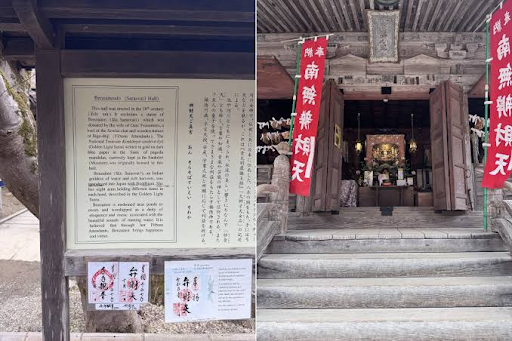
My son came back from his recent trip with photographs of the Benzaitendō at Chūson-ji in Hiraizumi, a thatched Edo-period hall in northern… pic.twitter.com/XA1w7vC488
The Transformation into Benzaiten
During the early 8th century, she was depicted in a multi-armed warrior form carrying weapons, resembling Durga. In this representation, she served as a protector of Buddhist teachings and institutions.
By the 9th century, her association with music became more prominent. Artists increasingly portrayed her holding a lute-like instrument, establishing her identity as a patron of music, performance and the arts.
Another significant transformation occurred around the 12th century, when Benzaiten became associated with Ugajin, an ancient Japanese Shinto deity depicted as a human-headed serpent with a beard. Ugajin was represented resting above or around the goddess, reflecting the blending of Buddhist and Shinto traditions.
By the 14th century, Benzaiten's association with wealth also strengthened through her connection with Kissohoten, the Japanese goddess of fortune. The similarity in the meanings of different Chinese and Japanese written forms of the word 'zai', associated with talent and wealth, contributed to the merging of their identities.
Consequently, Benzaiten came to represent knowledge, music, artistic abilities, prosperity and fertility. She eventually became the only female deity among Japan's Seven Gods of Fortune.
A Symbol of Cultural Exchange
Benzaiten's evolution also reflects the influence of Tantric Buddhism, in which feminine figures frequently represent offerings and qualities such as music, dance, flowers, fragrance and light.