Challenging the Aryan Invasion Theory: A Story of Integration between Sangam Literature and Vedic Traditions
Sangam poetry depicts a society in which Tamil kings supported Vedic rituals, where Sanskrit grammar and aesthetics enriched Tamil literature, and where shared spiritual symbols flourished along the banks of the Cauvery, Vaigai, and Ganges rivers.
NewsBharati 24-Nov-2026 14:24:55 PM
Total Views |


Current socio-political debates often frame classical Tamil culture and ancient Sanskrit-Vedic traditions as historical adversaries. This view suggests that ancient South Bharat was a socio-religious force in opposition to the ideologies, languages, and spiritual practices from the north. However, when we move beyond the political narratives of the 19th century and analyze the original texts—particularly the classical Sangam literature (generally dated between 300 BCE and 300 CE)—we uncover a different historical perspective.
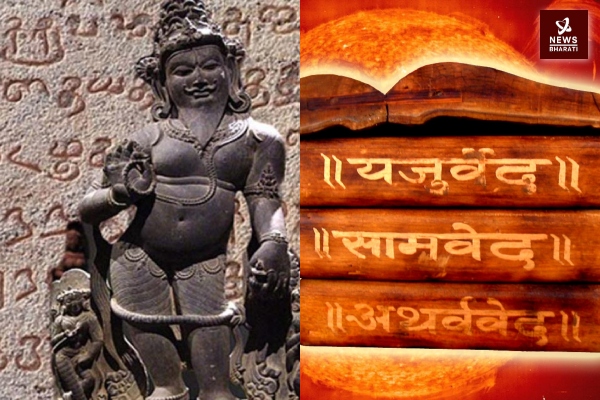
Instead of portraying a conflict between civilizations, the earliest Tamil literature reveals a deep and harmonious integration. Sangam poetry depicts a society in which Tamil kings supported Vedic rituals, where Sanskrit grammar and aesthetics enriched Tamil literature, and where shared spiritual symbols flourished along the banks of the Cauvery, Vaigai, and Ganges rivers.
Vedic Rituals and Royal Patronage in the Sangam Literature
The Sangam collections, particularly the Purananuru (which features 400 poems on governance, valor, and public affairs) and the Pattupattu (Ten Idylls), offer substantial historical evidence that Tamil kings were actively engaged in sponsoring, conducting, and honoring Vedic ceremonies (Yagnas). Rather than perceiving these Vedic practices as impositions, Tamil rulers viewed their execution as an essential aspect of just kingship (Sengol) and a necessary condition for the prosperity of society.
The title of the Pandya ruler Palyagasalai Mudukudumi Peruvaludhi translates to "The Great Valudhi of Many Sacrificial Halls." The court poet Nettimaiyar not only references these ceremonies but also poses a rhetorical question about whether the king’s sacrificial posts (Yupa Stambhas), erected to fulfill Vedic rituals, outnumber the weapons launched at his retreating foes. This language reflects not a culture under foreign dominance, but a celebration of shared royal values.
The Four Vedas as Naanmarai: Tamil Interpretation of Vedic Knowledge
In traditional Tamil literature, the Vedas are esteemed as Naanmarai, meaning "the fourfold hidden or sacred wisdom." The individuals who upheld this tradition were known as Antanar or Muppuloolor, referring to those who don the three-stranded sacred thread.
The Ideal Scholar: In Purananuru (Poem 6), the poet Kaarikannanar addresses the Chola king Great Killi, illustrating an ideal society where knowledgeable scholars recite the Naanmarai's sacred texts at dawn while lighting sacrificial fires.
Ethics and Governance: Thiruvalluvar’s Tirukkural, often regarded as the ethical cornerstone of classical Tamil philosophy, emphasizes the importance of preserving Vedic knowledge and the responsibilities of scholars. Verse 560 conveys that if a ruler deviates from justice, the cows will cease to produce milk, and the six responsibilities of the Antanar (Othal, Othuvithal, Vaelthal, Vaelvithal, Eethal, Aetral) will fade into obscurity.
This integration was so comprehensive that ancient Tamil literature seamlessly wove Vedic cosmology, the six Vedangas (supporting disciplines), and ritual ethics into its native poetic forms.
Shared Deities and Sacred Iconography
The spiritual landscape during the Sangam period illustrates the seamless integration of indigenous landscape-oriented worship (Tinai system) with broader pan-Bharatiya puranic imagery. According to the Tolkappiyam (Porulatikaram, Sutra 5), the five landscapes of ancient Tamilakam are assigned a primary divine archetype for each:
The Case of Lord Murugan & Lord Vishnu
Murugan / Seyon: In works such as the Tirumurugatrupadai, penned by the Sangam poet Nakkeerar, Lord Murugan is revered both as the crimson Tamil deity of the hills and as Skanda-Kartikeya, the leader of the divine hosts born from Shiva's sixth eye. The text depicts priests reciting Vedic mantras alongside local folk dancers presenting offerings of millet and honey.
Mayon / Vishnu: The Paripatal, a distinguished Sangam musical compilation, features hymns dedicated to Mayon (Vishnu) that convey philosophical ideas akin to those found in the Upanishads and Bhagavad Gita, portraying Him as the eternal, omnipresent essence that encompasses all elements (Pancha Bhuta), time, and creation.
Agastya and the Bridge of Knowledge
In the classical Tamil tradition, the sage Agastya (Agathiyar) holds a crucial position. He is honored as the father of Tamil grammar and the author of the now-lost treatise Agathiyam, as well as the spiritual mentor who led the first Sangam in Madurai.
The narrative of Agastya's journey from the North to the Podhigai Hills in South Bharat is not merely a tale of conquest; it represents an allegory of intellectual exchange. This journey illustrates the recognition between northern and southern traditions of a common heritage, with Agastya symbolizing the fusion of Sanskrit's linguistic precision and Tamil's poetic brilliance.
Additionally, the Tolkappiyam, authored by Tolkappiyar (often regarded as a student of Agastya), organizes its exploration of phonology, morphology, and poetics in a manner that parallels classical Sanskrit grammatical texts, such as those by Panini and the Prattisakhya, highlighting their shared phonetic underpinnings.
Epic Works of Synthesis: Silappadikaram and Manimekalai
The post-Sangam period gave rise to the dual epics Silappadikaram (The Tale of the Anklet) and Manimekalai, which further exemplify this cultural synthesis.
Silappadikaram (by Ilango Adigal): The epic begins with prayers to the Sun, Moon, and Rain, reflecting Vedic nature worship. Kovalan and Kannagi’s wedding in Puhar involves a ritual conducted by a Vedic priest around a sacred fire. The narrative follows Kannagi as she travels through various kingdoms where temples dedicated to Vishnu, Shiva, Murugan, and Indra coexist alongside Jain and Buddhist monasteries.
Manimekalai (by Chithalai Chathanar): This profound Buddhist epic set in Tamilakam engages in intricate debates among several philosophical schools of ancient Bharat, including Vaisheshika, Nyaya, Sankhya, Mimamsa, and Ajivika. This illustrates that the ancient Tamil urban centers were vital intellectual hubs participating in the larger philosophical dialogue of the subcontinent.
Conclusion: A Unified Tapestry of Diverse Regional Influences
The notion that ancient Tamil literature exists solely in opposition to Vedic or Sanskrit traditions is historically flawed. The core texts from the Sangam era showcase a dynamic and sophisticated society that embraced, integrated, and enhanced the broader pan-Bharatiya cultural, spiritual, and philosophical currents.
Tamil Nadu’s classical heritage need not be framed in a colonial-era "anti-Vedic" narrative to assert its significance. Its true brilliance lies in its ability to thoughtfully synthesize shared subcontinental themes of Dharma, Yagna, aesthetics, and devotion, articulating them through the unmatched poetic brilliance of the Tamil language.
The Sangam corpus illustrates that Bharat’s civilizational identity was never a singular construct but a harmonious symphony composed of interconnected regional influences.
Pankaj Jayswal
Pankaj Jagannath Jayswal, an Electrical Engineer, has spent 14 years working with MNCs at various levels. He is a prolific author who has written a book called "Modi Era..." about Prime Minister Narendra Modi. He has also written books about youth both in English and Hindi – a) "Youth: Universe Reflection" and b) "Yuva: Bramhand Ka Pratibimb."
He is a regular writer with the Times of India Readers Blog, Organiser, Hindi Vivek, Tarun Bharat, Swadesh, Hindusthan Samachar, Opindia, Kretely, TheHindi, Speaking Tree, and several other news portals. He written over 145 articles in English, Marathi, and Hindi.
He has extensive experience working on various Art of Living projects and is a Happiness course faculty member. He takes courses on personality development for all ages. He provides free career counselling to youths suffering from depression, anxiety, and suicidal ideation.
Email: Pankajjayswal1977@gmail.com
Website : http://www.sharencare.in