INDI bloc faces trouble in UP as Akhilesh Yadav offers Congress just 26 seats; Imran Masood questions SP commitment to alliance
The Samajwadi Party has offered Congress only 26 of Uttar Pradesh’s 403 Assembly seats, despite the latter seeking a much larger share, exposing a deep divide between the INDIA bloc allies ahead of the 2027 polls. The announcement of five SP candidates while negotiations were still underway has angered Congress MP Imran Masood, who questioned whether Akhilesh Yadav was serious about the alliance or preparing to fight Congress instead of the BJP.
Total Views |


The INDIA bloc's unity in Uttar Pradesh is facing an early test, with the Samajwadi Party and Congress struggling to reach an agreement over seat-sharing for the 2027 Assembly elections. The latest developments have exposed the widening gap between the two parties, with the Akhilesh Yadav-led SP offering Congress just 26 seats while the Congress has sought a much larger share.
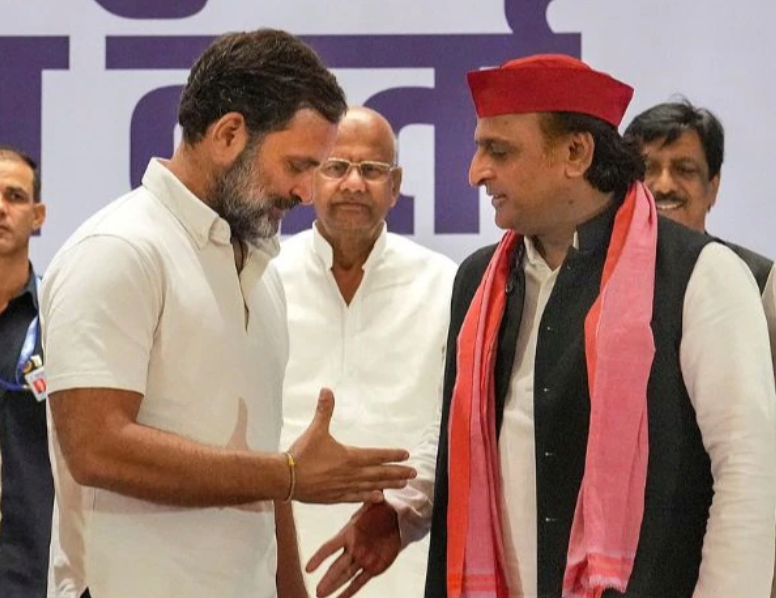
The disagreement escalated on November 24 after the Samajwadi Party announced its first list of five candidates even as its leaders were holding discussions with Congress representatives in Delhi. The timing of the announcement has triggered resentment within Congress, particularly in western Uttar Pradesh, where two of the constituencies named by the SP were reportedly part of the Congress wish list.
Congress MP and Uttar Pradesh Congress working president Imran Masood openly questioned the seriousness of the Samajwadi Party's negotiations. His remarks reflected the growing frustration within Congress over what it sees as unilateral decisions by its alliance partner.
VIDEO | Lucknow: As Samajwadi Party releases list of five candidates for UP Polls, Congress MP Imran Masood (@Imranmasood_Inc) says, “Whatever is happening here, it seems that there is a lack of seriousness in this matter. There is a lack of seriousness because while you… pic.twitter.com/aPJO3rz8DH
— Press Trust of India (@PTI_News) November 25, 2026
The episode has exposed the contradictions within the opposition alliance. While both parties publicly project unity against the BJP, their negotiations over constituencies and candidates have revealed a struggle for political space, influence and control over the electoral arrangement.
SP offers 26 seats against Congress demand of 131
The biggest disagreement concerns the number of seats to be contested by Congress. During the negotiations, Congress submitted a list of approximately 130 to 131 constituencies that it wants to contest in the 403-member Uttar Pradesh Assembly.
The Samajwadi Party, however, has proposed allocating only 26 seats to its alliance partner. The offer includes two constituencies won by Congress in the 2022 Assembly elections, four where it finished second, and 20 others where the SP believes Congress has a relatively weaker electoral presence.
According to SP general secretary Ram Gopal Yadav, the proposed 26 seats were selected on the basis of the parties previous electoral performances. He said the offer included two seats won by Congress, four where it had finished second, and 20 constituencies where the SP had secured between 60,000 and 70,000 votes while Congress had received around 2,000 votes.
The offer has exposed the imbalance in expectations between the two allies. Congress wants a substantially larger role in the state, while the SP appears unwilling to surrender constituencies where it believes its own candidates have stronger electoral prospects.
The gap between the two positions is substantial. Congress has placed around 130 seats on the negotiating table, while the SP has offered 26. Even if the parties eventually revise their positions, the initial proposal indicates that the two sides have very different ideas about Congress's political standing in Uttar Pradesh.
The Congress had initially sought 181 seats before reducing its demand to around 130. The reduction itself indicated that the party was prepared to negotiate. Yet the SP's offer remains far below the number Congress is seeking.
Five-candidate list exposes lack of coordination
The immediate flashpoint came when the SP released its first list of five candidates on Tuesday night, November 24, while seat-sharing negotiations were still underway.
The party announced Umar Ali Khan from Behat, Ashu Malik from Saharanpur, Nahid Hasan from Kairana, Mehboob Ali from Amroha and Jyoti Lodhi from Lalitpur.
Four of the five candidates are sitting legislators or established party figures, while Jyoti Lodhi has been fielded from Lalitpur. The list included two constituencies in Saharanpur district, Behat and Saharanpur, which were reportedly among the seats Congress wanted to contest.
The Saharanpur announcement is particularly significant because Congress MP Imran Masood represents the Saharanpur Lok Sabha constituency. Congress had reportedly sought a say in the Assembly constituencies falling within its parliamentary stronghold.
The SP's decision to name Ashu Malik from Saharanpur and Umar Ali Khan from Behat has complicated Congress's bargaining position. Ashu Malik is also regarded as a political rival of Masood.
By announcing candidates before finalising the seat-sharing arrangement, the SP has effectively signalled that it is unwilling to leave these constituencies open for negotiations. The move has raised questions about whether the Congress leadership was adequately consulted before the announcement.
The development has also exposed the limited influence Congress appears to have over its alliance partner's candidate-selection decisions. While discussions were taking place in Delhi, the SP went ahead with its own announcements in Lucknow.
Imran Masood questions Akhilesh Yadav's seriousness
Reacting to the announcement, Congress MP Imran Masood expressed dissatisfaction with the manner in which the SP was conducting negotiations.
He said, "Whatever is happening here, it seems that there is a lack of seriousness in this matter. There is a lack of seriousness because while you (Samajwadi Party) are holding talks on one side, you are making declarations on the other, which indicates that this is not being taken seriously."
Masood said the discussions had been taking place in a serious manner, with representatives of both parties sitting together to negotiate. However, the sudden announcement of candidates had raised doubts about the SP's intentions.
He added that Congress would now discuss the situation internally and decide whether it should continue participating in the negotiations.
His sharpest criticism came when he questioned whether Akhilesh Yadav wanted to fight the BJP or Congress.
"When you have made this declaration against me, I don't understand whether you want to fight me, the Congress, or the BJP? It has to be decided, doesn't it, whether you want to fight the BJP or fight us?" Masood said.
The remarks are a clear indication that the dispute has moved beyond the technical question of seat allocation. Congress leaders are now questioning whether the SP genuinely intends to accommodate its alliance partner or simply expects Congress to accept whatever seats are offered.
There was no immediate public response from the SP addressing Masood's criticism.
Akhilesh Yadav's 26-seat offer puts Congress in a corner
SP chief Akhilesh Yadav has maintained that seat allocation should be decided on the basis of electoral prospects and the winnability of candidates. In a message directed at Congress, he asked the party to identify additional constituencies beyond the 26 seats already discussed.
Akhilesh said the two sides should jointly assess the candidates and constituencies where the alliance could secure victories. He also suggested that the SP could identify winnable seats that Congress had not considered.
His message, however, came alongside the announcement of the five candidates, including nominees from constituencies reportedly sought by Congress.
This has created an awkward situation for the Congress leadership. If it accepts the 26-seat proposal without securing further concessions, it risks appearing to have surrendered much of its bargaining position. If it rejects the offer, it could deepen the dispute with an alliance partner on which it relies for electoral coordination in Uttar Pradesh.
The SP's position is backed by its stronger Assembly performance in recent elections. In 2022, the party won 111 seats, while Congress secured only two. The SP therefore has a stronger claim to being the principal opposition force in the state.
However, Congress is relying on its improved performance in the 2024 Lok Sabha elections to demand a larger role.
The party won six of the 17 parliamentary constituencies it contested in Uttar Pradesh, while the SP won 37 seats.
The two parties are now attempting to translate their Lok Sabha alliance into an Assembly-level arrangement, but the negotiations have exposed how differently they interpret their respective electoral strengths.
Congress faces questions over its bargaining power
Congress’s demand for around 130 seats in the 2027 Uttar Pradesh Assembly elections appears disproportionate to its electoral record in the state. In the 2022 Assembly polls, the party contested 399 of the 403 seats but managed to win only two. Its performance was equally poor in 2017, when it contested alongside the Samajwadi Party and won just seven seats, while the SP secured 54.
Despite this record, Congress is seeking a much larger share of constituencies, forcing the SP to question the basis of its demand. Akhilesh Yadav’s offer of 26 seats reflects the SP’s position that seat-sharing should be based on past performance and ground-level support rather than political claims. The party has also pointed out that Congress won only two seats in 2022, while the SP believes it has a stronger claim to several constituencies where Congress is seeking representation.
Congress is banking on its improved performance in the 2024 Lok Sabha elections to negotiate a better deal. However, its weak Assembly record continues to be a major hurdle. The sharp difference between its demand of around 130 seats and the SP’s offer of just 26 has exposed the gap between Congress’s ambitions and its electoral standing in Uttar Pradesh.