Karwa Chauth: Regressive or Women’s Adherence to Vaivahik Commitment?
Just like the Deepavali Firecrackers and Chhat Puja Arghyas dragged disapproval from a section of men and women of the present time, observance of Karwa Chauth too provoked the same disapproval from a sect of the society.
NewsBharati 25-Nov-2026 19:23:23 PM
Total Views |


As per economic times, Karwa Chauth 2026 increased D2C (direct-to-consumers) sales by 64% year-on-year not only in North India but across Central, Western and Eastern India and orders on commerce growth platform increased by 60%. “Demand for festival-labelled products surged 3.4 times in central India, 2.7 times in western India and 2.3 times in eastern and northeastern India. Southern India recorded growth of around 3%, while northern India remained the largest market, with demand reaching 3.9 times the year-earlier level.” Wrote economictimes on October 29, 2026.
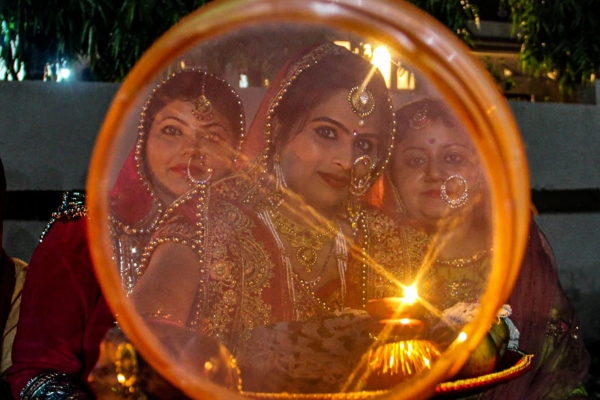
Just like the Deepavali Firecrackers and Chhat Puja Arghyas dragged disapproval from a section of men and women of the present time, observance of Karwa Chauth too provoked the same disapproval from a sect of the society. However, the Vrata, still, was observed with a bang providing a grand push to the Indian economy.
What is it that drives even modern women pray for their Patis’ (husbands) longevity while (on a lighter note) the Patis often don’t live up to the expectations of their Patnis (wives)? Till engaging in search for a satisfactory answer to such legitimate question, Karwa Chauth Vrata deserves to be lauded to reflect the position of responsibility & hence, empowerment, of the Stree (married woman) in her family. She would pray, so the man would have a long life!
Still, is it only the wife’s responsibility to ensure longevity of her Pati? This seems a legitimate question. Why aren’t Patis keeping fast for their Patnis’ well-being and longevity? Isn’t Vivah a mutual state of companionship?
Fairly acceptable answers to such legitimate questions could be found in Hindu Vivaha Mantra and Rituals from which it appeared that Vratas like Karwa Chauth, Savitri Chaturdashi, Mangalchandi etc. by the Vivahit Stree praying for longevity of her Pati & comprehensive well-being of the family appear nothing but attempts to live up to the oath the Stree takes during the Vedic Hindu Vivah rituals. Let’s visit certain parts of such Mantras all of which had been taken from a renowned Bengali Book ‘Purohit Darpan’ by Pandit Surendranath Bhattacharyya.
During the various elaborate rituals of Vedic Hindu Vivah, the bride, by offering popped rice (लाज) into the sacred fire prays for longevity of her bridegroom as well as for well-being & prosperity of her maiden family. She chants, ‘इदं नार्युप ब्रूते लाजानावपन्तिका आयुष्मानस्तु मे पतिरेधन्तां ज्ञातयो मम स्वाहा। इदमग्नये’ So, longevity of her ‘Pati’ is something that the bride herself prays for during LAJA HOMA or LAJANJALI. After such offering, the bride & the bridegroom circumambulates the sacred fire (AGNI PRADAKSHINA) and a set of chants are uttered by both of them one of which is ॐ अग्ने पवस्व स्वपा अस्मे धा इषमूर्जं च। यते पतिं दीर्घायुषं कृणु सुमङ्गल्यम्। In this course, AGNIDEVATA is invoked by both the bride and the bridegroom praying for long life of the bridegroom (not of the bride) & for comprehensive well-being of the Dampati (couple). So, a Vrata by the Patni for longevity of her Pati appears a part of the venture she takes up through Vivah.
Karak (Kartika Krishna) Chaturthi or Savitri (Jeshtho Krishna) Chaturdashi appears to help women derive motivation to live up to such Vaivahik (marital) commitment they undertook.
Why did both the bride and the couple pray for long life of only the bridegroom and not of the bride? Doesn’t this reflect inequality & misogyny in Hindu Vivah? Doesn’t the bride too deserve prayers for her long life?
Before the bride offers popped rice (लाज) into the sacred fire & prays for the longevity of her bridegroom, the bridegroom chants to Mahadevi Saraswati eulogizing her as PARAMESHWARI in enchanting expressions.
‘ॐ सरस्वति प्रेदमव सुभगे वाजिनीवति ।
यां त्वा विश्वस्य भूतस्य प्रजायामस्य चाग्रतः ॥
यस्यां भूतं समभवद् यस्यां विश्वमिदं जगत् ।
तामद्य गाथां गास्यामि या स्त्रीणामुत्तमं यशः’ ॥
In his invocation the bridegroom appears to depict that the way Devi herself creates & protects her creation, women too do the same. Hence, the bridegroom prays for perpetual protection of his bride from Devi Saraswati & also eulogizes his bride & all the women for being parts of Devi herself.
This implies that the bride remains protected by Mahashakti as the bridegroom prays to Her. On the other hand, the bridegroom needs the bride’s prayers & protection for longevity, good health & prosperity as the bride is a part of Mahashakti herself. This seems a position of higher empowerment of the bride.
Vivah does not appear the exact equivalence of the Western concept of marriage yielding Man & Wife though marriage indeed is the closest equivalent of Vivah. For example, at the end of SAPTAPADI in Hindu Vivah, divinity is invoked while the वर chants towards the वधू
‘अमोहमस्मि सा त्वं सा त्वमस्यमोऽहम्।
सामाहमस्मि ऋक् त्वं द्यौरहं पृथिवी त्वम्।
तावेहि विवहावहै सह रेतो दधावहै।
पुत्रान् विन्दावहै बहून् ते सन्तु जरदष्टयः’॥
Such romantic invocation précises into ‘I am what you are, you are what I am, thus we are meant to complement each other. Let us both engage in Vivah (वि + वह “विशेष रूप से वहन करना”) of each other & unite to continue an ideal and prolonged span of Vivahit (married) life procreating healthy, long-lived offspring.’
The word वर is linked to the word वरण। The bride (वधू) herself decides & selects (वरण) him as her bridegroom (वर). So, being selected by her, the bride-groom prays for longevity of the bride’s वर. It does not equate to praying for self-longevity or does not reflect narcissism as in Vedic Hindu Vivah the final call to choose her वर lies with the bride & the duty of due compliance lies with the bridegroom. From that perspective, the वधू empowers the वर by engaging in Vivah with him, a concept apparently reverse to the Western concept of ‘men empowering the women’.
The above elucidation appears to offer some clarity against the controversy regarding why a woman needs to pray for longevity of her Pati in Karwa Chauth while the Pati doesn’t pray similar for his Patni.
Debjani Bhattacharyya
Columnist and Political Analyst based at Kolkata