“Spain is Christian, not Muslim”
Spain"s streets are consequently reflecting a larger European dilemma.
Total Views |


Spain is witnessing a renewed confrontation over immigration, national identity and the place of Christianity in European society. The sight of demonstrators chanting “Spain is Christian, not Muslim” has drawn attention beyond the country’s borders. What appears at first to be a religious protest is, in reality, part of a much wider debate over demographic change, border control, cultural integration and the future character of European nations.
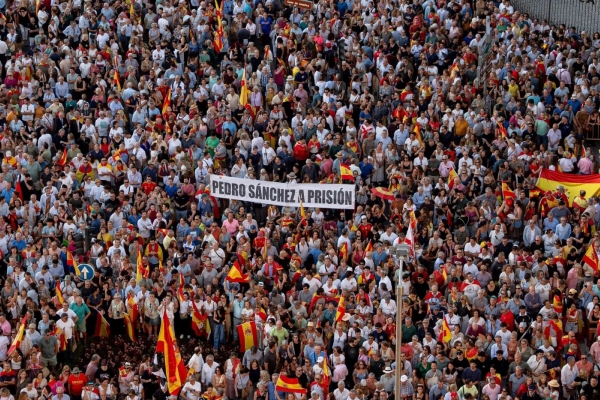
The slogans have found resonance in a society increasingly debating the consequences of immigration. The immediate backdrop is the migration crisis in Ceuta, the Spanish enclave in North Africa. In July 2026, a sudden influx from Morocco brought tens of thousands of people across the border. Thousands remained in makeshift camps and public spaces weeks later, placing considerable pressure on local accommodation, public services and administration. On September 2, thousands protested in Ceuta and other Spanish cities, demanding a response from the government. Demonstrations also exposed deep political divisions over border security, deportations and the responsibilities of the central government.
The Muslim dimension is significant. Spain's Muslim population has expanded considerably over recent decades, largely through immigration from Morocco and other African countries, as well as through second-generation families born in Spain. A demographic study by the CEU CEFAS Observatory estimates that Muslims numbered between 2.4 and 2.5 million at the beginning of 2025, approximately five per cent of the national population. It estimates that around 11 per cent of babies born in Spain in 2024 had at least one Muslim parent. These are estimates, not official religious census figures, since Spain does not record religious affiliation in its population census. Nevertheless, they indicate a demographic change that has become part of the country's public debate.
The historical context adds another layer. Spain was under Muslim rule in substantial parts of the Iberian Peninsula for centuries after the conquest beginning in 711. The period of Al-Andalus left a profound architectural, linguistic, scientific and cultural legacy. Muslim political rule gradually receded during the Christian Reconquista, culminating in the fall of Granada in 1492. The expulsion and forced conversion of Muslims in subsequent centuries shaped Spain's religious identity. Thus, Islam is not an entirely unfamiliar presence in Spanish history; what is different today is the character of modern immigration and the political questions surrounding integration, citizenship and national identity.
Ceuta itself illustrates the complexity. It is a Spanish city with Christian, Muslim, Jewish and Hindu communities. A large Muslim population has lived there for generations, and many residents are Spanish citizens. During the recent migration crisis, Muslim residents reported harassment because of their Moroccan appearance, despite being Spanish. This distinction matters: the question of irregular migration cannot be confused with the rights or identity of Muslim Spanish citizens.
The Spanish debate therefore has two dimensions. One concerns the state's responsibility to regulate its borders, prevent uncontrolled migration and ensure that public services and local communities are not overwhelmed. The other concerns the integration of people who have legally settled in the country, respect for Spanish law and the protection of equal citizenship. Neither question can be resolved through slogans or collective suspicion.
The government's response has also become a political issue. Prime Minister Pedro Sánchez's administration has faced criticism from conservatives and nationalist groups over its handling of the Ceuta crisis. Meanwhile, anti-racism organisations have warned against turning migration-related anxieties into hostility towards Muslims. Both the scale of the migration challenge and the danger of communal hostility are part of the reality.
Spain's streets are consequently reflecting a larger European dilemma. Across the continent, immigration has become inseparable from debates about cultural continuity, religious identity, national sovereignty and social cohesion. Christianity remains central to Europe's historical and cultural inheritance, but modern European citizenship also rests on equality before the law and freedom of religion.
The challenge for Spain is to address migration firmly, enforce its laws and demand integration without allowing religious identity to become a test of citizenship. Equally, defending pluralism cannot mean ignoring legitimate concerns about border management, demographic change or the capacity of institutions to absorb large and sudden migration flows. Spain's present tensions are a warning that when governments fail to address these questions transparently, the debate moves from policy chambers to the streets—and increasingly takes the language of religion and civilisational identity.
On November 20, hundreds of supporters of the far-right Falange Española marched through Madrid, raising slogans including “Christian Spain, not Muslim Spain” and demanding the “remigration” of foreigners. The march commemorated the 90th anniversary of the execution of the organisation’s founder, José Antonio Primo de Rivera. Its participants also carried the politics of Spanish nationalism into the streets, passing the headquarters of the conservative People's Party and the ruling Socialist Workers’ Party. The Falange is a far-right nationalist organisation, and its ideological history is distinct from that of mainstream Spanish Christianity.
The slogans have found resonance in a society increasingly debating the consequences of immigration. The immediate backdrop is the migration crisis in Ceuta, the Spanish enclave in North Africa. In July 2026, a sudden influx from Morocco brought tens of thousands of people across the border. Thousands remained in makeshift camps and public spaces weeks later, placing considerable pressure on local accommodation, public services and administration. On September 2, thousands protested in Ceuta and other Spanish cities, demanding a response from the government. Demonstrations also exposed deep political divisions over border security, deportations and the responsibilities of the central government.
The Muslim dimension is significant. Spain's Muslim population has expanded considerably over recent decades, largely through immigration from Morocco and other African countries, as well as through second-generation families born in Spain. A demographic study by the CEU CEFAS Observatory estimates that Muslims numbered between 2.4 and 2.5 million at the beginning of 2025, approximately five per cent of the national population. It estimates that around 11 per cent of babies born in Spain in 2024 had at least one Muslim parent. These are estimates, not official religious census figures, since Spain does not record religious affiliation in its population census. Nevertheless, they indicate a demographic change that has become part of the country's public debate.
The historical context adds another layer. Spain was under Muslim rule in substantial parts of the Iberian Peninsula for centuries after the conquest beginning in 711. The period of Al-Andalus left a profound architectural, linguistic, scientific and cultural legacy. Muslim political rule gradually receded during the Christian Reconquista, culminating in the fall of Granada in 1492. The expulsion and forced conversion of Muslims in subsequent centuries shaped Spain's religious identity. Thus, Islam is not an entirely unfamiliar presence in Spanish history; what is different today is the character of modern immigration and the political questions surrounding integration, citizenship and national identity.
Ceuta itself illustrates the complexity. It is a Spanish city with Christian, Muslim, Jewish and Hindu communities. A large Muslim population has lived there for generations, and many residents are Spanish citizens. During the recent migration crisis, Muslim residents reported harassment because of their Moroccan appearance, despite being Spanish. This distinction matters: the question of irregular migration cannot be confused with the rights or identity of Muslim Spanish citizens.
The Spanish debate therefore has two dimensions. One concerns the state's responsibility to regulate its borders, prevent uncontrolled migration and ensure that public services and local communities are not overwhelmed. The other concerns the integration of people who have legally settled in the country, respect for Spanish law and the protection of equal citizenship. Neither question can be resolved through slogans or collective suspicion.
The government's response has also become a political issue. Prime Minister Pedro Sánchez's administration has faced criticism from conservatives and nationalist groups over its handling of the Ceuta crisis. Meanwhile, anti-racism organisations have warned against turning migration-related anxieties into hostility towards Muslims. Both the scale of the migration challenge and the danger of communal hostility are part of the reality.
Spain's streets are consequently reflecting a larger European dilemma. Across the continent, immigration has become inseparable from debates about cultural continuity, religious identity, national sovereignty and social cohesion. Christianity remains central to Europe's historical and cultural inheritance, but modern European citizenship also rests on equality before the law and freedom of religion.
The challenge for Spain is to address migration firmly, enforce its laws and demand integration without allowing religious identity to become a test of citizenship. Equally, defending pluralism cannot mean ignoring legitimate concerns about border management, demographic change or the capacity of institutions to absorb large and sudden migration flows. Spain's present tensions are a warning that when governments fail to address these questions transparently, the debate moves from policy chambers to the streets—and increasingly takes the language of religion and civilisational identity.