Bhargavastra: India’s First Indigenous Vehicle-Mounted Counter-Swarm Drone System Completes Development Trials
Total Views |


New Delhi , November 27 : Solar Defence and Aerospace Limited (SDAL) has successfully completed the in-house development trials of Bhargavastra, an indigenously developed Vehicle-Mounted Counter Swarm Drone System (VMCSDS), at the Pokaran Field Firing Ranges. The trials were conducted from November 20 to 24, marking a significant step in India's efforts to strengthen its defence capabilities against the growing threat of enemy drone swarms.
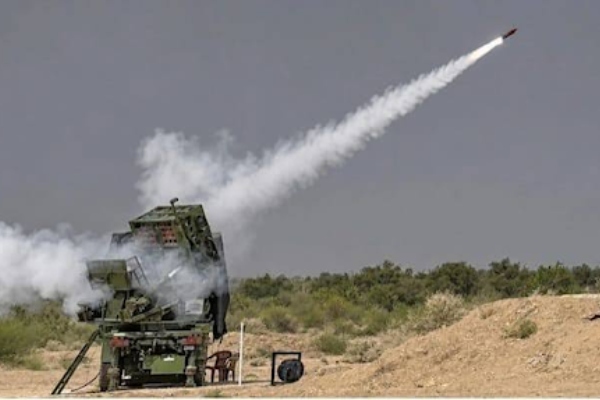
Bhargavastra is India's first indigenously designed and developed two-layer vehicle-mounted counter-swarm drone system. It combines air defence rockets and guided micro-missiles to provide an integrated defence mechanism capable of engaging multiple drones simultaneously.
The system has been developed by SDAL in response to the Indian Army's specific qualitative requirements issued through a Project Sanction Order (PSO) by the Ministry of Defence (Defence Production) on July 9, 2024. The project falls under the Make-II (Buy Indian-IDDM) category, with March 31, 2027, set as the date for completion.
Going beyond the initial requirement, SDAL independently developed an advanced Version-II of Bhargavastra equipped with guided micro-missiles. These missiles use autonomous guidance and infrared (IR) seekers to achieve precise target engagement.
Bhargavastra integrates multiple sensors, surveillance systems and weapon platforms into a single vehicle-mounted defence system. Its first layer uses air defence rockets, while the second employs guided micro-missiles to engage incoming drone threats.
The system is equipped with radio frequency (RF) detectors and surveillance radars to detect and track incoming drones. Electro-Optical (EO) systems provide continuous target tracking during both day and night operations.
Private enterprise, national duty. INDIA'S BURGEONING DEFENCE ECOSYSTEM PASSES ANOTHER TEST
— Rahul Shivshankar (@RShivshankar) November 26, 2026
Solar Defence and Aerospace Limited (SDAL) has successfully designed, developed and integrated Bhargavastra, a Vehicle-Mounted Counter Swarm Drone System (VMCSDS), and completed its… pic.twitter.com/9PSa1QD3HZ
An Artificial Intelligence (AI)-enabled integrated Command, Control, Communications, Computers and Intelligence (C4I) system coordinates sensor inputs, target tracking and weapon engagement.
The system offers a substantial engagement capacity, with a 64-tube rocket launcher in Version-I and a 64-micro-missile launcher in Version-II. The complete system is deployed across three Army-inducted vehicles carrying weapon launchers, sensors and integrated command-and-control equipment.
During the development trials at Pokaran, multiple firings of rockets and guided micro-missiles were successfully conducted.
The rockets were fired against actual swarm drone targets that were detected and tracked through the system's sensors and C4I network. The warheads successfully struck their designated points, demonstrating the system's operational effectiveness.
Separate trials also successfully demonstrated the guidance and terminal homing capabilities of the micro-missiles against drone targets.
Bhargavastra represents a major milestone in India's indigenous defence manufacturing efforts. The system has been designed, developed and manufactured entirely in India, including its software. Both the air defence rockets and guided micro-missiles have been developed indigenously, with complete Intellectual Property Rights (IPR) retained by SDAL.
The company plans further optimisation and trials to improve the system's engagement performance and probability of destroying incoming targets.