Supreme Court dissolves Thiruparankundram temple trust, orders Deepam lighting under CRPF security
The intervention by Apex court exposes serious questions over state control of Hindu temples, trustee accountability and protection of religious traditions.
Total Views |


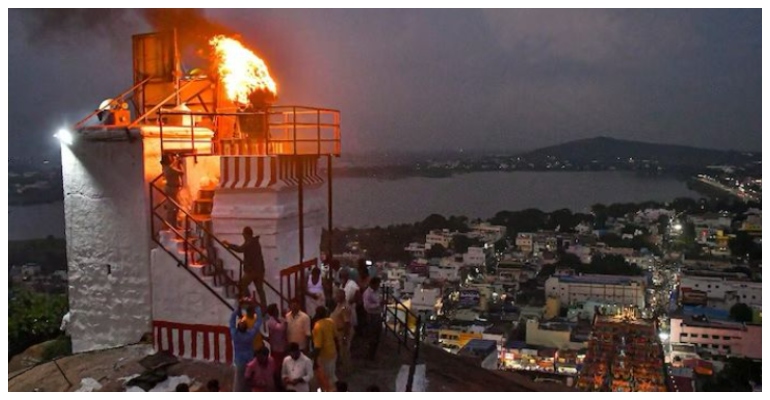
The Supreme Court on November 27 suspended the Board of Trustees of the Arulmigu Subramaniya Swamy Temple at Thiruparankundram in Madurai district, appointed two retired Madras High Court judges as receivers and directed that the Karthigai Deepam be lit at the disputed Deepathoon on November 28.
The Court also entrusted security arrangements for the temple and the nearby Sikandar Badusha Dargah to the Central Reserve Police Force (CRPF), following the Tamil Nadu administration's failure to implement its earlier direction.
A Bench of Justices Aravind Kumar and Vipul Pancholi took serious exception to the failure to comply with its November 20 order, which had permitted the lighting of the ceremonial lamp at the Deepathoon on November 24. Instead, the lamp was lit at its customary location near the Uchipillaiyar Temple, following a resolution by the temple trustees.
The Court appointed former Madras High Court judges Justices S Vaidyanathan and V Parthiban as receivers to take charge of the temple administration and ensure compliance. It directed that every devotee be permitted to light the lamp at the Deepathoon, maintaining a distance of at least 50 metres from the Dargah on all sides.
The CRPF was directed to protect both religious establishments and ensure that visitors to the Dargah were not prevented from offering prayers.
A judicial order cannot be negotiated away
The Supreme Court described the failure to implement its earlier direction as prima facie wilful and flagrant disobedience. It observed that there appeared to be administrative chaos in Madurai district and questioned whether executive authorities had acted at the behest of their political superiors.
"An order of this Court is not an invitation to negotiation until the Court itself modifies it," the Bench observed.
Supreme Court suspends Subramaniya Swamy Temple Board of Trustees, takes over administration through two-member committee.
— ANI (@ANI) November 27, 2026
The Supreme Court has suspended the Board of Trustees of the Arulmigu Subramaniya Swamy Temple at Thiruparankundram and superseded the temple administration… pic.twitter.com/GHrz77VXkf
The Court also warned that anyone attempting to dilute its directions would be dealt with firmly. It directed the Tamil Nadu Chief Secretary to submit a detailed affidavit containing communications, emails and other exchanges among officials to establish how the decision not to implement the November 20 order had evolved.
Contempt notices were issued to senior state and district officials, including the Chief Secretary, Director General of Police, HR&CE officials, Madurai Collector and temple authorities. The Chief Secretary was directed to appear personally before the Court.
The intervention brings into focus a fundamental constitutional question.
Government officials and temple administrators cannot substitute their interpretation of a judicial direction for the direction itself. Article 144 of the Constitution requires all civil and judicial authorities to act in aid of the Supreme Court.
Temple trustees suspended, questions raised over their composition
The suspension of the temple's Board of Trustees is another significant development. The five-member board had reportedly been constituted on November 13, barely a week before the Supreme Court's November 20 order.
During the hearing, counsel for the petitioners questioned the credentials and conduct of the trustees. One allegation concerned a trustee who reportedly did not profess Hinduism, raising questions about the suitability of the appointment to a board responsible for managing a Hindu temple. The possibility that the individual was Christian was raised in the controversy, but this religious identity has not been independently established.
The petitioners also questioned the board's November 24 resolution to conduct the Deepam ceremony only at its customary location. They argued that the trustees had effectively obstructed the implementation of the Supreme Court's direction.
The Court suspended the board and transferred immediate administrative responsibility to the two judicial receivers.
Who should control Hindu temple institutions?
The episode raises a larger question about the administration of Hindu religious institutions. Temple trustees are not merely office-bearers managing property and routine affairs. They are entrusted with protecting the institution's religious traditions, customs and interests.
When appointments are made through government-controlled mechanisms, the qualifications, religious commitments and accountability of those entrusted with temple management become legitimate subjects of scrutiny. The issue is not simply the identity of an individual trustee, but whether the governing body is equipped and willing to protect the religious institution it has been appointed to administer.
The Thiruparankundram developments also revive the debate over state control of Hindu temples and the extent to which administrative authorities should influence religious practices.
CRPF deployment marks an extraordinary intervention
The decision to entrust security to the CRPF is particularly significant. The Supreme Court's intervention followed allegations that the local administration and police had failed to facilitate implementation of its November 20 direction.
The central force has been assigned the responsibility of protecting the temple and Dargah, ensuring that devotees of both religious establishments can exercise their rights without obstruction. The 50-metre distance prescribed for the lamp-lighting ceremony is intended to safeguard the Dargah while allowing the Deepam to be lit at the disputed pillar.
The Court's directions are to be implemented on November 28, while the contempt proceedings will continue.
The developments at Thiruparankundram have transformed a dispute over a traditional religious observance into a wider confrontation involving temple administration, state accountability and constitutional authority. With the trustees suspended, judicial receivers in charge and the CRPF entrusted with security, the Supreme Court has made it clear that its directions cannot be frustrated through administrative resolutions or official inaction.