Congress revives closed case against CEC Gyanesh Kumar amid anti-SIR campaign: Political Vendetta?
The Congress-led UDF government in Keralam has ordered a fresh inquiry into a 2006 Vigilance case against Chief Election Commissioner Gyanesh Kumar, despite the earlier closure of the investigation for lack of evidence. The timing, coinciding with Congress-led protests against Kumar over the SIR exercise, has raised serious questions about political vendetta and the misuse of state machinery.
Total Views |


The Congress-led UDF government in Keralam has brought back a Vigilance case against Chief Election Commissioner Gyanesh Kumar that had been closed years ago for lack of evidence. The case dates back to 2006, when Kumar was serving as the state's Public Works Department (PWD) Secretary. The Vigilance and Anti-Corruption Bureau (VACB) had examined the allegations but found ‘no substantial evidence’ to take the matter further.
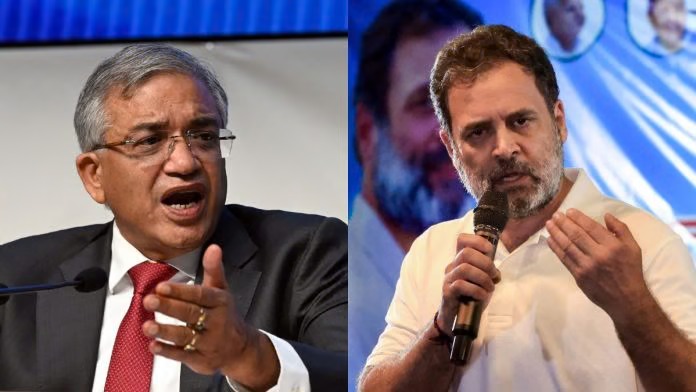
Congress faces questions over vendetta politics against CEC Gyanesh Kumar, Image: The Print
The timing of the decision has raised eyebrows. Congress and its allies are already running a nationwide campaign against Kumar over the Special Intensive Revision (SIR) of electoral rolls and demanding his resignation. Now, the Kerala government has chosen to reopen an old case against the same official, without publicly explaining what fresh evidence has suddenly emerged. It is difficult not to see the political significance of this move.
A case that was closed years ago
The allegations date back to 2006, during Kumar's tenure as Kerala PWD Secretary. They concerned the World Bank-funded Kerala State Transport Project. The then LDF government, led by Chief Minister V.S. Achuthanandan, transferred Kumar from the post after complaints surfaced.
The VACB began its preliminary inquiry in 2006-07 and examined several complaints over the following years. By around 2012, the agency had reportedly found that the allegations could not be substantiated. Several related cases were closed as "mistake of fact", with no further action recommended.
🚨 A 20-year-old corruption allegation against Gyanesh Kumar from his days as Kerala PWD Secretary in 2006 has resurfaced, triggering a fresh investigation.
— The Analyzer (News Updates🗞️) (@Indian_Analyzer) November 3, 2026
Kerala Vigilance had already investigated the allegations in 2006-07 and CLEARED him.
• The case involved a World…
What makes the present move particularly questionable is that these closures were formalised in 2012, when the Congress-led UDF government under Chief Minister Oommen Chandy was in power. The same party that is now reopening the case had an opportunity to examine the matter then. Yet it remained closed for years.
Old case revived as Congress targets CEC
The inquiry was reopened in October 2026 after a complaint by Congress activist Malayinkeezhu Venugopal. Home Minister Ramesh Chennithala, following consultations with Chief Minister V.D. Satheesan, directed the VACB to conduct a fresh preliminary inquiry.
The government has suggested that the earlier investigation may not have been complete. But where is the new evidence? After nearly two decades, the public has still not been told what fresh material justifies reopening a case that the Vigilance department had already closed.
The timing makes the move even more controversial. Congress leaders have been attacking Gyanesh Kumar over the SIR exercise and demanding his removal. Against this backdrop, the sudden revival of an old case looks less like a routine investigation and more like an attempt to put pressure on the Chief Election Commissioner.
Congress cannot attack the Election Commission politically and then expect questions about its own conduct to go unanswered. If there is fresh evidence, the Kerala government should make it public and allow the investigation to proceed on its merits. But reopening an old file without explaining what has changed only strengthens allegations of vendetta politics.
Congress and its selective outrage over institutions
The episode also exposes the Congress's selective approach to constitutional institutions. The party is quick to invoke institutional independence when it suits its political position, but its own conduct comes under scrutiny when state machinery is used against a constitutional functionary during an ongoing political confrontation.
The controversy also brings back questions raised during the tenure of former Chief Election Commissioner Navin Chawla. Opposition parties had questioned his perceived proximity to the Congress-led Union government and raised concerns about decisions taken during his time in office.
Congress cannot demand strict scrutiny of one Election Commissioner while dismissing concerns about another, depending on which political party benefits. Institutional independence cannot be a principle that applies only when the Election Commission acts in the party's favour.
A case reopened, but where is the fresh evidence?
With Assembly elections approaching in several states and the SIR exercise at the centre of a nationwide political dispute, the Kerala government's decision has taken on added significance.
Why is a case closed during its own government's tenure in 2012 being revived now?
What new evidence has emerged after all these years?
And why has this move come at a time when the party is demanding the resignation of the very same constitutional functionary?
Congress's regime-change politics will not work in India
The Congress and sections of the Opposition are increasingly willing to turn every institutional disagreement into a campaign to challenge the legitimacy of elected governments and constitutional authorities.
Instead of fighting political battles through democratic debate and the ballot box, their approach increasingly revolves around street mobilisation, pressure campaigns and attempts to create an atmosphere of institutional crisis. The demand for Gyanesh Kumar's resignation, followed by the revival of an old Vigilance case in Kerala, fits into a wider pattern of confrontation that deserves serious scrutiny.
The Opposition must understand that India is not Bangladesh or Nepal, and its democratic institutions cannot be treated as instruments for a regime-change experiment. Political differences, protests and criticism are part of democracy, but attempts to manufacture a crisis around constitutional institutions cannot replace electoral accountability. India's governments are changed through the mandate of its people, not through pressure tactics or politically manufactured outrage.
India is a constitutional democracy, not a laboratory for imported regime-change politics. The Opposition is free to challenge the government, but it cannot expect political propaganda, institutional pressure and recycled allegations to deliver what it has failed to secure through the people's mandate.