Pakistan's anti-India obsession turns Hindu-Jewish friendship into a threat
Rezaei, speaking to Iranian state broadcaster IRIB, claimed that Munir described the emerging Hindu-Jewish relationship as a threat to Muslims and Pakistan. Najam Sethi, a Pakistani journalist, subsequently referred to the alleged remarks on his programme.
NewsBharati 04-Nov-2026 16:07:27 PM
Total Views |


The suggestion that Hindus and Jews coming closer poses a threat to Muslims is an extraordinary way of looking at history. Yet, according to Iranian security official Mohsen Rezaei, Pakistan Army Chief Asim Munir reportedly raised precisely this concern during a four-nation security meeting in Tehran on October 26.
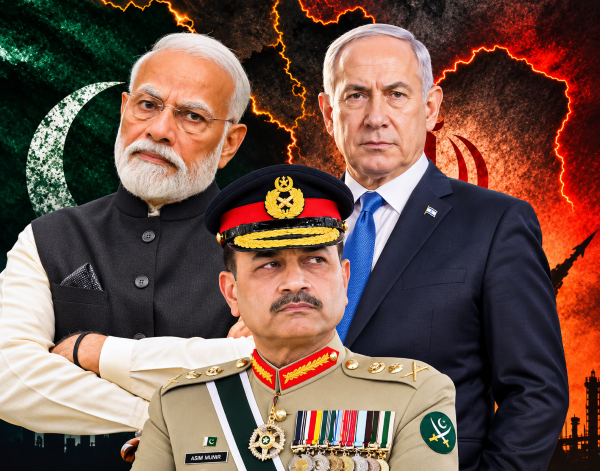
Rezaei, speaking to Iranian state broadcaster IRIB, claimed that Munir described the emerging Hindu-Jewish relationship as a threat to Muslims and Pakistan. Najam Sethi, a Pakistani journalist, subsequently referred to the alleged remarks on his programme.
The claim may not have been independently confirmed. But it is important to treat it as Rezaei's account of a private meeting. Nevertheless, the reported remarks raise an interesting question: why should cordial relations between two ancient communities be viewed through the prism of religious confrontation?
A history that contradicts Pakistan's narrative
India's relationship with Jewish communities is not a recent diplomatic development. It has roots stretching back centuries, long before the establishment of modern nation-states or the creation of Israel.
The Bene Israel community of Maharashtra, the Cochin Jews of Kerala and the Baghdadi Jewish community established their presence in different parts of India. They retained their religious identity, traditions and customs while becoming part of the larger Indian social fabric.
The Bene Israelis, particularly, developed a close cultural association with the Konkan region. They adopted Marathi as their language of everyday communication and participated in local social and economic life while preserving Jewish religious practices.
The Cochin Jewish community offers another remarkable example. Its history is closely associated with the trading networks of Kerala's Malabar Coast. Jewish settlements, synagogues and commercial establishments existed alongside Hindu, Muslim and Christian communities.
Unlike the recurring expulsions and religious persecution experienced by Jewish communities in several parts of medieval and early modern Europe, Indian Jewish communities generally enjoyed a comparatively secure environment in which they could practise their faith.
This is not to suggest that Indian history was entirely free of discrimination or social complexities. It does, however, demonstrate a civilisational tradition in which religious difference did not automatically translate into hostility.
Everyday India tells a different story
This coexistence is not confined to history books. It remains visible in several Indian neighbourhoods.
In Pune, the area around the historic Ohel David Sassoon Synagogue reflects a long association between Jewish institutions and the city's wider multicultural neighbourhoods. In Mattancherry and Fort Kochi, Jewish religious heritage exists alongside Hindu temples, Muslim establishments and Christian institutions. The streets around the Paradesi Synagogue have long been commercial and cultural meeting points for different communities.
These are not military alliances or political arrangements. They are examples of ordinary people sharing neighbourhoods, conducting business and respecting one another's religious spaces.
That is precisely what makes the attempt to manufacture a Hindu-Jewish versus Muslim confrontation so questionable. India's experience demonstrates that friendship between Hindus and Jews does not require hostility towards Muslims. Nor does India's relationship with Israel diminish its longstanding cultural, economic and diplomatic engagement with countries across the Muslim world.
Shared traditions, distinct faiths
Hindu and Jewish traditions also have certain cultural and philosophical points of familiarity. Both are ancient religious traditions with deep connections to historical memory, ritual observances, sacred texts and inherited customs.
Sanskrit and Hebrew continue to occupy important places in their respective religious traditions. Both communities attach importance to festivals, family rituals, dietary practices and the preservation of religious identity across generations.
Diwali and Hanukkah, although entirely different festivals with distinct historical and theological origins, are both associated with the symbolism of light and its triumph over darkness.
These similarities should not be exaggerated into claims that the two religions are identical. Their theological foundations and religious practices remain distinct. But neither is there any reason why their differences should prevent mutual appreciation.
What really worries Pakistan?
The issue becomes clearer when viewed against Pakistan's geopolitical circumstances.
India and Israel have steadily expanded cooperation in defence, intelligence, counterterrorism, agriculture, water management, technology and innovation. This partnership is driven by national interests, shared security concerns and practical economic requirements. It is not a religious compact.
For Pakistan, however, India's growing international partnerships present a strategic challenge. Its longstanding hostility towards India has often been expressed through religious and ideological narratives. The two-nation theory, which provided the ideological foundation for Pakistan's creation, continues to influence sections of its political and military establishment.
Portraying Hindu-Jewish relations as a threat to the Muslim world is an extension of this worldview. It attempts to transform India's independent foreign-policy choices into a religious confrontation and place Pakistan in the position of speaking for Muslims everywhere.
But Muslims are not a monolithic political constituency, and Pakistan cannot claim to represent the interests or views of the entire Muslim world.
India's civilisational strength has historically rested on its ability to accommodate different traditions without requiring them to surrender their identities. Its friendship with Jewish communities and its engagement with Israel are consistent with that tradition.
A Hindu-Jewish friendship does not need an enemy to justify its existence. India's history offers a more compelling answer to religious polarisation than Pakistan's latest attempt to manufacture an imaginary confrontation.

Rajesh Korde
Journalist having more than three decades of experience with many newspapers in Goa, Pune, Karnavati (Ahmedabad) and Abu Dhabi (UAE). A visting faculty at many Journalism Schools, is now pursuing third Masters – MA in Indology. Also an avid traveller and a photographer