The Sovereign Shift: Why India’s Tech Exports Out-Earning Gulf Oil Changes Everything
India’s tech exports are challenging Gulf oil dominance, reflecting decades of industry growth, digital infrastructure expansion, and ambitions to move up the global technology value chain.India’s tech exports are challenging Gulf oil dominance, reflecting decades of industry growth, digital infrastructure expansion, and ambitions to move up the global technology value chain.


There was a time when global wealth had a very specific, heavy scent, and that was the smell of crude oil.
For generations, economic power belonged strictly to whoever controlled the ground beneath their feet. If your soil held black gold, you dictated terms to the rest of the world. If your country relied on brainpower, software, or services, you were slotted into a secondary tier. You were useful, reliable, and hardworking, but essentially just a back-office support system for wealthier nations.
That entire global hierarchy has just completely broken down.

The latest Nasscom estimates for FY2025–26 put India’s technology exports at a record 246 billion dollars
Read that again. India’s digital exports are now out-earning the combined oil revenues of two of the most powerful energy producers on the planet
This was not a sudden fluke or a random statistical spike. It was a methodical, unrelenting takeover. If you rewind to FY22, the gap looked almost impossible to close. India’s tech exports were sitting at 178 billion dollars, while Saudi and UAE crude exports towered at a massive 376 billion dollars. Back then, oil was not just leading the pack. It was ahead by nearly 200 billion dollars Then the tide turned, year by single year.
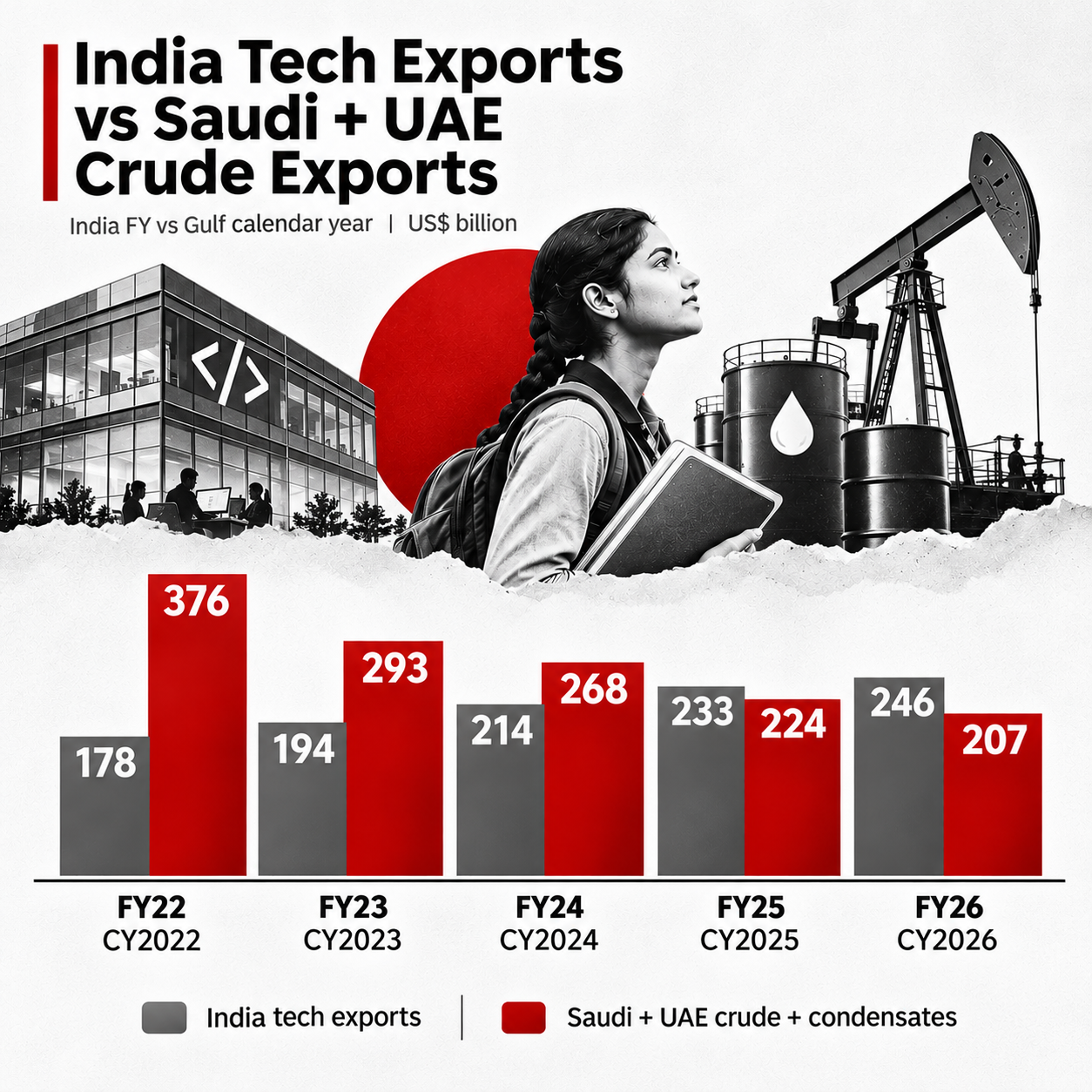
Now, in FY26, that lead has solidified even further. Tech stands at 246 billion dollars against crude at 207 billion dollars. In just five years, India completely erased a 198 billion dollar deficit and built a solid 39 billion dollar lead.
The fundamental difference between these two export models comes down to what actually powers them. Oil extraction relies entirely on finite natural reserves. Every single barrel pumped out leaves less in the ground for tomorrow. On top of that, every price tag remains hostage to foreign cartels, unpredictable shipping routes, and sudden policy shifts across international borders.
Behind that 246 billion dollar milestone are millions of Indian developers, researchers, and system architects. They are not just sitting in high-rise offices across major hubs like Bengaluru, Pune, or Hyderabad. They are writing code, managing infrastructure, and solving real problems from tier-2 and tier-3 towns across the country. They build massive enterprise cloud frameworks, design semiconductors, secure global banking networks, and deploy complex AI models for global corporations.
When tech exports continue to grow during a period of global economic tightening, it sends a crystal-clear message to the market. International firms are no longer outsourcing to India just to save a quick dollar on labor costs. They are doing it because their core business operations will literally collapse without Indian talent.
When you strip away the corporate buzzwords and look at this trend strictly through the lens of economic logic, the picture becomes very clear.
When a country sells oil, it depletes a physical asset. Once the well runs completely empty, the revenue stream vanishes. But when a country exports software, engineering capabilities, and digital intellectual property, the underlying capital compounds over time. Every line of code written sharpens the domestic talent pool, strengthens institutional knowledge, and brings high-value capital directly back into the local economy.
For decades, post-colonial economic logic dictated that developing nations were meant to supply raw materials or low-cost manual labor, while developed or resource-rich blocs held all the real leverage. India has completely dismantled that old assumption step by step.
True economic sovereignty is never determined by what you dig up from under the earth. It is built on what you cultivate inside the minds of your people.
The oil wells of the Gulf will remain vital to global trade for years to come. But the actual center of global value has shifted toward those who design software, protect critical data, and build the digital architecture of the modern world. India has not just joined that game, it is actively setting the pace for everyone else.