RSS’ global perspective is geocultural, not geopolitical
But under both these Prime Ministers who came from RSS background, foreign policy centred around a firm ‘India First’ positioning.
Total Views |


- Kartik Lokhande
As the city of Mumbai gears up to host Sarsanghchalak of Rashtriya Swayamsevak Sangh ( RSS ) Dr. Mohan Bhagwat, a lot of buzz is created around the event and various dimensions relating to RSS. However, one area that often goes unnoticed is the global perspectives of the RSS. In the centenary year of RSS, and with an assertive Indian diplomacy fuelling the rise of India as a strong and stable economic power in an increasingly uncertain world, it is essential to understand that RSS’ global perspective is geocultural.
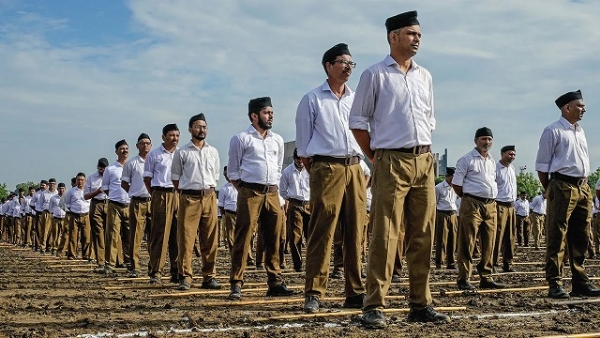
For others the worldview is determined through the geopolitical lens. For RSS, it is determined by geocultural consciousness steeped into realism rooted in the history of territorial integrity. India’s foreign policy over the decades has been directly or indirectly shaped by this geocultural consciousness. It will not be an exaggeration to say that India’s evolution from being a non-aligned, and hence non-committal, nation to being an assertive practitioner of multilateralism without compromising on own interest, can be attributed to the thought-provoking contributions of the RSS apart from the evolutionary geopolitical pressures in the conflict-ridden world. The main difference between the geopolitical and geocultural approaches lies in the understanding of these concepts. While the geopolitical approach is rooted in considerations of gains or losses, the geocultural approach has civilisational context. For, a nation is not just a territory co-inhabited by people but a civilisational unity with cultural consciousness at its core. Hence, even when priority is accorded to territorial integrity, the reference is to shared cultural roots. This thinking has shaped the spirit of ‘unity in diversity’ that India symbolises in the world.
A careful study of the resolutions passed by the top decision-making structures of the RSS sheds more light on this understanding. RSS has consistently condemned Pakistan occupying part of sovereign Indian territory of Kashmir and fomenting terrorism rooted in Islamic fundamentalism. Through the biased Western lenses, RSS was described as communal when it foresaw the threat of Islamic terrorism to global peace. However, now, the world has come to recognise that threat. Similarly, RSS criticised Communist China’s expansionism. Prime Minister Pt. Jawaharlal Nehru, leading the erstwhile Congress Government, was so charmed by Communist China that he could not realise the serious threat to India’s territorial integrity till around 1962. RSS rightly blamed the erstwhile Government for appeasement that allowed the loss of a buffer state like Tibet to Chinese aggression.
Over the years, RSS continued to deliberate upon and shape the public discourse in favour of territorial integrity, self-reliant defence, and safeguarding of the interests of Indians within and outside the Indian territory. Hence, right since 1971, when East Pakistan was liberated into a new country Bangladesh, RSS has been flagging the persecution of Hindu, Buddhist and other minorities there at the hands of Islamic radicals. RSS opposed the Islamisation of Bangladesh and its impacts on India’s national security. Effectively, it underlined the need for enhanced international understanding of the developments in Bangladesh, Sri Lanka, Tibet, Nepal, Pakistan, China, US, and several other countries. It also viewed the agreements like the one signed at Tashkent or Simla as compromises because those rewarded the aggressors. It always emphasised upon the importance of self-reliance (Aatmanirbharta) for India.
RSS supported a strong national defence including nuclear capabilities against threats from Pakistan, China. Also, it recognised the risk of internal subversion backed conspiratorially by the international forces that did not want India to rise to the stature of a global power. Hence, it demanded the global forums like the United Nations and SAARC to highlight minority atrocities, and also questioned the silence of the human rights bodies over the issue. Its support to the Citizenship Amendment Act, 2019 aimed at protecting the non-Muslim minorities in neighbouring countries was rooted in proper understanding of the historical Partition-time assurances to India by Pakistan (East and West Pakistan both) to protect non-Muslim minorities there.
Obviously, many draw comparisons between the tenures of two Prime Ministers from the BJP – one under (now late) ‘Bharat Ratna’ Atal Bihari Vajpayee and another under Narendra Modi. Keen observers of India’s foreign policy realise that the common strategic goal to safeguard India’s interests remained the same while adapting to changing global situations. But under both these Prime Ministers who came from RSS background, foreign policy centred around a firm ‘India First’ positioning. Under Prime Minister Narendra Modi, Indian civilisational values have got more international attention as reflected in the declaration of International Yoga Day, renewed global interest in Indian heritage like Ramayana, Mahabharata, Bhagavad Geeta, Buddhist studies, and other cultural footprints.
Without compromising on the protection of Hindus, India has been successful in having friendly relations with Islamic countries except terror-exporting Pakistan. Because, India exhibited the philosophical unity with the world through practice of Bharatiya ethos of ‘Vasudhaiva Kutumbakam’ through initiatives like ‘Vaccine Maitri’ during COVID pandemic. The practice of multilateralism can be seen in friendly ties with the US and Russia at the same time. Despite sending out strong messages to China, India has underlined its cultural belief in ‘cooperation, not conflict’. The same was reflected in India’s stand over Russia-Ukraine and other such conflicts. Thus, self-reliance has formed the core of Indian foreign policy now.
The rise of India at a global stage is helmed by political leadership and guided by Indian geocultural values that RSS stands for.
--