How Sarvam AI is shaping a “Digitally Sovereign India”
Total Views |


- Kajal Bhalerao
India is steadily becoming self-reliant through indigenous innovations, which are strengthening the digital capabilities of India. This comes as Sarvam AI, an innovation of a Bengaluru-based startup, has caught the limelight at the India AI Impact Summit 2026 so much that Google CEO Sundar Pichai cited it. He highlighted how Indian companies are developing local AI models, signalling how the innovations are taking place at grassroot-levels.
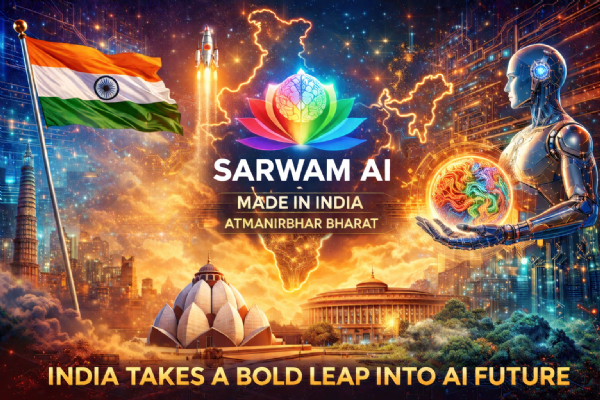
India is steadily becoming self-reliant through indigenous innovations, which are strengthening the digital capabilities of India. This comes as Sarvam AI, an innovation of a Bengaluru-based startup, has caught the limelight at the India AI Impact Summit 2026 so much that Google CEO Sundar Pichai cited it. He highlighted how Indian companies are developing local AI models, signalling how the innovations are taking place at grassroot-levels.
"You know, even recently, the work Sarvam has done developing local AI models, certainly, what you're talking about is actually happening. And, you know, I just don't see any impediments to that, and I think it is very, very well positioned," Pichai was quoted as saying by news agency PTI.
This reflects the vision of “Made in India” and “Atmanirbhar Bharat", which contributes to India's journey of being sovereign and a global technology leader.
.
What is Sarvam AI?
.
On February 18, Sarvam AI was unveiled, which is a model that it said is made to cater to India’s diverse languages and cultural contexts, giving it an edge against big guns such as ChatGPT and Claude in the AI industry.
Apart from English, Sarvam AI chatbot is available in 22 Indian languages and claims to have better accuracy for Indian languages than top industry models such as Gemini 3 Pro, Opus 4.5, and GPT-5.
At the India AI Impact Summit 2026, one pavilion drew record-breaking crowds — not from Silicon Valley, but from a homegrown startup.
— The Better India (@thebetterindia) February 19, 2026
Sarvam AI emerged as the biggest crowd-puller at Bharat Mandapam, with thousands of students, developers, and tech enthusiasts queuing up to… pic.twitter.com/YO9yUiiWOG
Sarvam AI’s journey is not just a series of product launches, but it places India at the global AI table.
.
The Founders of Sarvam AI: Deep Technical Roots
.
It started in July 2023 with two friends and experts, Dr Vivek Raghavan, who has extensive experience in building India’s digital public infrastructure. He was previously the Chief Product Manager and Biometric Architect at UIDAI, where he contributed to the Aadhaar project and worked on AI initiatives for the Supreme Court and GSTN.
Dr. Pratyush Kumar: Led India's open-source AI efforts across Indian languages. He was previously associated with AI4Bharat at the Indian Institute of Technology (IIT) Madras. He left the academic safety of AI4Bharat to prove that Indian languages should not be an "afterthought" in Silicon Valley.
Sarvam AI showcased at #IndiaAIImpactSummit2026 testifies why tomorrow belongs to India. Providing cutting-edge AI solutions in 22 Indian languages it ensures technology reaches every hand paving way for Modi Ji's vision of Viksit Bharat where technology is trusted ally of… pic.twitter.com/GaEs8y0mBC
— Amit Shah (@AmitShah) February 19, 2026
Their first big win, OpenHathi, was like a love letter to Hindi, showing the world that global tech could finally "speak" with a local soul.
.
Sovereign AI Mission
.
Sarvam AI stands out as one of the 12 organisations selected under the Innovation Centre pillar of the IndiaAI Mission to develop indigenous foundational models, with financial and computer support amounting to 246.72 crore.
Its goal is simple but massive: to make sure India is not just a consumer of foreign AI (like OpenAI or Google) but a creator of its own. The government of India has sought locally built AI models, and companies like Sarvam are demonstrating their ability to provide services and to bring this local-level AI model to the global level, delivering similar content.
Key Features of Sarvam AI
- The two Sarvam AI models are the Sarvam 30B and Sarvam 105B, which will be the sovereign AI ecosystem in India and will reach the global level by doubling the power and will compete with more powerful AI models.
- The company develops large language models (LLMs) and multimodal AI systems with a focus on Indian languages and region-specific use cases.
- Unlike most global AI models, Sarvam AI places Indian languages at the core, with English treated as secondary.
- The system supports 22 Indian regional languages, allowing more accurate understanding of local scripts, expressions and contexts.
- Its training draws from India-specific sources such as financial documents, literature, newspapers and historical texts, making responses more culturally grounded.
- Sarvam AI’s speech recognition technology
-Supports 10 Indian languages within a single 74-million-parameter model
- Lightweight footprint of approximately 294 MB, suitable for on-device deployment
- Automatic language detection, with no need for manual language selection
- Processes speech at around 8.5× real-time speed
- Time-to-first-token < 300 milliseconds on a Qualcomm Snapdragon 8 Gen 3 chipset
This marks a milestone in India’s developing history. Through continuous innovations, investment in research and the promotion of local solutions, our country is shaping a future that is sustainable, inclusive and globally competitive, reinforcing its position in the rapidly evolving digital world.
Seeing the massive 105B model and the Sarvam Kaze AI glasses famously worn by Prime Minister Narendra Modi felt less like a corporate launch and more like a "coming of age" moment for Indian tech. They did not just build software; they fought for a future where India’s digital identity belongs to India. Apart from Kaze, the company unveiled 11 AI platforms in the weeks leading up to the event. Key platforms are:
- Sarvam Akshar – High-accuracy document digitisation system
- Sarvam Studio – Multilingual content creation platform
- Saaras V3 – Speech recognition model
- Sarvam Vision – Visual AI for Indian scripts
- Bulbul V3 – Advanced speech model
- Sarvam Arya – India-focused foundational model
Success is always a big step with struggle. The pivotal step towards a milestone in the development of technological, self-reliance and digital sovereignty. This reflects the growing momentum among domestic startups, research institutions, and national technology missions to design and deploy homegrown AI solutions tailored to India’s socio-economic, linguistic, and governance needs. Bengaluru-based Sarvam AI, a conversational AI firm Gnani.ai, has boosted the “Make in India”.
.
.
.
.
.
.