AI With a Soul: How Modi’s MANAV Vision Revives Integral Humanism
NewsBharati 25-Feb-2026 17:44:44 PM
Total Views |


When Prime Minister Narendra Modi addressed the AI Summit in Delhi, the speech could easily have been confined to predictable themes—innovation, start-up ecosystems, data infrastructure, and global competitiveness. Instead, it unfolded as something more consequential: a philosophical positioning of Artificial Intelligence within India’s civilizational worldview.
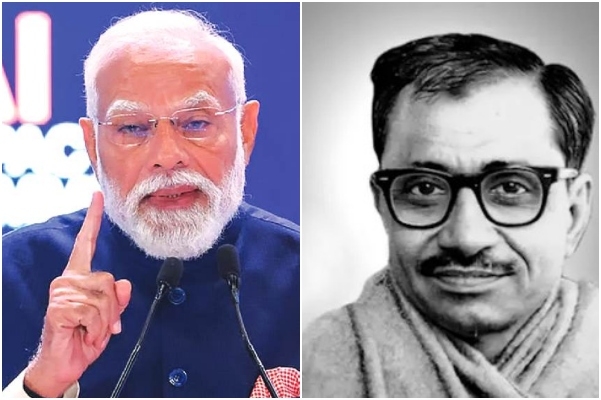
At a moment when global debates on AI oscillated between technological triumphalism and existential anxiety, Modi introduced a distinctly Indian axis into the conversation. His central assertion was clear and categorical: AI will not govern human beings; human beings will govern AI. In a world increasingly shaped by algorithmic decision-making — where predictive models influence markets, warfare, health, and even democratic processes — that statement is not merely political rhetoric. It is a civilizational claim about hierarchy, agency, and moral sovereignty.
To fully understand this articulation, one must revisit Integral Humanism (Ekatma Manav Darshan), propounded by Pandit Deendayal Upadhyaya. Deendayal Ji’s philosophical intervention emerged during a period when newly independent India was ideologically torn between Western capitalism and Marxist socialism. Both systems, he argued, were rooted in materialist assumptions. Capitalism reduced the individual to a consumer and producer driven by accumulation; Marxism reduced him to a class entity shaped by economic determinism. Though politically opposed, both frameworks shared a reductionist anthropology.
Integral Humanism offered an alternative starting point. The human being, Deendayal Ji asserted, an integrated whole — composed of body (Sharira), mind (Mana), intellect (Buddhi), and soul (Atma). Any system that addresses only material needs while neglecting moral and spiritual dimensions inevitably produces imbalance. Development, therefore, must be holistic. Society is not a contractual aggregation of self-interested individuals but an organic entity animated by Dharma — the normative principle that sustains harmony and justice — and guided by a shared civilizational consciousness (Chiti).
Seen through this lens, Modi’s AI speech appears less as a technological roadmap and more as a digital - age translation of Integral Humanism. The most striking conceptual device in the address was the formulation of AI as MANAV. The acronym was not cosmetic; it encoded a normative architecture. The concept of “MANAV” signifies Modi’s civilizational perspective, anchored in classical Indian philosophy, wherein the human being is understood in a holistic and integrated framework.
M – Moral and Ethical. In global AI discourse, ethical concerns are often framed as compliance questions: bias mitigation, risk control, data protection. Modi’s emphasis suggested something deeper—that morality is foundational, not peripheral. In Integral Humanist terms, this corresponds to Dharma. Technology must operate within ethical limits because unrestrained power destabilizes social order. AI, therefore, is not value-neutral; it must reflect moral intention.
A – Accountability and Governance. Algorithmic systems cannot be allowed to function in opaque autonomy. Accountability ensures that technological power remains subject to democratic oversight. This aligns with Integral Humanism’s rejection of both centralization and unchecked market dominance. Governance must serve societal harmony rather than technocratic elites.
N – National Sovereignty. In the digital era, sovereignty is no longer confined to physical borders. Data flows, algorithmic dependencies, and technological supply chains redefine national autonomy. Deendayal Ji’s concept of Chiti — a nation’s distinctive civilizational consciousness — implies that development must reflect indigenous priorities rather than imported ideological templates. Modi’s insistence on sovereignty in AI echoes that principle. Technological dependence can evolve into cultural dependence; self-reliance in AI becomes an extension of civilizational selfhood.
A – Accessible and Inclusive. Integral Humanism stresses social cohesion and balanced development. AI must not become an elite instrument that widens inequalities. Instead, it should democratize knowledge and opportunity. India’s digital public infrastructure—from identity platforms to digital payments—demonstrates how scale and inclusion can coexist. The AI vision seeks to extend this logic into emerging domains.
V – Values-driven and Legitimate. Legitimacy does not arise merely from efficiency; it arises from ethical consonance with society’s deeper ethos. AI systems that undermine dignity or cultural integrity may be technologically advanced but socially destabilizing.
Together, MANAV repositions AI from a purely computational phenomenon to a moral-political instrument. It asserts that technological acceleration must remain subordinate to human purpose.
Modi’s analogy of GPS reinforced this philosophical ordering. A GPS system can provide real-time location, calculate routes, and optimize travel. Yet it does not decide the destination. Direction remains a human prerogative. The metaphor is deceptively simple but conceptually profound. It rejects techno-determinism—the belief that technological capability should automatically dictate societal choices. In reaffirming that humans choose direction, Modi reaffirmed moral agency.
This emphasis resonates directly with Integral Humanism’s anthropocentric hierarchy. Systems are upakarana — instruments. Instruments exist for human welfare; humans do not exist to serve systems. In an age where artificial intelligence can simulate cognition and generate autonomous outputs, maintaining this hierarchy becomes politically and ethically urgent.
The speech also foregrounded a key civilizational trait: dynamism without deracination. Indian civilization, Modi argued, has endured for millennia not because it resisted change, but because it assimilated change without losing its ethical core. The example of India’s embrace of the internet revolution and the rise of its IT sector illustrates this adaptive capacity. Technology was not perceived as alien or culturally corrosive; it was internalized. AI, in this narrative, is not a rupture but continuity—another phase in India’s evolving engagement with knowledge.
This continuity feeds into the broader aspiration of India as a Vishwaguru. Crucially, this leadership is framed not through military assertion or financial dominance, but through intellectual and normative contribution. Integral Humanism rejects domination as a civilizational goal; leadership flows from moral example. In the global AI debate — often polarized between market absolutism and state surveillance — India proposes a third axis: ethical civilizational stewardship.
Of course, philosophical articulation alone is insufficient. The credibility of the MANAV vision will depend on institutional design: regulatory clarity, data governance frameworks, transparency mechanisms, research autonomy, and public accountability. Ethical intent must translate into enforceable structures. If implemented coherently, India could demonstrate that rapid technological innovation need not come at the cost of human dignity or national sovereignty.
Even at the level of intellectual positioning, something significant has occurred. Modi’s speech signals that India does not intend to approach AI merely as a technological race to be won. It seeks to shape the normative grammar within which that race is conducted. By embedding AI within the philosophical contours of Integral Humanism, India asserts that its digital future will be aligned with its civilizational past.
In doing so, the speech challenges a prevailing global assumption—that technological progress inevitably detaches societies from moral tradition. Instead, it advances a counter-proposition: that the most sustainable innovation is innovation anchored in ethical consciousness.
Artificial Intelligence represents one of the most transformative forces of the 21st century. It can augment productivity, accelerate research, enhance governance, and improve quality of life. It can also concentrate power, erode privacy, and distort human autonomy. The difference lies not in the code itself, but in the civilizational framework within which the code operates.
By insisting that AI must remain MANAV—human-centric, ethical, sovereign, inclusive — Modi effectively restated the foundational insight of Integral Humanism: material progress divorced from moral order is unstable. Systems must serve the integrated human personality. Humanity must remain sovereign over its creations.
Whether this vision becomes a durable model or remains aspirational will depend on execution. But as a statement of intellectual intent, it marks a decisive moment. India is not merely participating in the AI revolution; it is attempting to philosophically reinterpret it.
If that reinterpretation succeeds, the contribution will extend beyond policy. It represents a civilizational assertion: that even in the age of artificial intelligence, the ultimate measure of progress remains the dignity, agency, and integral development of the human being.
At a moment when global debates on AI oscillated between technological triumphalism and existential anxiety, Modi introduced a distinctly Indian axis into the conversation. His central assertion was clear and categorical: AI will not govern human beings; human beings will govern AI. In a world increasingly shaped by algorithmic decision-making — where predictive models influence markets, warfare, health, and even democratic processes — that statement is not merely political rhetoric. It is a civilizational claim about hierarchy, agency, and moral sovereignty.
To fully understand this articulation, one must revisit Integral Humanism (Ekatma Manav Darshan), propounded by Pandit Deendayal Upadhyaya. Deendayal Ji’s philosophical intervention emerged during a period when newly independent India was ideologically torn between Western capitalism and Marxist socialism. Both systems, he argued, were rooted in materialist assumptions. Capitalism reduced the individual to a consumer and producer driven by accumulation; Marxism reduced him to a class entity shaped by economic determinism. Though politically opposed, both frameworks shared a reductionist anthropology.
Integral Humanism offered an alternative starting point. The human being, Deendayal Ji asserted, an integrated whole — composed of body (Sharira), mind (Mana), intellect (Buddhi), and soul (Atma). Any system that addresses only material needs while neglecting moral and spiritual dimensions inevitably produces imbalance. Development, therefore, must be holistic. Society is not a contractual aggregation of self-interested individuals but an organic entity animated by Dharma — the normative principle that sustains harmony and justice — and guided by a shared civilizational consciousness (Chiti).
Seen through this lens, Modi’s AI speech appears less as a technological roadmap and more as a digital - age translation of Integral Humanism. The most striking conceptual device in the address was the formulation of AI as MANAV. The acronym was not cosmetic; it encoded a normative architecture. The concept of “MANAV” signifies Modi’s civilizational perspective, anchored in classical Indian philosophy, wherein the human being is understood in a holistic and integrated framework.
M – Moral and Ethical. In global AI discourse, ethical concerns are often framed as compliance questions: bias mitigation, risk control, data protection. Modi’s emphasis suggested something deeper—that morality is foundational, not peripheral. In Integral Humanist terms, this corresponds to Dharma. Technology must operate within ethical limits because unrestrained power destabilizes social order. AI, therefore, is not value-neutral; it must reflect moral intention.
A – Accountability and Governance. Algorithmic systems cannot be allowed to function in opaque autonomy. Accountability ensures that technological power remains subject to democratic oversight. This aligns with Integral Humanism’s rejection of both centralization and unchecked market dominance. Governance must serve societal harmony rather than technocratic elites.
N – National Sovereignty. In the digital era, sovereignty is no longer confined to physical borders. Data flows, algorithmic dependencies, and technological supply chains redefine national autonomy. Deendayal Ji’s concept of Chiti — a nation’s distinctive civilizational consciousness — implies that development must reflect indigenous priorities rather than imported ideological templates. Modi’s insistence on sovereignty in AI echoes that principle. Technological dependence can evolve into cultural dependence; self-reliance in AI becomes an extension of civilizational selfhood.
A – Accessible and Inclusive. Integral Humanism stresses social cohesion and balanced development. AI must not become an elite instrument that widens inequalities. Instead, it should democratize knowledge and opportunity. India’s digital public infrastructure—from identity platforms to digital payments—demonstrates how scale and inclusion can coexist. The AI vision seeks to extend this logic into emerging domains.
V – Values-driven and Legitimate. Legitimacy does not arise merely from efficiency; it arises from ethical consonance with society’s deeper ethos. AI systems that undermine dignity or cultural integrity may be technologically advanced but socially destabilizing.
Together, MANAV repositions AI from a purely computational phenomenon to a moral-political instrument. It asserts that technological acceleration must remain subordinate to human purpose.
Modi’s analogy of GPS reinforced this philosophical ordering. A GPS system can provide real-time location, calculate routes, and optimize travel. Yet it does not decide the destination. Direction remains a human prerogative. The metaphor is deceptively simple but conceptually profound. It rejects techno-determinism—the belief that technological capability should automatically dictate societal choices. In reaffirming that humans choose direction, Modi reaffirmed moral agency.
This emphasis resonates directly with Integral Humanism’s anthropocentric hierarchy. Systems are upakarana — instruments. Instruments exist for human welfare; humans do not exist to serve systems. In an age where artificial intelligence can simulate cognition and generate autonomous outputs, maintaining this hierarchy becomes politically and ethically urgent.
The speech also foregrounded a key civilizational trait: dynamism without deracination. Indian civilization, Modi argued, has endured for millennia not because it resisted change, but because it assimilated change without losing its ethical core. The example of India’s embrace of the internet revolution and the rise of its IT sector illustrates this adaptive capacity. Technology was not perceived as alien or culturally corrosive; it was internalized. AI, in this narrative, is not a rupture but continuity—another phase in India’s evolving engagement with knowledge.
This continuity feeds into the broader aspiration of India as a Vishwaguru. Crucially, this leadership is framed not through military assertion or financial dominance, but through intellectual and normative contribution. Integral Humanism rejects domination as a civilizational goal; leadership flows from moral example. In the global AI debate — often polarized between market absolutism and state surveillance — India proposes a third axis: ethical civilizational stewardship.
Of course, philosophical articulation alone is insufficient. The credibility of the MANAV vision will depend on institutional design: regulatory clarity, data governance frameworks, transparency mechanisms, research autonomy, and public accountability. Ethical intent must translate into enforceable structures. If implemented coherently, India could demonstrate that rapid technological innovation need not come at the cost of human dignity or national sovereignty.
Even at the level of intellectual positioning, something significant has occurred. Modi’s speech signals that India does not intend to approach AI merely as a technological race to be won. It seeks to shape the normative grammar within which that race is conducted. By embedding AI within the philosophical contours of Integral Humanism, India asserts that its digital future will be aligned with its civilizational past.
In doing so, the speech challenges a prevailing global assumption—that technological progress inevitably detaches societies from moral tradition. Instead, it advances a counter-proposition: that the most sustainable innovation is innovation anchored in ethical consciousness.
Artificial Intelligence represents one of the most transformative forces of the 21st century. It can augment productivity, accelerate research, enhance governance, and improve quality of life. It can also concentrate power, erode privacy, and distort human autonomy. The difference lies not in the code itself, but in the civilizational framework within which the code operates.
By insisting that AI must remain MANAV—human-centric, ethical, sovereign, inclusive — Modi effectively restated the foundational insight of Integral Humanism: material progress divorced from moral order is unstable. Systems must serve the integrated human personality. Humanity must remain sovereign over its creations.
Whether this vision becomes a durable model or remains aspirational will depend on execution. But as a statement of intellectual intent, it marks a decisive moment. India is not merely participating in the AI revolution; it is attempting to philosophically reinterpret it.
If that reinterpretation succeeds, the contribution will extend beyond policy. It represents a civilizational assertion: that even in the age of artificial intelligence, the ultimate measure of progress remains the dignity, agency, and integral development of the human being.
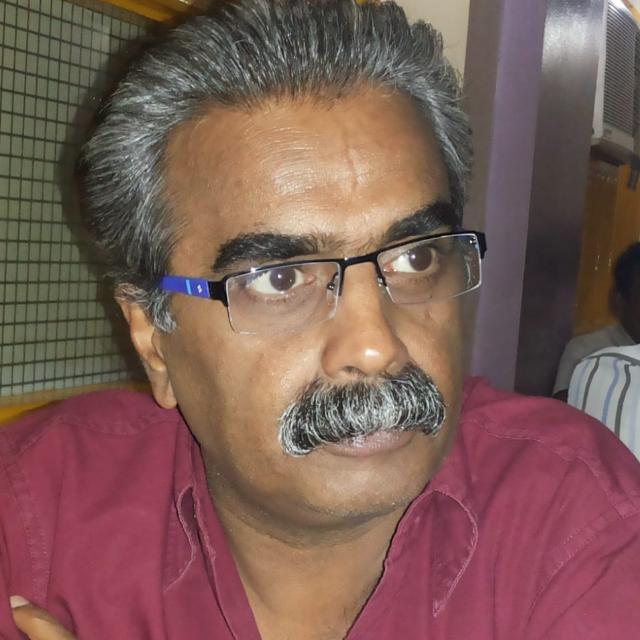
Satyajit Shriram Joshi
Satyajit Shriram Joshi is Pune based senior journalist.